
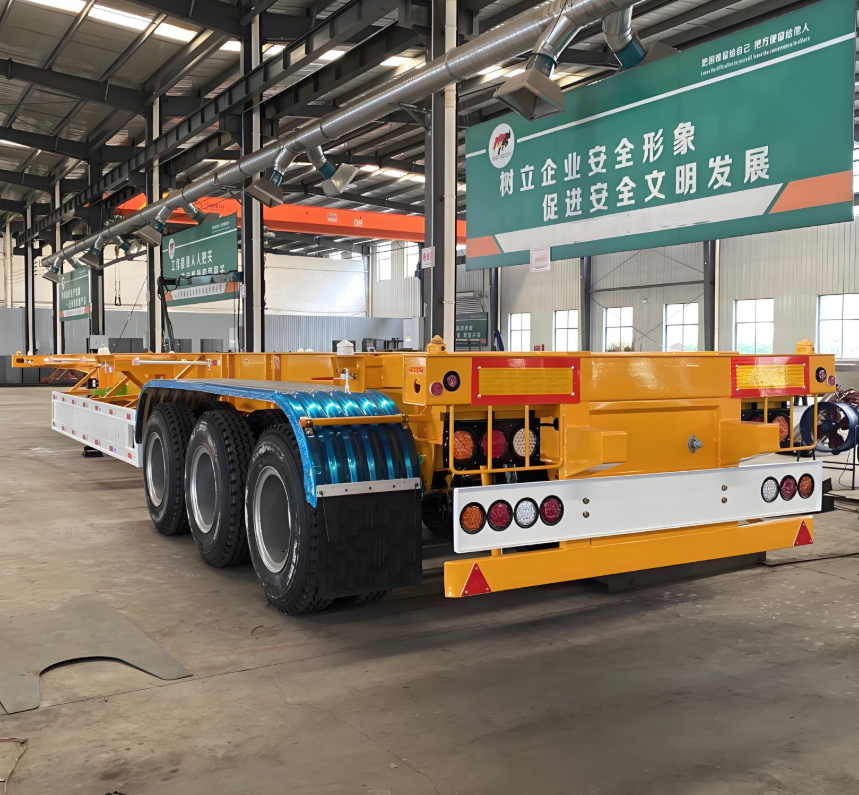
40 ft Shipping Container Trailer: 3 Axle vs 4 Axle Chassis

What It Is and Best Uses
Buyers looking at a 40 ft shipping container trailer often think they are comparing one container chassis to another. In practice, they are choosing a working standard for the next few years. The 40 ft size is familiar. The real decision is what sits underneath it: three axles or four. That choice affects daily port pickup, yard circulation, warehouse transfer, inland delivery, and long-term maintenance. Boca’s container chassis range puts 3 axle, 4 axle, 40 ft, and skeletal models in one place, which makes side-by-side comparison much easier for buyers.
A 40 ft shipping container trailer, in simple terms, is the chassis used to move standard shipping containers between ports, warehouses, rail terminals, inland depots, and industrial yards. It is the link between the container and the road. That part is not complicated. The market has understood that for years. What buyers still get wrong is what kind of chassis standard they are building around. Boca’s category page describes container chassis as a core transport solution for ISO containers moving between ports, warehouses, rail terminals, and distribution centers, which aligns with how most buyers already use the product in practice.
The people who care most about this are procurement managers, fleet operators, and importers. They are trying to avoid buying a trailer that looks right on paper but becomes awkward six months later. They are comparing a 40 ft container chassis for sale and trying to decide whether they need a mainstream tri-axle format or a more specialized 4 axle model. In many cases, the real lesson is simple: a good-looking spec sheet does not always create a good fleet standard.
A lot of customers do not buy the wrong trailer. They buy the wrong rule.
They look at the hardest route, the heaviest box, or the toughest loading day they might see once in a while, and they let that exception define the whole fleet. Later, the issue is not that the trailer cannot work. The issue is that it becomes the wrong common platform. Workshop routines get heavier, dispatch treats a “standard” trailer like a special case, and parts planning becomes harder than it needs to be. The technical choice may still be defensible. The operating choice is where it starts to fail.
That is why this article is not built around brochure language. It is built around route reality.
If your work is mostly port pickup, warehouse transfer, yard circulation, and repeat inland movement on broadly normal roads, three axles are usually not a compromise. They are usually the sensible starting point.
If your work is denser, rougher, harder on the running gear, or more demanding in how load is distributed, then the fourth axle starts to mean something real.
Those two sentences may sound simple, but most bad buying decisions happen because people refuse to make them early enough.
Boca’s site is useful here because it does not isolate the discussion into one single product page. The container chassis semi trailer category sits alongside a dedicated 3 axle product, a dedicated 4 axle product, and a 40 ft product page, so buyers can compare the mainstream and heavier-duty directions without guessing where each one belongs. The site’s product pages also present WhatsApp and Email contact options directly on the product listings, which makes it easier for importers and procurement teams to move from comparison to quotation when they are ready.
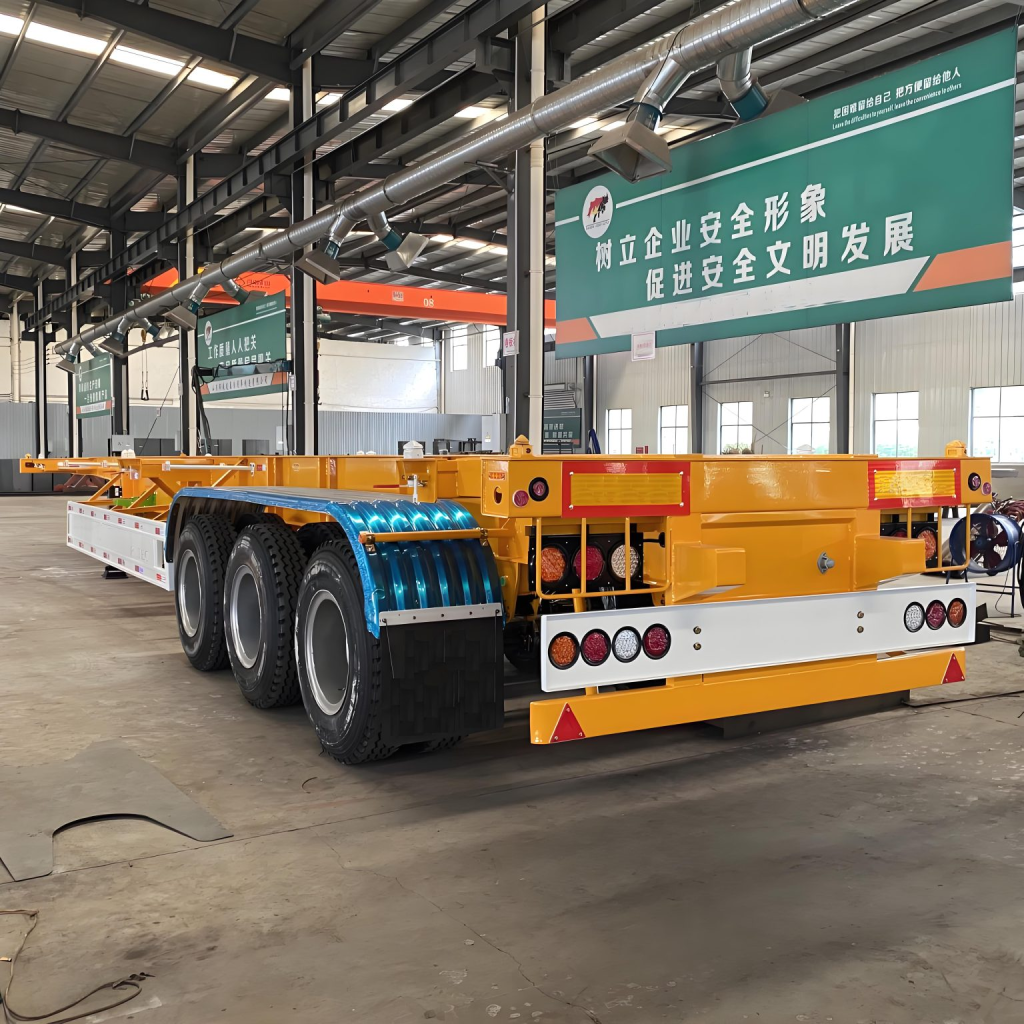
The best use cases are not hard to understand once you stop thinking about “stronger” and start thinking about “more appropriate.”
A 40 ft chassis is the normal answer when fleets need a platform built around standard 40 ft container movement, with some configurations also supporting two 20 ft containers depending on locking design. That matters because many buyers still assume the format tells the whole story by itself. It does not. The trailer length tells you what class of container movement you are in. The axle choice tells you how that movement will actually feel in service. Boca’s category page and product pages describe 40 ft chassis as commonly used for 40 ft containers, while some locking configurations can support two 20 ft containers depending on model design.
So if the question in your head is “What is a 40 ft trailer used for?”, the answer is straightforward.
If the question is “Which chassis setup should I build a fleet around?”, that is where the real decision starts.
Key Specs to Compare: Size, Axles, and Payload
A lot of buyers say they compare specifications, but what they really do is scan them. That is not the same thing.
When you are looking at a 40 ft container chassis for sale, the point is not to read every spec line like a technical manual. The point is to know which specs actually change ownership, dispatch, maintenance, and route fit. That means the important comparison is not “Which page has the longest feature list?” It is “Which spec differences are going to show up in daily work?”
Start with the obvious one: 40 ft is common because it sits in the center of real container movement. It fits the most familiar transport task in intermodal and inland operations. Boca’s category page lists 40 ft models prominently and describes the 40 ft container chassis as one of the most widely used formats across shipping lines, transport companies, and freight forwarders.
But that does not mean all 40 ft chassis should be compared as if they were interchangeable.
Here is what actually matters.
- Size tells you the transport class. A 40 ft chassis is built around standard container movement and broad compatibility with 40 ft operations. It gives buyers the most familiar platform for port, yard, warehouse, and inland transport.
- Axle count tells you the operating character. Three axles and four axles may sit under the same 40 ft concept, but they do not produce the same ownership experience.
- Payload is only part of the story. Buyers talk about load capacity first, but axle count also affects load distribution, route tolerance, daily handling, workshop complexity, and how easily the trailer becomes a repeat fleet model. This is an inference from how the 3 axle and 4 axle pages emphasize different duty profiles, road adaptability, and running characteristics.
- Locking design matters more than many buyers expect. A 40 ft chassis may carry one 40 ft container, and some versions can support two 20 ft containers depending on locking arrangement and design. That should always be confirmed at model level.
- Ownership is a spec too. The spec sheet does not usually say “this trailer will be easier to standardize across fifteen units,” but that is still part of what buyers are choosing.
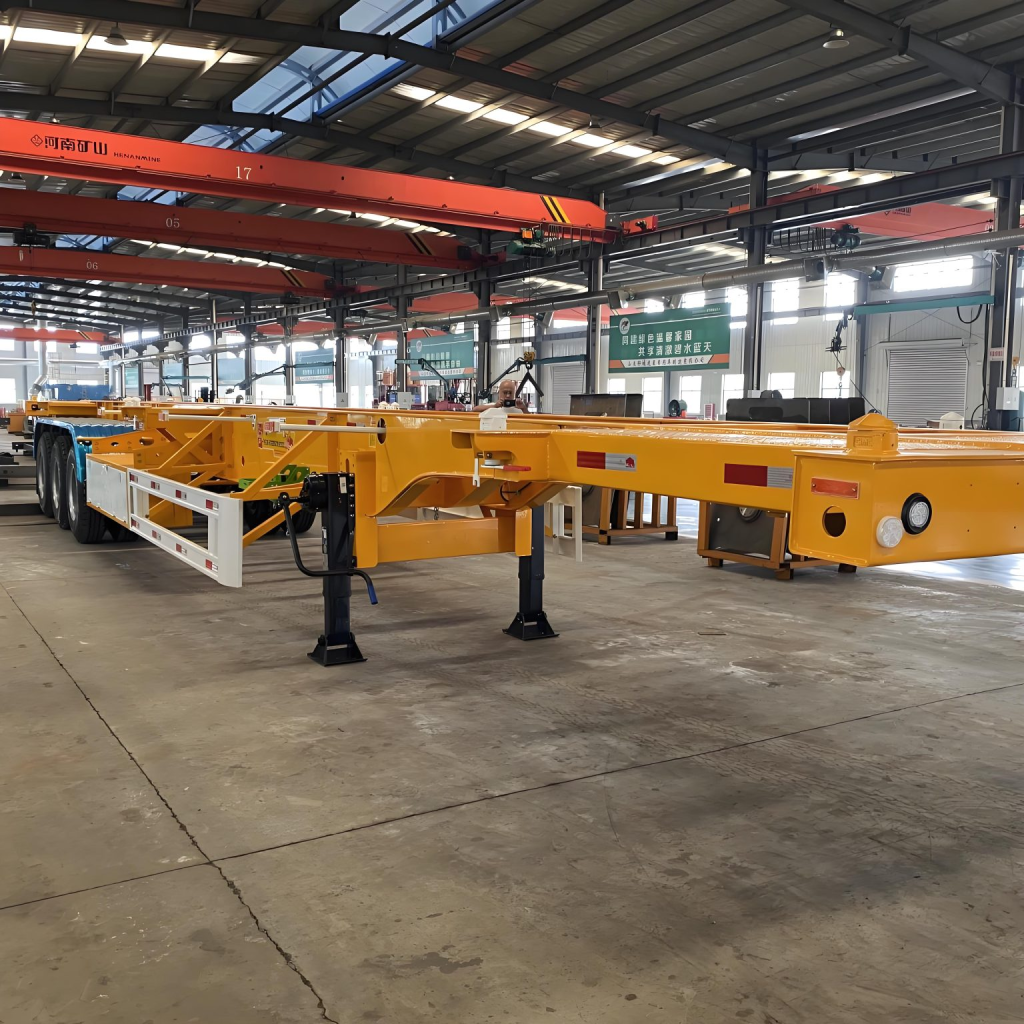
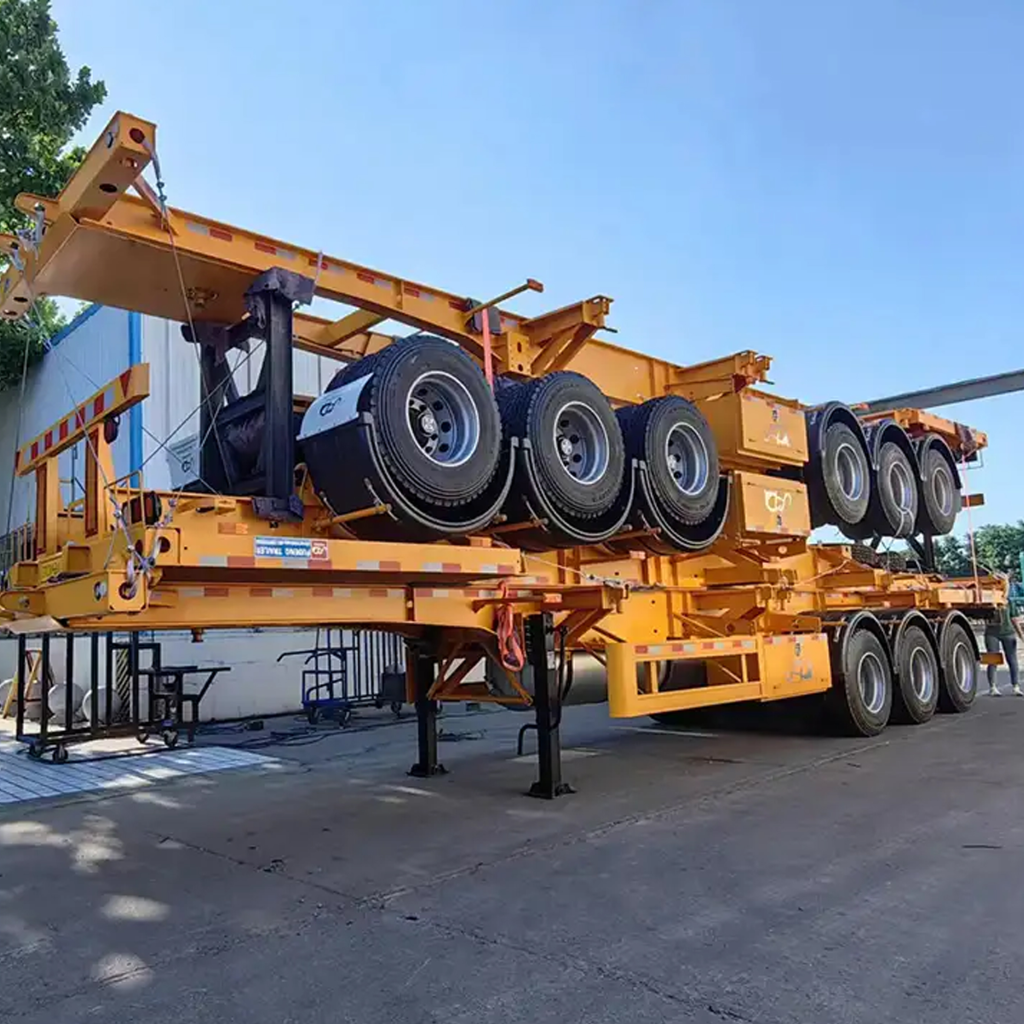
The most basic mechanical difference between 3 axle and 4 axle is easy to state and easy to underestimate. The fourth axle spreads the undercarriage work across more running positions. That can help when the route is genuinely hard on the trailer, when container loads are denser, or when axle-weight distribution needs more room. Boca’s 4 axle page explicitly frames the model as a heavy-duty chassis for 20 ft, 40 ft, and 45 ft standard containers and says that, compared with 3 axle designs, it offers greater cargo capacity, improved road adaptability, and stronger braking performance for more demanding service.
That is the mechanical difference, but the business difference is more important.
Three axles tend to suit fleets that want one reliable working standard for mainstream container transport. Boca’s tri-axle pages position the format around 20 ft and 40 ft ISO container transport in ports, shipyards, intermodal systems, and long-haul freight. That is a clue about where the model sits: not as a stripped-down option, but as a common, adaptable platform for routine container logistics.
The reason this matters is that axle count changes more than paper payload.
It changes daily handling. A trailer that spends its life in repeat port pickup, yard reversing, warehouse access, and short transfer cycles is judged every day by how naturally it fits that rhythm. It also changes long-term ownership. More undercarriage hardware means more service points, more wear items, and more maintenance planning. None of that sounds exciting in a product listing, but it becomes very real once the trailer enters the fleet.
A simple way to read the spec sheet is to picture one normal week, not one extreme day. If the trailer is mostly picking up boxes at the port, running into an industrial park, dropping at a warehouse, and repeating that same loop five or six days a week, the smarter question is not “Which chassis looks tougher?” It is “Which chassis will stay easier to schedule, easier to maintain, and easier to standardize across more units?” That is why 3 axle often wins mainstream work even when 4 axle looks more impressive on paper.
So when buyers say they are comparing “size, axles, and payload,” they should translate that into better questions:
- What size defines the container task I actually do most?
- What axle setup matches the roads and load profile I see most often?
- Do I need extra load distribution often enough to justify extra running gear?
- Will this trailer become my fleet’s common platform, or just a route-specific tool?
- If I buy ten more later, will I still be happy that I chose this axle layout?
That is how professionals read specs: not as a list to admire, but as a preview of how ownership will feel.
Pros, Cons, and Cost Factors
This is where many buyers sound confident too early, because “pros and cons” on paper are not the same as pros and cons inside a working fleet.
Everybody knows there are pros and cons. The harder part is knowing which pros matter on your routes and which cons will show up in your workshop instead of on day one.
3 axle: why it stays the mainstream answer
A 3 axle chassis usually makes sense because it is easier to live with when the work is ordinary, repetitive, and broad enough to support one common operating standard. Port pickup in the morning, warehouse transfer in the afternoon, yard circulation in between, inland delivery tomorrow, same pattern again next week. That kind of job rewards a platform that is stable, familiar, and not overly specialized.
That is why three axles keep showing up as the natural starting point.
The real strength of a 3 axle chassis is not that it is “basic.” It is that it is easier to make it the fleet’s most repeatable trailer. Boca’s 3 axle pages present tri-axle chassis as mainstream equipment for standard 20 ft and 40 ft ISO container transport across port and intermodal operations, which fits exactly that role.
3 axle — best for
- mainstream port pickup and delivery
- yard and depot circulation
- warehouse transfer
- inland routes that are demanding enough to need a serious chassis, but not demanding enough to justify a more specialized one
- fleets that want one common platform across a large share of work
3 axle — strengths
- easier to standardize across multiple units
- fewer running positions and less undercarriage complexity
- usually easier service planning
- often better aligned with routine daily handling in port and warehouse environments
- more natural as a common fleet standard
3 axle — less ideal for
- routes that repeatedly push the chassis into harder-duty territory
- operations that regularly need more help with load distribution
- buyers who know a significant share of the work is already outside mainstream conditions
That last point matters. Three axles are not “less capable” by default. They are less appropriate only when the route begins to demand something more specific than a mainstream chassis standard.
4 axle: where it becomes worth the extra complexity
A 4 axle chassis has real advantages, but only if the work asks for them often enough.
This is the most important judgment in the whole comparison. Four axles are not the automatic upgrade path from three. They are the more specific answer to a more specific route problem. Boca’s 4 axle page describes the model as a heavy-duty container chassis for 20 ft, 40 ft, and 45 ft containers and directly contrasts it with 3 axle models in terms of capacity, road adaptability, and braking for demanding logistics environments.
That is useful product language, but buyers still need to translate it into fleet language.
A fourth axle starts making real sense when the route regularly includes rougher roads, denser loads, repeated hard-duty cycles, or stricter pressure on how load is shared. Not once in a while. Repeatedly.
That difference between “occasionally hard” and “consistently demanding” is where a lot of purchasing mistakes happen.
4 axle — best for
- tougher mixed inland routes
- repeated dense-load operations
- heavier-duty transport environments
- buyers who need more distribution margin because the work demands it often
- fleets adding a route-specific chassis, not necessarily replacing the mainstream fleet standard
4 axle — strengths
- more load distribution potential
- better match for harsher route conditions
- clearer value when the trailer sees repeated demanding work
- stronger case in environments where axle-weight sensitivity matters more
4 axle — less ideal for
- ordinary port and warehouse work that does not truly need the extra running gear
- fleets trying to keep service routines light and highly standardized
- buyers who are choosing around an exception rather than the normal route pattern
Here is the sentence many buyers need to hear:
If the route does not use the fourth axle, the fourth axle does not become “extra safety.” It becomes extra ownership.
Maintenance footprint: where the comparison stops being theoretical
This is where the difference stops sounding like an engineering topic and starts sounding like a fleet manager’s problem.
Three axles usually mean less undercarriage complexity, fewer service points, fewer wear items, and fewer repeated inspection tasks. Across one trailer that may sound manageable either way. Across a growing fleet, it shapes workshop rhythm in a very visible way.
Four axles mean more running gear to support. That may be absolutely justified. But it should be justified by the route, not by buyer anxiety.
Many customers assume the biggest cost decision is the purchase price. It usually is not. The bigger long-term question is whether the trailer creates the right maintenance burden for the work it will actually do. If it does, that cost is productive. If it does not, the trailer becomes the wrong kind of expensive.
Parts and service complexity
Service complexity is not just about how many parts exist. It is about how many parts have to become normal for the business.
A 3 axle chassis is easier to turn into a workshop routine. Parts stocking is cleaner. Service planning is more repeatable. The maintenance team sees the same pattern more often. That is one reason 3 axle so often becomes the common fleet platform.
A 4 axle chassis can still be an excellent business decision. But it is usually a stronger decision when it is attached to a known harder-duty route group. In that case, the fleet is not trying to pretend all work is the same. It is matching service complexity to route complexity.
That is usually the point where a fleet stops buying trailers one by one and starts buying around route structure.
Cost logic without fake precision
You asked not to write dead numbers into a blog that should stay useful over time, and that is the right call.
The useful cost logic is this: 3 axle versions are often priced lower than 4 axle versions, but the final quotation still depends on configuration, suspension choice, axle brand, and export requirements. Boca’s category page lists multiple 3 axle, 4 axle, and 40 ft chassis products with different current site prices, which supports the point that price varies by model and setup.
The bigger issue is that initial price and ownership cost are not the same thing.
A buyer who saves money upfront but creates the wrong fleet standard may lose that advantage later in maintenance burden, service planning, downtime, or poor route fit. A buyer who spends more on a 4 axle chassis for genuinely harder routes may be making the better decision. Cost only makes sense when it is tied to the route.
Long-term ownership thinking
A fleet does not own the trailer only on delivery day. It owns it in dispatch. It owns it in the workshop. It owns it when another five units need to be ordered. It owns it when the first replacement decision comes around.
So the real pros and cons are not just about what the chassis can do. They are about what kind of fleet logic the chassis creates.
For buyers who want the difference in a simpler form, the comparison looks like this:
Quick comparison
- Best for: 3 axle for mainstream work; 4 axle for harder recurring work
- Less ideal for: 3 axle when route intensity is consistently high; 4 axle when route intensity is mostly ordinary
- Cost pressure: 3 axle often lighter upfront; 4 axle often heavier upfront but justified on demanding routes
- Workshop impact: 3 axle is usually simpler to normalize; 4 axle adds legitimate but higher service complexity
- Fleet planning impact: 3 axle often suits the main platform; 4 axle often suits targeted deployment or supplementary lanes
Buyers rarely regret a good chassis. What they regret is building the wrong fleet standard around it.
How to Choose for Your Route
This is where the buying decision stops being theoretical. Do not let one occasional heavy box, one rough stretch of road, or one worst-case delivery write the rule for the whole fleet. Start with the route you repeat most, then decide how much exception coverage you actually need.
Port pickup and delivery
If your main work starts at the port gate and ends at a yard, warehouse, or inland depot on broadly predictable roads, a 3 axle chassis is usually the more rational answer. This kind of route rewards a trailer that is dependable, repeatable, and easy to rotate through normal fleet activity. It does not need to look more aggressive on paper. It needs to keep moving with less friction.
That is why many port-based fleets naturally center on tri-axle container trailers. In that environment, the value of 3 axle is not just cost or simplicity. It is fit. The route uses its strengths every day.
Yard circulation
Yard work often looks simpler from the outside than it really is. It is repetitive, unforgiving, and full of small operational annoyances that become expensive when multiplied across the fleet.
In a yard or depot circulation pattern, chassis are judged by how naturally they fit repeated turning, positioning, reversing, and short movement. That is where over-specification becomes visible. A 4 axle chassis may still operate there, of course. The question is whether that yard work is the main job or just one part of a much harder route. If it is the main job, three axles often feel more natural as the standard platform.
Warehouse transfer
Warehouse transfer follows the same logic. A fleet doing regular warehouse-to-yard or port-to-warehouse work is usually trying to protect flow, not maximize mechanical drama. The priority is keeping equipment easy to manage, dispatch, and standardize. That is exactly where 3 axle keeps winning.
Not because 4 axle is wrong. Because a common fleet platform should be built around the most common work, not the rarest demand.
Mixed inland routes
If the work moves beyond smooth corridors and starts mixing paved roads with more variable conditions, the decision becomes less automatic. This is the point where the fourth axle deserves real attention. The question is not “Can three axles still do it?” The question is “How often does the route punish a three-axle standard badly enough that a four-axle standard becomes the cleaner ownership decision?”
That is a harder question, and it cannot be answered by brochure language alone.
Rough roads
Rough roads change the calculation because they change repetition.
One rough section on an otherwise ordinary route does not automatically justify four axles. But a route that repeatedly puts more stress into the running gear, suspension behavior, and load-sharing demands is a different matter. That is when a 4 axle chassis stops feeling like over-spec and starts feeling like a more route-correct answer. Boca’s 4 axle page leans into this by positioning the model for rugged terrain and demanding logistics conditions rather than just generic container movement.
Denser container loads
This is another place where buyers rush too quickly.
A route that occasionally sees a dense box is not the same as an operation that regularly sees denser container loads. Too many buyers let the uncommon heavy move write the fleet standard for everything else.
That is bad procurement logic.
If denser loads are frequent, then yes, four axles start to become easier to defend. If dense loads are occasional, then the smarter move may be to keep the mainstream fleet on 3 axle and solve the exception separately.
More demanding compliance environments
The safe thing to say here would be “it depends,” but that does not help buyers much.
So here is the more useful version: more axles can improve the load-distribution conversation, but they do not erase the need to check local rules, tractor combination, and actual route conditions. If your operating environment is more demanding on axle distribution, 4 axle deserves a serious look. If that environment is not the norm, do not buy certainty you do not use. Boca’s 4 axle product page itself frames the model around higher capacity, better adaptability, and stricter weight-sensitive environments, which is where this argument belongs.
Can one platform cover most of the work?
This is the question smart buyers ask before they ask for a final quotation.
If one platform can cover most of the work, then standardization has real value. It simplifies dispatch. It simplifies service. It simplifies future ordering. That is why 3 axle so often becomes the common fleet model for ordinary container operations.
But if the route map is genuinely split, forcing one platform to cover everything can be a mistake. Some fleets need a mainstream standard and a harder-duty supplement. That is not indecision. That is better route reading.
When a split fleet makes more sense
A split fleet is rational when the route profile is not one route profile at all.
If a large share of the business is standard port and inland work, and another meaningful share is rougher, denser, or more compliance-sensitive, then three axles may be the right main platform while four axles serve as a targeted or supplementary model.
This is where it helps to think less like a shopper and more like a fleet planner. You are not choosing one trailer in isolation. You are choosing what kind of trailer should be copied, what kind should be reserved, and what kind should stay special.
That is also the point where the manufacturer conversation matters. A buyer working through route-specific setups, locking configurations, suspension choices, or export details usually needs more than a generic product card. Boca’s china semi trailer manufacturer page is more useful at this stage because it speaks to factory capability, customization, and export production rather than only listing one model at a time.
If you are comparing a 40 ft container chassis for sale for fleet expansion, this is the point where the better question is no longer “Which one is stronger?” but “Which one should become my standard, and which one should stay route-specific?”
That is also why it makes sense to review the wider container chassis range before making a final decision. In many cases, the real comparison is not between two isolated product pages, but between two ownership models.
FAQ + Quick Checklist
FAQ
1) Is a 3 axle or 4 axle 40 ft container chassis for sale better for port work?
For mainstream port pickup, yard transfer, warehouse delivery, and repeat inland work on broadly normal roads, 3 axle is usually the more sensible answer. It is easier to standardize and easier to live with as a common fleet platform. A 4 axle chassis only becomes the better answer when the route is harder often enough to justify it.
2) How much more does a 4 axle container chassis cost than a 3 axle model?
In general, 3 axle versions are often priced lower than 4 axle versions, but the final quotation depends on configuration, suspension, axle brand, and export requirements. The useful way to compare price is not fixed site numbers. It is total fit for the route and the ownership burden that follows. Boca’s current category listings show different pricing across 3 axle, 4 axle, and 40 ft models, which supports the broader cost-logic point.
3) What capacity should buyers realistically expect from a 40 ft container chassis for sale?
The better way to ask this is not “What is the biggest number?” but “What load profile is normal for my routes?” Capacity matters, but so do load distribution, road condition, and long-term service complexity. A 4 axle chassis may offer more support for heavier-duty work, but buyers should still match that to route reality rather than assuming bigger is always better.
4) Can a 40 ft container chassis carry one 40 ft box and two 20 ft containers?
It can, depending on the locking design and model configuration. Boca’s category and related product pages indicate that some 40 ft chassis setups can carry one 40 ft container and, in some cases, two 20 ft containers. That should be confirmed at model level before ordering.
5) Is 3 axle easier to maintain across a fleet?
In many fleets, yes. That is one of its biggest real advantages. Three axles are often easier to normalize in parts planning, service routines, and replacement logic. That is why 3 axle so often becomes the common fleet platform for mainstream work. This is an inference from Boca’s positioning of 3 axle as a mainstream, widely used format and 4 axle as a heavier-duty solution.
6) When should importers choose a 4 axle chassis instead?
Importers should look harder at 4 axle when their customers or their own operations are running rougher roads, denser loads, more demanding compliance environments, or repeated harder-duty cycles. If the work is not like that most of the time, 4 axle may become extra burden rather than extra value.
Quick Checklist
Before you ask for a quote, confirm these points:
- your main route type, not just your hardest route
- whether the work is mostly port pickup, yard circulation, warehouse transfer, or mixed inland delivery
- your average container weight pattern, not just one exceptional heavy box
- whether the roads are mostly ordinary or regularly rough and demanding
- whether your priority is a single common fleet platform or a split fleet
- how much maintenance simplicity matters to your workshop and parts planning
- whether you need a model that may support one 40 ft container or two 20 ft containers depending on locking design
- whether you need factory customization or a more standard configuration
- whether you are buying one unit, or quietly choosing the standard for the next several units
If you are still comparing a 40 ft container chassis for sale, keep one rule in mind: choose around the work you repeat most, not the work that scares you most.
For mainstream port, yard, warehouse, and inland container movement, 3 axle is usually the more natural starting point. For rougher, denser, or more demanding route conditions, 4 axle earns its place. If your operation sits between those two realities, route matters more than brochure language.
If you are comparing a 40 ft container chassis for sale for port work, inland delivery, or fleet expansion, ask for a quote based on your real route pattern, average box weight, road condition, and customization needs — not just the heaviest case you can imagine. If you send Boca your main route type, load plan, and quantity requirement, it becomes much easier to judge whether a 3 axle or 4 axle chassis is the better fit.
For model selection, factory customization, and export details, contact Boca by WhatsApp or Email through the product pages or the china semi trailer manufacturer page.