

Bottom Dump Trailer Aggregate Flow: How to Prevent Bridging and Uneven Discharge

A load of crushed aggregate can leave the quarry looking completely normal, then behave very differently when the bottom gates open. One section starts flowing, another remains packed above the outlet, and a steady discharge turns into an uneven stop-and-start release. When bottom dump trailer bridging appears, forcing the load to move is not the first question to answer. The more useful task is to determine whether moisture, particle shape, compaction, loading pattern, gate movement, or buildup changed the flow path.
Start with what the material actually did
A bridge above an outlet, a narrow channel through the load, and a gate that never reaches normal travel may all be described as “the aggregate stopped.” However, each pattern points toward a different investigation. The first flow path, the retained material shape, and the residue left afterward often provide better evidence than repeated gate cycling.
How Bridging and Uneven Discharge Appear in Operation
The first warning can be subtle. Aggregate begins leaving through the opening, then one stream becomes noticeably thinner while material above it appears almost stationary. A few moments later, part of the retained mass may collapse and leave suddenly.
Another load can behave differently. Material directly above the center keeps moving, while aggregate near the sides remains against the hopper surfaces. The trailer is still unloading, but the flow has narrowed into a channel instead of clearing across the full outlet.
A bridge and a flow channel leave different clues
A stable bridge usually means part of the material has formed a self-supporting structure above the opening. Coarse angular stone can interlock. Meanwhile, damp fines can add enough cohesion for a much larger portion of the load to behave as one mass.
Channel flow creates another picture. Material follows the easiest route downward, while surrounding aggregate receives less movement. The center can empty first and leave high residue along one or both sides.
One side flows first
Compare side-to-side loading density, material segregation, usable gate opening, and recurring buildup on the slower side.
Normal flow suddenly slows
A moisture pocket, compacted fine material, changing particle distribution, or a narrowing flow path may be reaching the outlet.
The gate opens but little material moves
Separate a self-supporting material mass from restricted gate clearance or abnormal gate actuation before changing the mechanism or repeating the unloading cycle.
The first seconds of discharge deserve attention. From a safe observation position, note where material begins moving and whether the whole opening becomes active. Unusual scraping, binding, actuation noise, leakage, or clearly unequal gate movement should be recorded at the same time.
A complete video is especially useful when the problem repeats. Several unloading cycles filmed from similar safe positions make changes in flow direction, gate timing, sudden release, and retained material much easier to compare.
Separate Material Behavior From Gate or Body Problems
A useful diagnosis asks whether the symptom follows the material or follows the trailer. That distinction prevents unnecessary mechanical changes when the real difference came from moisture, fines, or stockpile condition.
Consider a common quarry pattern. Several dry morning loads discharge without difficulty. Later, material is taken from a wetter part of the stockpile and begins hanging above the outlet. In that sequence, material condition deserves early attention.
Now consider the opposite pattern. Different batches of gravel and crushed stone repeatedly hesitate in the same location. Residue also returns around the same gate edge after unloading. In that case, the physical flow path deserves a closer look.
Evidence that points more strongly toward the aggregate
- The same trailer discharges normally when material is noticeably drier.
- Trouble increases after rainfall or after loading from a wetter stockpile section.
- Fine material remains in cohesive clumps after leaving the body.
- Several trailers carrying the same batch show similar flow behavior.
- A visible arch remains above an apparently clear opening.
- Coarse and fine fractions visibly separate during loading or discharge.
Evidence that points more strongly toward the trailer
- The same part of the opening repeatedly clears later than the rest.
- Gate travel appears unequal or stops before its normal position.
- Hardened fines have reduced the usable passage around an edge.
- A dent, rough wear area, damaged surface, or deformation interrupts the flow path.
- Air, hydraulic, linkage, or control-system behavior is irregular during operation.
- Different material conditions still produce the same residue pattern.
Material and equipment problems can also develop together. Moist fines may first collect around a transition. After repeated cycles, that deposit can harden and reduce the effective opening for later loads.
Switching back to dry aggregate may reduce the symptom without removing the restriction already created inside the flow path.
For broader bulk-material operations, the BOCA dump semi trailer range provides relevant category context. Material behavior, unloading arrangement, route condition, and actual site operation still need to guide the final configuration.
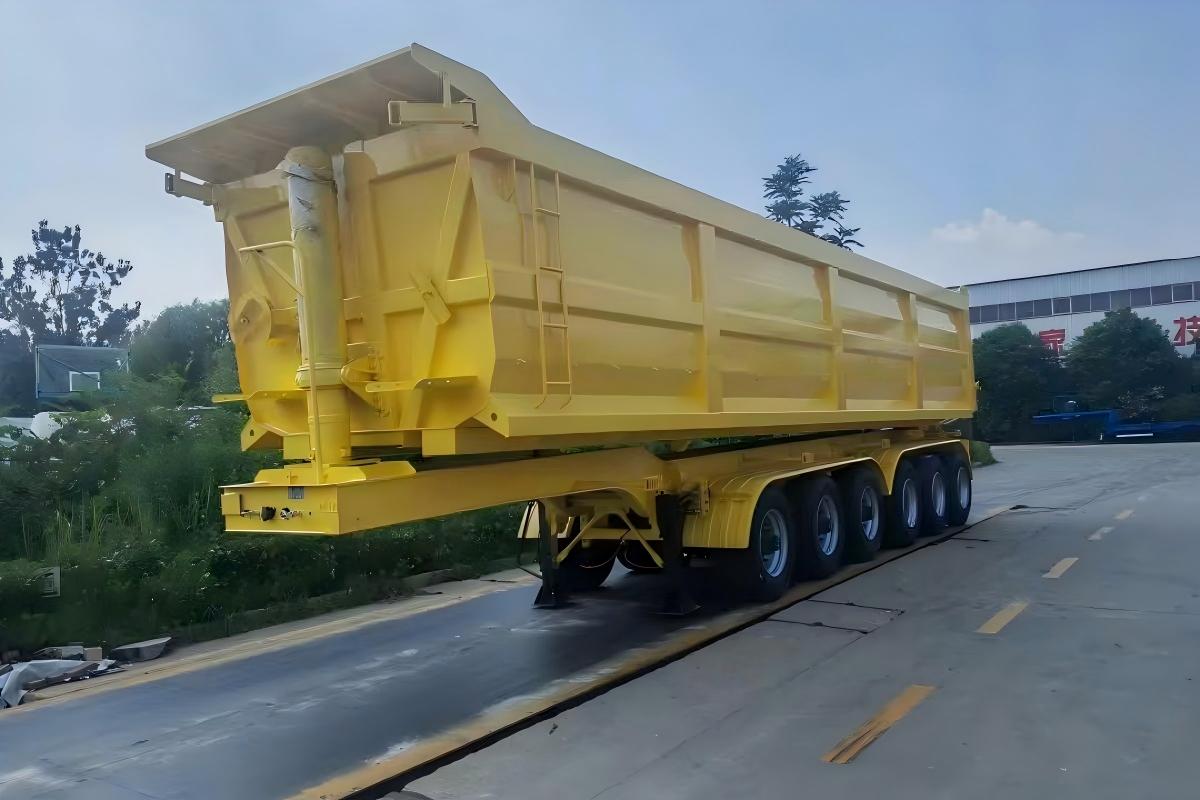
Bulk Material Reference
Body Condition Matters Before the Discharge Mechanism Is Blamed
Aggregate does not interact only with the final opening. Body surfaces, transitions, residue, wear, and local deformation influence the material before it reaches the outlet.
This BOCA image provides a real dump-body reference for bulk-material transport. A bottom-discharge application still requires the actual hopper, gate opening, and actuation arrangement to be confirmed against the intended aggregate and operating cycle.
Check Moisture, Particle Size and Load Compaction
Moisture often changes aggregate behavior faster than any mechanical adjustment. However, the description “wet material” is too broad for reliable troubleshooting. Surface-damp stone, cohesive damp fines, saturated aggregate, and isolated wet pockets can all behave differently.
Stockpile position can explain why two loads with the same material name behave differently. Material taken from a drained outer face may flow well. Later, a loader can reach a lower section that retained more water after rain.
Moist fines can change the character of the whole load
Dry aggregate mainly resists movement through particle friction and interlocking. Once the fine fraction gains enough moisture, additional cohesion develops. The mixture can then hold its shape longer instead of collapsing freely toward the outlet.
This effect often becomes easier to recognize after discharge. Damp residue may remain attached to body surfaces or fall in compacted clumps. Those observations provide more information than looking only at the top layer before unloading.
Particle shape can be as important as nominal size
Angular crushed stone has more opportunity to lock against neighboring particles than smooth gravel. Flat or elongated pieces can also span an opening differently from more rounded material.
Two aggregates with a similar size designation do not necessarily have the same flow characteristics. Shape, surface roughness, moisture, and the proportion of fines all influence how the load rearranges near the gate.
Broad gradation can create a denser lower layer
A mix containing coarse stone and substantial fines can pack more tightly because smaller particles occupy spaces between larger pieces. The material may still look loose at the surface while becoming dense lower in the body.
Transport vibration can strengthen that difference. Fines may migrate downward through voids as the trailer crosses quarry roads, rough construction access, or longer highway sections.
Loading pressure and road vibration can work together
A loader that repeatedly drops material into one concentrated area can create a dense zone before transport begins. Road vibration then gives the particles more opportunities to settle.
Compaction alone does not guarantee bridging. However, when damp fines and angular particles are already present, additional packing can make the load less willing to reorganize as the gate opens.
Capture material evidence before the body is cleaned
A useful incident record goes beyond the word “aggregate.” The following details make later comparisons much more meaningful.
- Material source or stockpile section
- Dry, damp, saturated, frozen, or mixed moisture condition
- Visible fines, clay, dust, or contamination
- Approximate particle-size range
- Rounded, angular, flat, elongated, or mixed particle shapes
- Visible clumping or segregation
- Recent rainfall and stockpile drainage condition
- Whether similar material flowed normally on earlier trips
Inspect Gate Opening, Buildup and Flow Path
Once material condition has been reviewed, attention should move to the usable discharge opening. A gate can appear to complete its movement while accumulated residue still narrows part of the passage.
Actuator travel and effective clearance are not the same check. Material only responds to the space actually available for flow.
Buildup usually starts where movement already slows
Fine material often collects in corners, around transitions, and along irregular surfaces. Initially, a thin deposit may look too small to affect the unloading cycle.
After repeated exposure to moisture and pressure, however, the residue can harden. The surface becomes rougher, the usable opening becomes smaller, and another load has an easier place to begin sticking.
This creates a feedback loop. Slow flow leaves residue, while the residue encourages slower flow on the next cycle. A deposit that repeatedly appears in one location is therefore useful diagnostic evidence.
Compare the opening from side to side
Unequal movement can direct the first material stream toward the easier side. Once that path establishes itself, surrounding aggregate may continue feeding it instead of clearing uniformly across the opening.
Video can help here as well. One side may begin moving slightly later, pause briefly, or stop before the other side. Those details are easy to miss during a fast discharge but become obvious when several cycles are compared.
Follow the route material takes through the empty body
After the trailer is empty and safely isolated, the inspection should follow the material path toward the outlet. Dents, ridges, damaged surfaces, hardened deposits, rough wear areas, or local deformation can all interrupt flow before material reaches the gate.
The gate edge also deserves attention after closing. A stone trapped during the previous cycle or compacted fines near a moving part can affect the next load before new material even enters the body.
Abnormal gate movement is a separate mechanical clue
A material bridge can create unusual resistance around the outlet, but it does not explain every mechanical symptom. Depending on the trailer design, the gate may use pneumatic, hydraulic, mechanical-linkage, or another control arrangement.
Leakage, irregular movement, binding, incomplete travel, or motion outside the normal operating pattern calls for inspection of the actual gate and actuation system. Continued cycling should not become a substitute for diagnosis when normal movement cannot be confirmed.
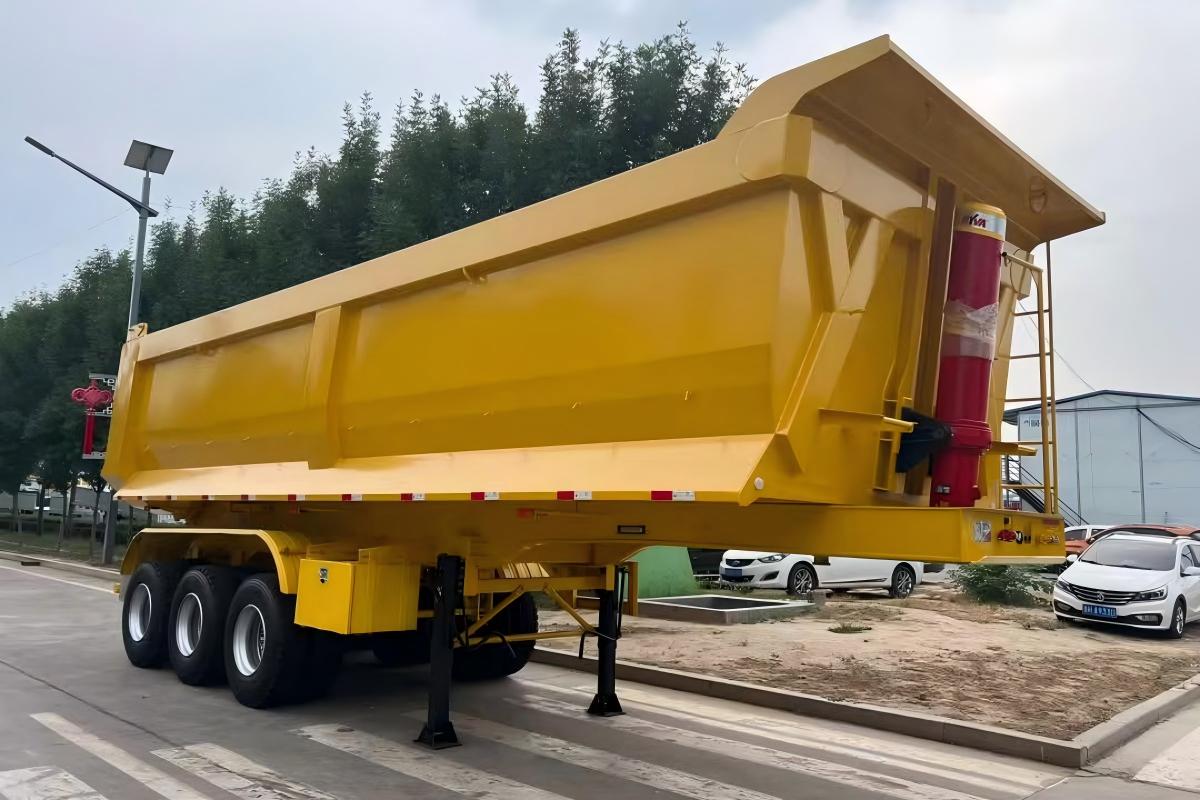
Mechanical Reference
Body and Actuation Condition Still Matter in Flow Diagnosis
Repeated residue, visible deformation, unusual movement, leakage, damaged linkage, and changes around the body structure can influence discharge behavior. These observations should be recorded separately from moisture and particle characteristics.
The image shows a real BOCA dump trailer body and hydraulic-system reference. A bottom-discharge trailer may use a different gate and actuation arrangement, so the fitted system should be checked rather than inferred from the body type alone.
Review Loading Pattern and Discharge Sequence
Some unloading problems begin before the trailer leaves the loading area. Repeated bucket drops into one position can create a denser local zone than material distributed along the body.
Particle segregation can develop at the same time. Larger stone may roll away from the drop point, while fine material remains closer to the center of the pile. Later, vibration can strengthen that difference.
Loading location can change what sits above the outlet
A consistent loading method creates useful diagnostic history. If the discharge pattern changes after material placement changes, local density or segregation becomes a stronger explanation.
Side-to-side balance matters for the same reason. A denser zone can move differently from a looser area, especially when moisture and fines are already distributed unevenly.
This does not mean every uneven load will bridge. Loading pattern becomes important when the same discharge asymmetry repeatedly follows the same placement pattern.
The beginning of discharge tells more than the empty trailer
Once the gate starts moving, the first material stream shows where resistance is lowest. If one section begins flowing immediately while another remains still, that difference should be captured before the retained material changes position.
A clean-looking body after unloading can hide the original event. A bridge may eventually collapse and remove much of the evidence. A short video taken only after flow restarts therefore has limited diagnostic value.
A retained section changes the operating condition
When material has left one side while another section remains loaded, the internal weight distribution is no longer the same as a normal unloading cycle. That difference deserves attention before the operation continues.
Likewise, a stable-looking bridge can release suddenly. The goal should not be to create that release through impact or abrupt movement. The safer judgment is whether the condition still fits the established unloading procedure.
A useful record follows the complete cycle
- Empty body and gate condition before loading
- Material source and visible moisture condition
- Loader, conveyor, or other loading method
- Where loading drops were concentrated
- Road surface and unusual vibration before unloading
- The first area to begin flowing
- Where flow narrowed or stopped
- Any sudden release during the cycle
- Residue location after discharge
- Gate condition after closing
Reduce Recurrence Without Unsafe Manual Intervention
A blocked unloading cycle creates pressure to restore production quickly. However, material suspended above an opening can collapse with little warning. The more reliable approach is to understand why the flow stopped and prevent the same combination of conditions from returning.
Personnel should remain clear of the potential material-release path and moving gate mechanisms. Entering the body, reaching beneath retained aggregate, or standing where a collapsing mass could travel should not become part of routine troubleshooting.
Avoid turning a flow restriction into an impact event
Hammering body panels, striking gate parts, using another machine against the trailer, or making aggressive vehicle movements provides little control over the result. Those actions can also introduce damage that was not present before the blockage.
Repeated opening and closing deserves similar caution. Gate cycling may change the material position, but it does not identify why the flow stopped. If mechanical movement is already abnormal, additional cycles can complicate the original problem.
Use a clean flow path as a new baseline
After safe unloading and isolation, recurring residue zones should be documented before cleaning. A layer of damp fines around the same edge or transition is valuable evidence.
The next comparable load can then show whether that buildup contributed. If the hesitation disappears after the flow path is restored, the deposit probably played a role.
If the same pattern returns immediately, material condition, gate geometry, loading distribution, or another local restriction still requires attention.
Seasonal patterns should not be dismissed as random
A load that flows easily through a dry season may behave very differently after sustained rain. Likewise, cold conditions can introduce frozen lumps or stiff pockets where local climate permits.
The opposite transition can create trouble as well. Residue deposited while wet can later dry into a hard layer, leaving a physical restriction even after incoming material becomes dry again.
Weather and stockpile condition belong in recurring discharge records because they help separate seasonal material changes from a trailer fault that continues regardless of the environment.
When repeated bridging becomes a configuration question
If similar aggregate repeatedly bridges even after the flow path is clean and gate movement is confirmed normal, the issue moves beyond routine cleanup. The discharge arrangement should be reviewed against the real material and unloading cycle.
Useful comparison points include:
- Usable gate-opening dimensions rather than actuator travel alone
- Gate type and actuation or control arrangement
- Hopper and body transitions leading to the outlet
- Maximum particle size, particle shape, fines content, and moisture condition
- Required discharge pattern, such as controlled spreading versus rapid emptying
- Whether the problem appears across several comparable loading and transport cycles
There is no single gate-opening rule that applies to every aggregate. Final dimensions and configuration need to match the intended material, payload, operating procedure, and actual trailer design.
When to Stop Unloading and Inspect Professionally
Not every change in aggregate flow indicates equipment damage. Still, unloading should stop when the material, gate, or trailer no longer behaves predictably under the established operating procedure.
A large retained mass over an open outlet is one example. Strong one-sided retention, abnormal gate travel, leakage, visible distortion, or unusual structural noise are others.
Stop when gate movement no longer looks normal
Binding, irregular travel, incomplete opening, or unexpected closing behavior deserves mechanical investigation. Repeated actuation should not replace inspection when normal movement cannot be confirmed.
After proper isolation, qualified maintenance personnel can review linkage movement, mounting areas, fitted pneumatic or hydraulic components where applicable, gate alignment, controls, and interference. Applicable manufacturer procedures and local workplace requirements remain controlling.
Visible structural change moves the issue beyond routine cleanup
Cracked welds, bent supports, damaged hinges, distorted gate edges, severe body deformation, or new gaps around a mounting area deserve competent technical inspection before normal service resumes.
A sudden material release can expose a weakness that already existed. Alternatively, the release itself can create additional damage. The condition after a serious blockage therefore matters as much as the blockage.
Recurring failures across different materials deserve a deeper review
If the same discharge restriction continues with dry aggregate, damp aggregate, different gradations, and different loading patterns, a purely material-based explanation becomes less convincing.
At that point, the inspection should include gate travel, usable opening, local body geometry, residue history, actuation-system behavior, and previous repair around the discharge structure.
For broader bulk-material projects, the BOCA dump trailer category provides a practical starting point for reviewing body construction and project requirements. If a bottom-discharge layout is required, state that requirement clearly so the available gate arrangement, body configuration, axle layout, route requirements, and destination regulations can be confirmed before specification.
FAQ
A Better Diagnosis Follows the Material From Loading to Final Residue
Uneven discharge is difficult to reconstruct after the body has been cleaned and the details have been forgotten. The strongest evidence connects material condition, loading position, transport vibration, gate movement, the first flow path, and the residue left afterward.
That approach also reduces unnecessary changes. A moisture-driven problem should not automatically trigger gate modification, while a recurring mechanical restriction should not be dismissed as difficult aggregate.
- Record where material begins moving, where it slows, and where residue remains.
- Compare moisture, gradation, loading distribution, gate movement, and buildup across several cycles.
- Pause unloading when retained material, actuation behavior, gate condition, or structural condition becomes unpredictable.
Dump Application Review
Match the Discharge Arrangement to the Material and Real Unloading Cycle
A useful technical review starts with evidence from the actual application. Relevant information includes aggregate type, moisture condition, approximate particle-size range, visible fines, loading method, travel environment, gate type, usable gate opening, actuation method, and recurring residue location.
A complete unloading video adds important context. Initial gate movement can be compared with the first material stream, later hesitation, any sudden release, and the final condition of the empty body.
Before requesting a configuration review or quotation, prepare the following details where available:
- Aggregate type and approximate maximum particle size
- Typical moisture condition and visible fines
- Target payload and loading method
- Required discharge pattern or unloading objective
- Gate type, opening dimensions, and actuation system if already known
- Photos or video showing where flow starts, slows, and leaves residue
If the project specifically requires a bottom-discharge layout, state that requirement clearly so the available gate arrangement and body configuration can be confirmed before specification. Those details provide a much stronger basis for reviewing bottom dump trailer bridging than a general description such as “the material sometimes sticks.”