

Container Chassis Frame Twist on Uneven Terminal Yards: Inspection Before Loading
Uneven terminal yards can make a container chassis appear twisted without proving permanent frame damage. Learn what to inspect before loading, how to assess support conditions, and when engineering review is necessary.

A container chassis parked across an uneven terminal yard can look twisted even when its frame has not suffered permanent deformation. One rear corner may appear higher, a crossmember may look tilted, or the twist lock positions may seem out of line.
The challenge in container chassis frame twist inspection is determining whether those signs come from uneven support or a structural problem that needs engineering assessment. A visual difference alone cannot settle that question.
Before loading, the useful approach is to examine the ground and support conditions, look for damage around the frame and corner fittings, and decide whether the chassis needs a controlled geometry check. This helps avoid two equally unhelpful conclusions: treating every apparent twist as permanent damage, or assuming that uneven pavement explains everything.
What uneven support can make a straight chassis look like
At a terminal, the ground beneath a chassis is not always uniform. A wheel may sit in a shallow depression while another rests on firmer pavement. Landing gear may be supported at a different elevation from the axle group. Depending on the chassis design and suspension condition, these differences can alter how the frame sits.
The result may resemble chassis diagonal distortion when viewed from the rear. A crossmember appears to slope, one beam looks higher than the other, or the corner support positions no longer seem to share the same plane. Yet a nearby building, painted yard line or container stack is not necessarily a reliable reference for frame geometry.
What matters is whether the irregularity belongs to the chassis or to the way the chassis is being supported. A frame can respond elastically to uneven support, while permanent deformation involves a lasting change in its structural geometry. Both may produce similar visual symptoms.
An uneven yard can explain an apparent twist, but it cannot rule out damage. The support condition and the chassis structure need to be considered together before loading is approved under the applicable procedures.
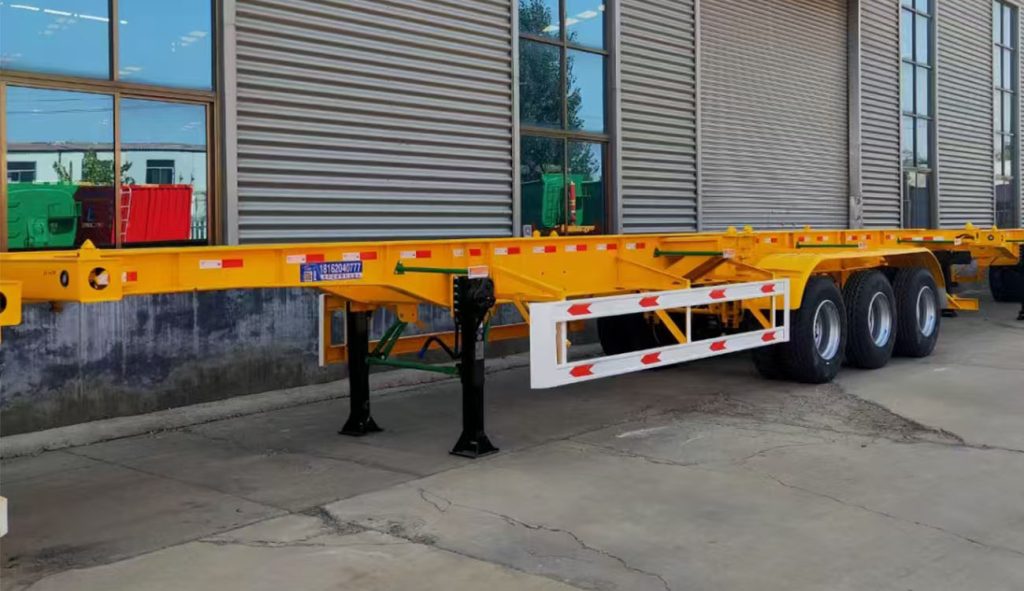
That distinction becomes more important after a reported ground strike or when the same chassis has developed repeated corner-alignment complaints. In those circumstances, an irregular frame position should not be dismissed simply because the surrounding pavement is uneven.
Inspect support and corner seating before loading
The initial inspection should capture the condition in which the problem was noticed. If the chassis is standing with one landing foot on a raised area, that detail may explain the visual difference more effectively than a close-up photograph of the frame.
Record whether the chassis is connected to a tractor, supported on landing gear, or standing in another permitted configuration. The position of the wheels, suspension condition and ground contact all influence how the observations should be interpreted.
The inspection also needs to account for the actual frame layout. Different chassis configurations may use different container support and securing arrangements. For broader structural context, BOCA’s container chassis guide explains chassis configurations and their operating applications.
Attention can then move to the corner fittings and twist lock assemblies. On an unloaded chassis, visible differences in lock orientation, mounting position or surrounding structure may indicate a local problem worth investigating. They do not automatically prove that the entire frame is twisted.
If the concern arose during a previous loading attempt, the position of any seating gap matters as much as its appearance. A gap at one container corner can involve the support condition, the securing hardware, local mounting damage or frame geometry. Without that context, it is difficult to identify the cause.
- A wider view showing the chassis position and the ground beneath its supports.
- Photographs of the affected corner fittings and nearby structural connections.
- The chassis identification, load status and support arrangement when the irregularity appeared.
- Any recent ground strike, unusual loading event or earlier alignment complaint.
These records preserve the original condition without turning the inspection into an improvised loading test. A container should not be lowered merely to see whether the frame can be pulled into alignment, and twist locks should not be forced to compensate for an unresolved seating problem.
Recheck on suitable level support using approved datums
A chassis that appears twisted in one parking position may look different when its support conditions change. That observation can be informative, but moving to another patch of apparently level pavement is not, by itself, a controlled measurement.
A reliable comparison needs a suitable reference plane, the support arrangement specified for the chassis, and the correct manufacturer-approved measurement points. Depending on the design, the required condition may involve the landing gear, suspension, tractor connection or other prescribed supports.
Where the current equipment condition makes movement unsafe or uncertain, repositioning should not become part of an informal field test. Qualified personnel should determine how the necessary inspection can be carried out under the approved procedures.
Once the appropriate conditions are established, the geometry can be examined against the manufacturer’s references rather than against the yard surface. Measurements taken at arbitrary beam edges or convenient ground locations can create apparent differences that are not meaningful for the specified frame assessment.
A diagonal measurement may help identify an out-of-square condition when the correct datums and procedure are used. However, a diagonal difference is not the same as a direct measurement of torsional frame twist. The two observations should not be treated as interchangeable.
The same distinction applies to corner elevation. A difference between approved reference points may support further investigation, but its significance depends on the measurement setup, the chassis design and the relevant acceptance criteria.
There is no sound basis for applying an invented universal diagonal-difference limit to every container chassis. Without the applicable manufacturer’s criteria, a measurement can be recorded and referred for assessment, but it cannot independently establish structural acceptability.
A comparison becomes more meaningful when the original support condition, the approved measurement arrangement and the resulting observations are all documented. If the apparent distortion changes but visible cracks or displaced components remain, those damage indications still require attention.
Distinguish temporary twist from damage needing assessment
The purpose of the second examination is not simply to obtain a straighter-looking chassis. It is to understand which explanation the evidence supports and where that evidence stops.
Temporary support-related deflection and permanent structural deformation can appear similar in a photograph. A frame that changes orientation when properly supported may have been responding to uneven ground, while an irregularity that persists under the specified conditions raises a different concern.
A repeated discrepancy deserves attention, but its location matters. A displaced twist lock bracket may create a corner-seating problem without demonstrating permanent deformation along the entire chassis. Conversely, a local impact may have affected more than the part showing the most obvious damage.
The surrounding structure should therefore be considered with the geometry results. Cracking near welded connections, displaced mounting components, torn material or evidence of a significant strike changes the concern from apparent alignment to possible structural integrity. For further context on frame construction and key components, see BOCA’s container skeleton trailer design guide.
When loading should remain on hold: Suspected structural damage, uncertain corner-lock engagement or an unresolved condition affecting safe loading should be escalated under the approved site and equipment procedures. Structural repair and release-to-service decisions belong to qualified personnel using the applicable manufacturer requirements.
The absence of visible cracks is not proof that a frame is straight, just as a tilted rear view is not proof of permanent damage. The decision must reflect the complete evidence rather than a single visual clue.
Document the yard and chassis for engineering review
A useful inspection record should tell the next reviewer what was observed, where it happened and under which conditions. This is especially valuable when equipment moves between terminal yards, workshops and different operating teams.
A photograph showing only the affected corner may capture the symptom but lose its cause. Wider images showing the ground, supporting equipment and overall frame orientation give the reviewer a more complete picture. Close-ups of twist lock mounts, crossmembers and accessible weld zones can then establish the condition of the surrounding structure.
Where measurements are available, the record should identify the approved datums, support condition, measurement method and actual readings. The values are useful only when the reviewer can understand how they were obtained.
The equipment identification is equally important. A chassis model, serial number, known configuration and available manufacturer documentation allow the findings to be considered against the correct design rather than an assumed standard.
For equipment managers, consistent records can reveal whether similar complaints occur at a particular yard position or follow one chassis between locations. These are different problems, and the distinction may influence what needs to be investigated next.
For procurement teams, recurring alignment complaints become a configuration question only after the condition of the existing chassis has been assessed. A new unit may be worth considering when a fleet is expanding or when the intended depot duty is not adequately covered by its current equipment. Uneven ground alone is not evidence that a different chassis is needed.
Before comparing configurations, establish the container sizes and expected loads, whether the chassis will operate solely inside terminals or also travel on public roads, and how the equipment will be supported during loading. These operating conditions matter more than choosing a trailer based on axle count or a general description of frame strength.
Share the relevant support-condition records, chassis identification, corner and weld photographs, and available manufacturer measurement references when discussing container chassis trailers with BOCA. Ask which configurations can be evaluated for the intended application and what supporting drawings or technical evidence are available before making a purchasing decision.
A completed container chassis frame twist inspection should make one point clear: whether the observed condition has been adequately explained, remains inconclusive, or requires formal structural assessment. That is more useful than a simple note stating that the chassis “looks twisted.”
Frequently Asked Questions
Can a visual check prove that a chassis is straight?
No. Visual inspection can reveal obvious damage and unusual alignment, but it cannot verify frame geometry. A reliable determination requires the applicable manufacturer-approved reference points, suitable support conditions and relevant measurement criteria.
Should corner locks be forced into alignment?
No. Forcing a twist lock or container corner into position may conceal a problem with the securing hardware, seating arrangement or chassis geometry. The cause should be assessed before the affected loading operation resumes.
What should be recorded after a ground strike?
Record the incident location, chassis identification, likely contact area, operating condition and any visible damage. Preserve photographs and relevant equipment records, then follow the applicable reporting and inspection procedure even if no immediate deformation is apparent.
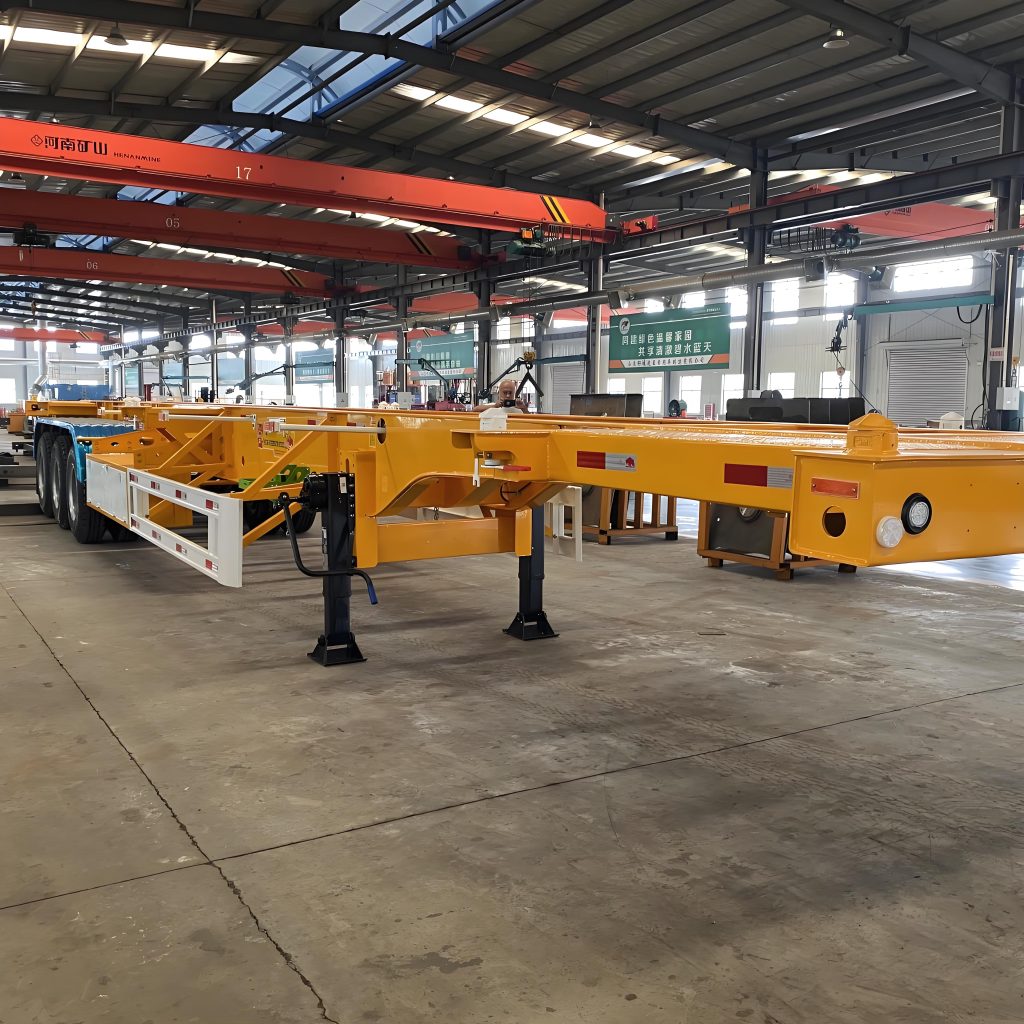
Once the frame condition has been assessed, the next question is whether the available chassis configurations match the depot’s operating requirements. A visible twist on uneven ground is not, by itself, a reason to replace the trailer.
For a configuration enquiry, share your container sizes and expected loads, terminal and road-use requirements, and the conditions under which the chassis will be supported and loaded. If an existing unit has shown alignment problems, include its identification, inspection records, manufacturer measurement references and photographs of the affected corners or structural connections.
Explore BOCA’s container chassis range and use the quotation option to discuss suitable configurations and supporting technical evidence. Structural assessment and release-to-service decisions for existing equipment remain separate matters for qualified personnel.
View Chassis Options & Request a Quote