

Food Grade Tanker Trailer Cleaning Between Loads: Preventing Cross-Contamination

A practical guide to reviewing cargo history, hidden residue, cleaning coverage, verification and tanker configuration when changing food-liquid loads.
A tanker can leave the discharge point looking empty and still carry enough residue to affect the next load. Product can remain behind valve seats, inside hose ends, around gaskets, near baffles or in pipe sections that do not drain completely.
Food-grade tanker cleaning between loads therefore starts with the cargo transition rather than the wash hose. The previous cargo, next cargo, product-contact path and available cleaning capability all affect the decision.
The practical question is not simply whether the tank has been washed. It is whether the complete product path is suitable for the next food-liquid service.
Why the Previous Load Defines the Cleaning Plan
The previous cargo changes both the type of residue and the difficulty of removing it. Edible oil can leave a persistent film. Syrup can remain as sticky material in low points. Dairy-derived liquids introduce a different hygiene and cross-contact profile.
The next load matters just as much. A same-product reload is not the same situation as a change from edible oil to juice, while a strongly aromatic product followed by a neutral liquid can create sensory carryover even when the stainless surface appears clean.
Identify the actual product, residue behaviour, relevant allergens, aroma and any abnormal discharge condition.
Check whether the following cargo introduces tighter hygiene, sensory, cross-contact or dedicated-service requirements.
Determine whether routine cleaning is sufficient or whether additional dismantling, verification or specialist review is needed.
Not every food-to-food changeover should follow the same route
A description such as “food liquid” is too broad to define an effective cleaning process. Oil, protein, sugar, flavour compounds and suspended solids behave differently during drainage and washing.
In practical terms, a known same-product movement may follow a different approved procedure from a product change. An oil- or fat-rich previous load may require additional attention to films and seals. Strong aromas, allergens or difficult residues can justify tighter verification. Unknown or restricted previous cargo should stop routine release until suitability is established.
Elapsed time also matters. Residue left in the system can dry, oxidise or become harder to remove, meaning the same cargo can create a different cleaning problem after a long delay than after immediate drainage.
Verify Cargo History Before Choosing the Cleaning Method
Operational pressure often appears before the next loading slot. The tanker returns, the wash bay becomes available and the schedule encourages immediate cleaning. Starting before the cargo transition is confirmed, however, can result in the wrong cleaning process being applied efficiently.
Records should identify what the equipment actually carried. Descriptions such as “oil,” “beverage” or “food product” may be too broad when formulation, aroma, allergen status or customer restrictions affect the next decision.
Information worth confirming before cleaning begins
- Trailer and compartment identification
- Actual previous cargo
- Relevant formulation or grade
- Allergen information where applicable
- Loading and discharge timing
- Incomplete discharge or abnormal residue
- Cleaning already performed
- Next planned cargo
- Restricted previous loads
- Required cleaning method
- Required verification method
- Release authority
The review should extend beyond the tank shell. A portable pump can have a different product history from the vessel, and a hose may have been used with another trailer between trips. In multi-compartment operations, each compartment should retain a meaningful history when different liquids have been carried.
The next step is to compare that history with the following shipment. Some cargo owners restrict previous products. Others require a specific sanitation process, dedicated equipment or defined verification evidence.
Unexpected residue, colour or odour should be allowed to challenge the paperwork. If trailer identity, cargo history and physical evidence do not agree, investigate the discrepancy before cleaning or loading continues.
Follow the Complete Product Path, Not Only the Tank Shell
Large tank walls attract attention because they are easy to inspect. Cross-contamination problems, however, often remain in smaller areas where liquid slows, changes direction or becomes trapped.
A useful inspection therefore follows the entire wet path: loading connection, tank or compartments, outlet, valves, manifolds, pumps, hoses and every removable fitting that contacts the product.
- Tank shell and compartment surfaces
- Baffles and shadowed areas
- Manhole and upper fitting areas
- Outlet sump and low points
- Bottom valves and valve seats
- Discharge manifolds
- Elbows and short branches
- Pumps and meter bodies
- Hoses and hose couplings
- Adapters and removable fittings
- Gaskets and O-rings
- Relevant vent paths
Low points can retain the previous cargo after the main tank looks empty
Gravity discharge does not guarantee complete drainage. A pipe sag, outlet pocket or valve cavity can retain liquid after the main compartment stops flowing. Trailer attitude on the wash pad can also change where retained product collects.
This matters when the following liquid differs from the last one. A relatively small trapped quantity can be dispersed through a much larger load once filling begins.
Valves, seals and hoses often deserve more attention than exposed walls
A valve can look clean externally while residue remains around the seat or seal interface. Gaskets can retain material at their contact surfaces, and hose interiors introduce additional areas around couplings, recesses and seals.
Surface condition also affects cleanability. Cracked seals, worn elastomeric parts, damaged fittings or deeply scored product-contact surfaces may become difficult to clean consistently. In those cases, maintenance can be more effective than repeatedly extending the wash cycle.
Cleaning requirements should influence the tanker layout
When reviewing a stainless steel tank trailer for food-liquid service, cleanability should be considered alongside transport capacity. Valve layout, drainage, compartments, piping and inspection access all affect what must be cleaned between loads.
Confirm the final material, product-contact fittings, compartment arrangement and sanitation requirements against the actual cargo and operating procedure before ordering.
Review Stainless Steel Tank Trailer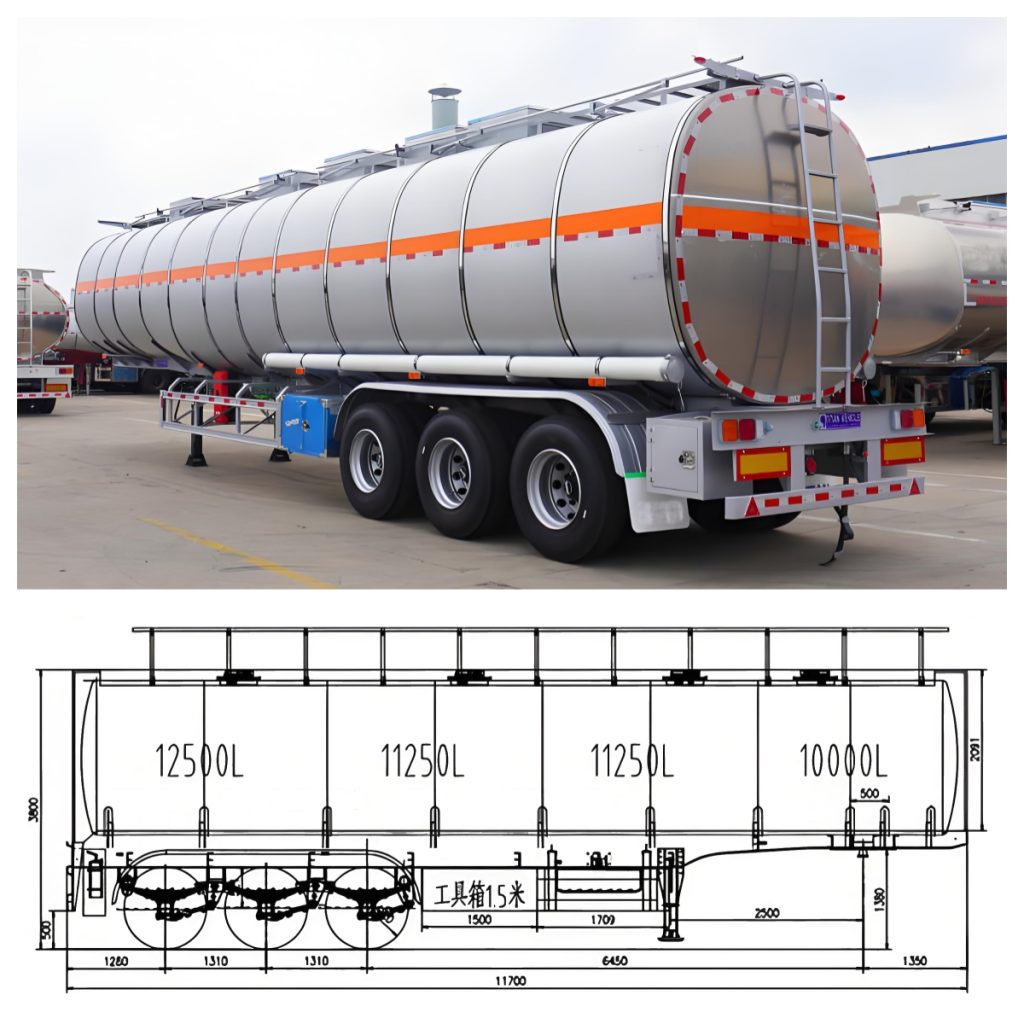
Build the Cleaning Sequence Around the Actual Residue
A reliable sequence removes residue in an order that follows the equipment. It starts with product recovery and drainage, then moves through soil removal, cleaning, rinsing, final drainage and inspection.
There is no responsible universal recipe for every food liquid. Cleaning chemistry, concentration, temperature, contact time and sanitising conditions should come from the approved operating procedure, cargo requirements and cleaning-product instructions.
Confirm the cargo transition before connecting wash equipment
Trailer identity, compartment history, previous cargo, next cargo and required verification should be known before the process starts.
Drain recoverable product before washing
Cleaning should not become the primary method for removing a significant remaining quantity. Effective drainage reduces soil loading and improves later cleaning control.
Use the pre-rinse to remove loose soil
A pre-rinse can remove readily soluble residue, but clear discharge water does not prove that oily film, allergen residue, odour compounds or hidden material have disappeared.
Match the cleaning action to the soil
Cleaning performance depends on chemistry, mechanical action, flow, time, temperature and access. Stronger chemistry cannot compensate for a cavity the cleaning solution never reaches.
Move cleaning action through pipes, valves and pumps
Washing the vessel while leaving discharge equipment static creates an incomplete process. Product-contact branches need deliberate exposure to the approved cleaning method.
Control removable parts separately
Caps, adapters, gaskets and hoses can reintroduce residue after the tank has been cleaned. Clean and dirty parts should therefore remain controlled during the process.
Complete the required rinse and drainage
When the approved process requires rinsing after cleaning agents, those residues also need to be removed. Standing rinse water should not remain beyond the defined operating condition.
Inspect while critical surfaces remain accessible
Inspection is easier before manholes, caps and fittings are closed. Good lighting and a consistent inspection order help reveal film, trapped liquid, damage, foreign material or unexpected odour.
The process should also respond to what appears during cleaning. Persistent colour, unusual foam or unexpected particles may indicate that the actual residue differs from the assumed condition. In that situation, investigation is more useful than automatically moving to the next step.
Verification Should Support a Release Decision
Completing the cleaning process does not automatically mean the trailer is ready for the next load. Verification asks whether the available evidence supports the required condition before product enters the system again.
The appropriate evidence depends on the food-safety programme, cargo-owner requirements, destination rules and the identified contamination risk. Universal internet thresholds should not replace the applicable operating standard.
| Check | What it can reveal | Important limitation |
|---|---|---|
| Visual inspection | Film, particles, pooled liquid, damage and foreign material | Cannot establish invisible cross-contact by itself |
| Odour review | Persistent cargo aroma or unexpected chemical smell | Some relevant hazards have little or no detectable smell |
| Defined hygiene check | Process evidence where included in an established sanitation programme | One result does not represent every contaminant or location |
| Specific analytical test | A defined allergen, microbiological or other target where testing is required | Requires a suitable method, sampling plan and acceptance rule |
Visual cleanliness has a clear limit
Visual checks quickly identify soil, standing water and damaged components, but they cannot reliably establish the absence of every allergen, microorganism or cleaning residue.
Sampling location also matters. Testing an easily reached wall does not necessarily represent a valve seat, hose end or low section of pipe. A useful verification plan concentrates on the locations where the cleaning process is most likely to struggle.
A failed result needs an operational consequence
Loading should remain blocked until the cause is investigated and the defined release condition is restored. Corrective action may include recleaning, opening an accessible component, replacing a seal, changing an approved process step or carrying out additional verification. Repeated failure should trigger root-cause review rather than repeated use of the same ineffective cycle.
Document the Load, Cleaning Method and Release Decision
Cleaning records create continuity between transport, sanitation and loading. More importantly, they explain why a particular trailer was considered suitable for a particular next load.
A generic note such as “washed” provides little value after an unusual transition. A stronger record connects the actual previous cargo with the method used, inspection findings, verification and final release decision.
- Trailer identification
- Compartment identification
- Previous cargo
- Next-load requirement
- Cleaning location
- Cleaning method
- Relevant controlled cleaning agents
- Parts removed or opened
- Inspection findings
- Verification result
- Corrective action
- Release decision
Deviations deserve a place in the record as well. A valve that repeatedly needs additional cleaning, or a hose that retains unexpected residue, can reveal a recurring maintenance or process weakness.
Cleaning completion and release should remain separate concepts. Completing the work confirms that the planned process occurred. Release confirms that the required evidence supports the next operation.
Know When Routine Cleaning Is No Longer Enough
Routine cleaning works best when cargo history is known, residue behaves as expected and the wash facility can execute the required process. Several conditions should trigger a more cautious review.
The previous cargo cannot be established
Unknown history removes the basis for assessing residue, allergen relevance and cleaning compatibility. An empty-looking tank is not enough to resolve that uncertainty.
Unexpected or incompatible exposure is suspected
Possible exposure to an unsuitable non-food material requires qualified technical and food-safety review. A routine food-tanker wash should not automatically be assumed to restore suitability.
Residue or odour remains after the normal process
Repeated residue can indicate hidden cavities, damaged seals, inadequate cleaning flow or hardened product. Persistent aroma can also remain in hoses, seals and other components after visible soil has disappeared. Targeted dismantling or maintenance may be more useful than another identical wash.
Verification repeatedly fails
Repeated failure can reveal a systematic weakness involving equipment geometry, maintenance, sampling or cleaning coverage. Reviewing failure trends can show whether the same fitting, compartment or product transition appears repeatedly.
The available wash facility cannot perform the required method
Not every cleaning location has the same circulation capability, component-cleaning facilities, drainage control or verification tools. If the required process cannot be completed properly, convenience should not determine the release decision.
Use Cleaning Duty as a Tanker Configuration Input
Frequent cargo changes make cleaning access part of daily operating efficiency. Planned cargo families and available sanitation facilities should therefore be considered before the product-contact layout is finalised.
This is where cleaning requirements become a purchasing issue. A layout that works well for one transport duty may introduce unnecessary cleaning difficulty in another if it adds compartments, valves, hose runs or low points that are difficult to drain and inspect.
When comparing tank semi trailer configurations, define the expected cargo transitions first. Then review the product path, discharge arrangement, cleaning access and available wash capability against those transitions.
List the product changes expected most often rather than describing only one ideal transport duty.
Review the required compartments, valves, pumps, hoses and discharge arrangement that cleaning must cover.
Confirm the available cleaning facility, drainage conditions and verification approach before the final layout is selected.
A useful configuration discussion should begin with the operating duty rather than a generic request for a food-grade tanker.
- Previous and next cargo families
- Relevant allergen controls
- Required cleaning process
- Available wash facility
- Required capacity
- Compartment arrangement
- Product-contact piping layout
- Valve and hose arrangement
- Pump requirement where applicable
- Drainage limitations
- Inspection access
- Destination country or market
Common Questions About Food-Tanker Load Changes
Can a food-grade tanker carry a different food product after cleaning?
Potentially, but “food-grade” does not make every transition automatically acceptable. The previous cargo must be permitted, the cleaning process must address the relevant residue and cross-contact risk, and the next load’s required release conditions must be met. Some cargo owners may require restricted histories, additional verification or dedicated equipment.
Does clear rinse water prove the tanker is ready for the next load?
No. Clear rinse water can indicate that loose visible soil has been reduced, but it does not by itself establish removal of oily film, allergen residue, microorganisms, cleaning chemistry or material trapped in valves, hoses and low points.
When should cleaning requirements influence the tanker specification?
They should be considered before the product-contact layout is finalised when the tanker will change cargos regularly. Compartment count, valve arrangement, piping, hoses, pumps, drainage and inspection access can all affect cleaning difficulty and turnaround time.
A useful tanker enquiry should identify the products you expect to carry, how often they change, the cleaning method available and the product-contact components that must be cleaned and inspected between loads.
Send the cargo family, required capacity, compartment requirement, preferred tank material, pump and valve arrangement, cleaning method, destination market and any existing equipment drawings. These details make it easier to review the configuration around the real operating duty rather than a generic tanker specification.
Send Cargo & Tanker RequirementsFinal Load-Change Priorities
Effective food-grade tanker cleaning between loads depends on more than a clean-looking tank. Cargo history identifies the initial risk, the next load defines the required release condition, and the actual equipment layout determines where residue can remain.
- Confirm the previous and next cargos before selecting the cleaning process.
- Follow the full product path through valves, piping, hoses, pumps, seals and low points.
- Use verification that matches the identified risk rather than relying on appearance alone.
- When buying or configuring a tanker, treat cleanability, drainage and inspection access as operating requirements rather than secondary details.