

Hydraulic Lowbed Ramps Lifting Unevenly: Cylinder Synchronization and Hose Checks
When hydraulic lowbed ramps move unevenly, the cause may involve cylinder control, hose restrictions or mechanical binding. Learn what to check and when professional diagnosis is needed.

When hydraulic lowbed ramps lift unevenly, the slower ramp is not necessarily attached to a failed cylinder. Unequal support, a binding pivot, a restricted hose or a difference in hydraulic flow control can produce similar movement. The useful question is not simply which ramp is slower? but what changed before the two ramps began moving differently?
If movement is unexpected, suspend loading and follow the trailer manufacturer’s approved procedure for securing the equipment. The observations below help maintenance supervisors describe the problem and decide what a qualified hydraulic technician needs to investigate; they are not a repair or release-to-service procedure.
A ramp that hesitates at one position may have a mechanical obstruction, hose-routing problem or hydraulic-control issue. That pattern narrows the investigation, but it does not establish the cause. A sound diagnosis needs the actual ramp arrangement, hydraulic schematic and safe inspection evidence.
Stop and describe how the two ramps move differently
A report that “the left ramp lifts faster” can describe several distinct faults. One side may start first and the other catch up. Both may begin together, with one slowing near the middle of its travel. Or the ramps may finish at different positions after an otherwise steady movement. These patterns should not be treated as interchangeable.
The direction matters as much as the timing. A difference reported only during raising may send the investigation in a different direction from a difference observed during both raising and lowering. Note the original position of each ramp, whether it was touching the ground, and whether the trailer was loaded or unloaded. Use operator recollections and existing footage rather than running the system again to recreate a hazardous condition.
There is also a design question that needs answering before anyone labels this a synchronization failure. Some ramps have independent controls; others may share a circuit or use flow-control components. Two ramps moving at different speeds are not automatically violating a synchronization requirement unless that requirement exists for the installed design.
Rule out unequal support and mechanical binding
The ground beneath a lowbed trailer is part of the story. A ramp resting against firm pavement may behave differently from one meeting a rut, a raised edge or loose material. Uneven trailer support can also change the resistance at the rear loading assembly. Record those conditions before concluding that the hydraulic circuit delivered different force to the cylinders.
The same caution applies to the hinge line. A displaced guard, contact mark, bent bracket or damaged pivot can create resistance that resembles poor hydraulic performance. If the difference consistently appeared near one angle, the service team should consider both pivot friction and the routing of hoses through that part of the movement. Neither explanation is proven by the symptom alone.
Anyone examining the mechanism must work within the manufacturer’s authorized isolation and support arrangements. A raised hydraulic ramp is not a safe working support by itself; no one should reach into a pinch point, pull a hinge pin or try to free a jammed ramp as an improvised test.
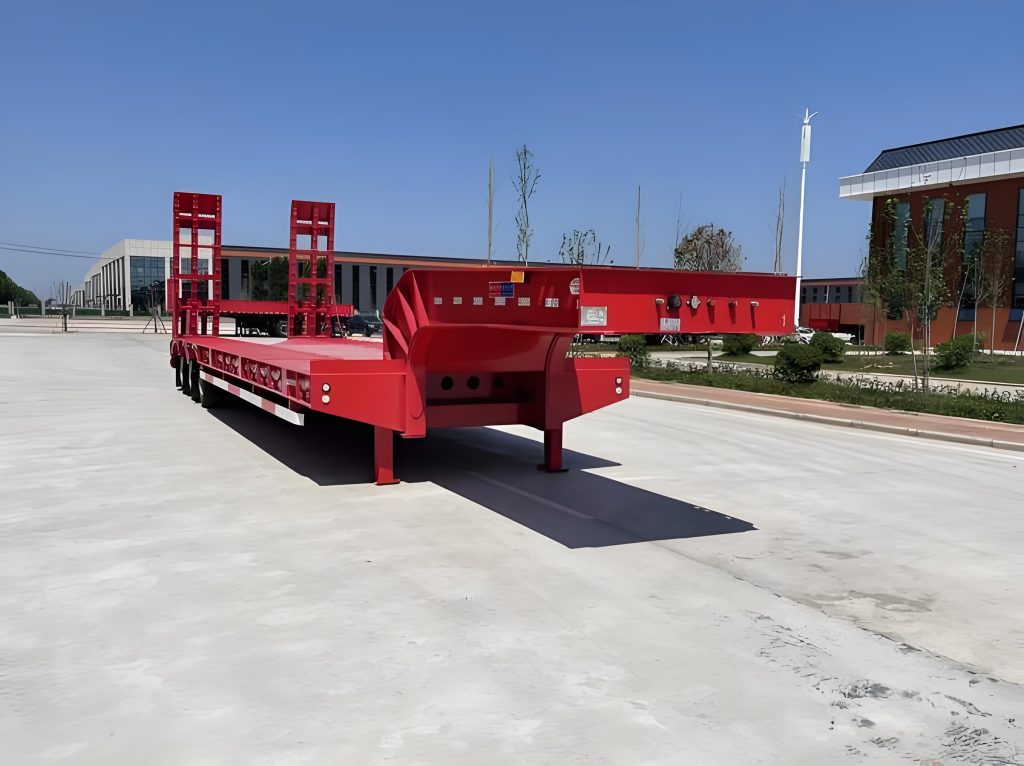
For context on different loading arrangements, BOCA’s lowbed semi trailer guide explains broader trailer layouts. It does not determine the circuit or service requirements of the trailer currently showing the fault.
Compare hoses and external hydraulic conditions
A hose can appear normal from one viewpoint and still be trapped against a moving part. Conversely, a sharp-looking bend does not prove a restriction. Hydraulic ramp hose checks are most useful when the observed routing is compared with the actual circuit drawing and the manufacturer’s intended installation—not merely with the hose on the opposite ramp.
From existing photographs or an authorized safe visual inspection, look for crushed sections, abrasion, damaged clamps, rubbing near pivots and visible oil residue. A change after hose replacement or other hydraulic service is important history, but it does not automatically mean the newly fitted part is defective. The two sides may also have different hose functions or valve arrangements by design.
Leave pressure and synchronization tests to qualified personnel
Sharing a hydraulic power source does not automatically mean that two ramps are designed to move together. The first question is whether the installed system uses independent ramp controls or a circuit intended to coordinate their movement. Where a flow divider or another flow-control device is fitted, its function and condition become part of the investigation. Restricted flow, internal cylinder leakage and unequal mechanical resistance can also affect ramp travel. The actual hydraulic schematic is needed to determine which explanation is relevant.
Pressure readings, flow comparisons and cylinder leakage investigations need the correct measurement points, equipment and manufacturer-approved procedures. An arbitrary test pressure or a trial adjustment may produce a misleading result and introduce further risk. If the hydraulic drawing, cylinder identification or hose specification is unavailable, obtaining those records is the next diagnostic step—not improvising a test.
Unexpected ramp movement, uncertain support, suspected structural interference or hydraulic leakage calls for the approved stop-and-secure procedure and qualified assessment. Do not loosen fittings, swap hoses, search for leaks by hand or disconnect lines while pressurized. Stored hydraulic energy may remain after the power source is stopped.
The UK Health and Safety Executive’s guidance on high-pressure fluid injection hazards explains why even a small hydraulic leak can cause severe injury.
Finding a cause is not the same as authorizing the trailer for loading. Any repair verification and return-to-service decision must follow the actual manufacturer’s acceptance criteria and the rules applicable to the equipment and worksite.
Prepare a fault record for service or ramp review
A technician can act on “the right ramp hesitated halfway through raising on uneven ground after recent hose work” more effectively than “the hydraulic cylinder is bad.” The first report preserves what was observed; the second asserts a conclusion the evidence may not support.
A useful service record brings together a small set of facts:
- Identity and arrangement: trailer identification, ramp layout, cylinder markings and relevant service history.
- Movement and conditions: which side led or lagged, direction of travel, position where the symptom appeared, ground support and loading status.
- Existing visual evidence: dated photographs or footage showing the ramp position, hose routing, oil residue or contact marks without recreating unsafe movement.
- Engineering records: hydraulic schematic, cylinder and hose configuration, and manufacturer-approved isolation and test procedures.
If the fault is intermittent, distinguish the dates and conditions on which it was reported from those on which it was not observed. That can reveal a useful connection with support conditions or recent work, although it still will not prove a particular component failed.
For existing equipment, the next decision belongs with the maintenance team and qualified service personnel. For a fleet discussing a different lowbed arrangement, the same record becomes a practical starting point for a supplier conversation. Machine dimensions, loading conditions, ramp layout and supporting documentation need to be considered together; suitability cannot be assumed from a product category or a general article.
If hydraulic lowbed ramps are lifting unevenly, the most defensible outcome is a clearly documented fault, an appropriately secured trailer and a model-specific assessment—not a replacement part chosen from the symptom alone.
Frequently Asked Questions
Does uneven lifting always mean a failed cylinder?
No. Ask for the cylinder identification and documented evidence separating internal leakage or actuator damage from external resistance and control-circuit faults before specifying a replacement.
Can unequal ramp loading affect movement?
Yes. Different contact conditions can change resistance. Preserve the loading and ground-condition record, but do not add a machine or repeat a loading cycle to reproduce the fault.
Which observations help locate an intermittent fault?
Date, raising or lowering direction, initial ramp position, surface conditions and the timing of recent service work. Existing footage is helpful when it shows the symptom without requiring unsafe repeat operation.
An existing ramp-motion fault needs qualified service assessment before loading resumes. If your fleet is replacing a trailer or reviewing a different loading arrangement, the next step is to compare configurations against the equipment and actual site conditions—not to choose a model based on the fault alone.
For a useful quotation discussion, provide the machine type, operating weight, track or wheel width, ground clearance, loading frequency, available rear access, road and ground conditions, and destination market. Include your vehicle identification and existing inspection records where relevant, and ask which ramp arrangement and supporting technical documents apply.
Explore BOCA’s lowbed range, then use the quote enquiry on that page to discuss the proposed configuration.
Explore Lowbed Options & Request a Quote