
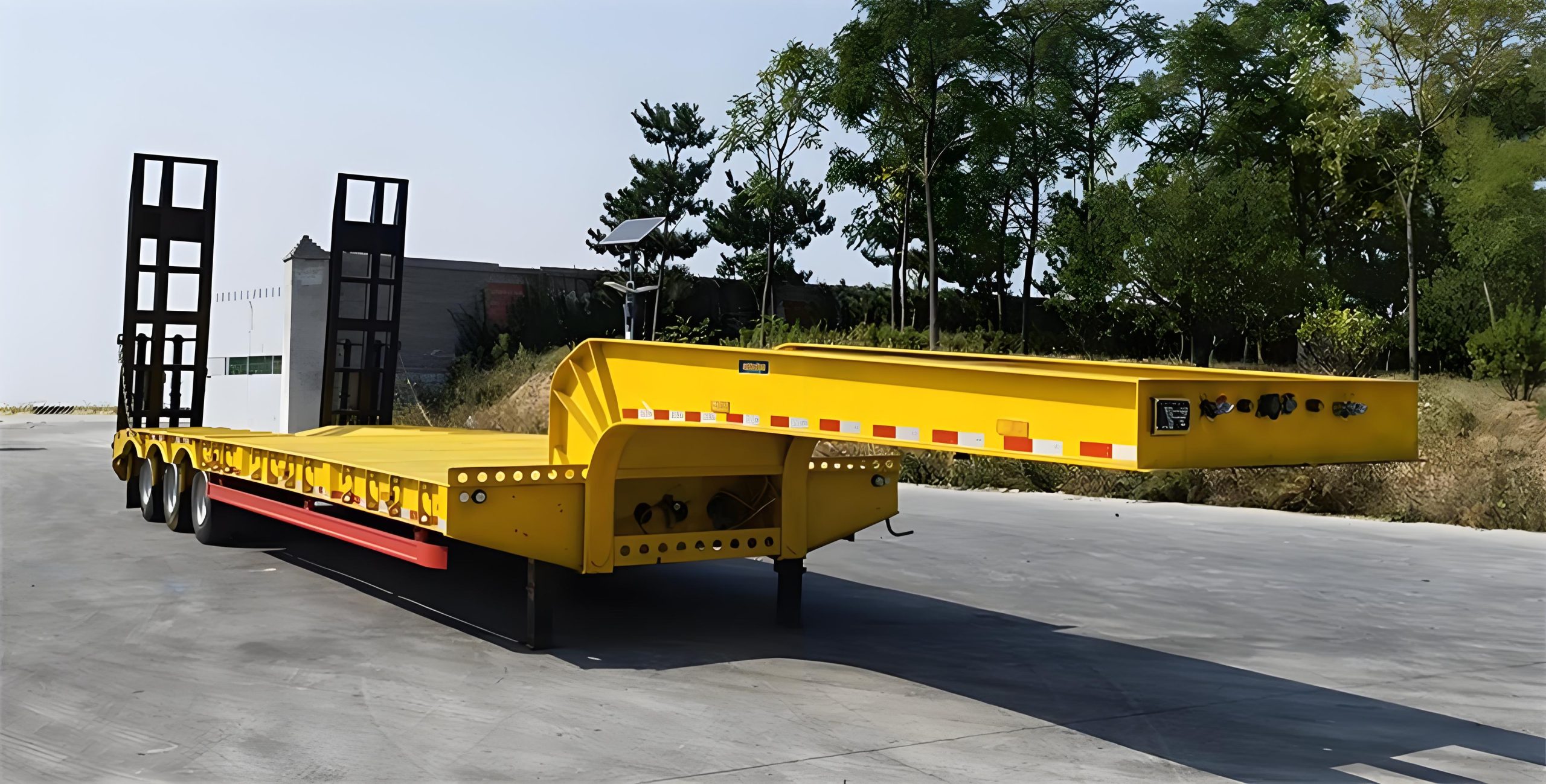
Lowbed Semi Trailer Buying Guide: Types, Specs & Load Capacity

Which lowbed semi trailer do you need?
Quick Selection Guide for Lowbed Trailers
| No. | Application / Requirement | Recommended Type | Key Consideration |
| 1 | General construction machinery | Standard Fixed-Neck Lowbed | 30–120 t capacity depending on axle configuration |
| 2 | Heavy excavators / loaders with front loading | Detachable Gooseneck (RGN) Lowbed | Front loading reduces the need for ramps |
| 3 | Long beams / wind tower sections | Extendable Lowbed | Extendable deck length, typically around 20–30 m |
| 4 | Mining equipment / transformers / generators | Multi-Axle Heavy-Duty Lowbed | Designed for 150+ t heavy-haul applications |
| 5 | Oversized / wide equipment | Customized Lowbed | Confirm deck width, overall dimensions, axle load, and local route regulations |
Need a quote? Send your heaviest equipment, deck length, and routes — Get a quote.
Overview
Lowbed semi trailer are among the most widely used heavy-duty transport vehicles globally. Designed with an ultra-low chassis height, robust steel frame, and large-capacity axles,lowbed semi trailers are the preferred equipment for transporting bulldozers, excavators, loaders, cranes, mining equipment, and large construction equipment.
This guide will provide you with all the information you need about lowbed semi-trailer—including design features, technical specifications, applications, axle configurations, loading methods, and purchasing advice—to help you choose the right model for your business.
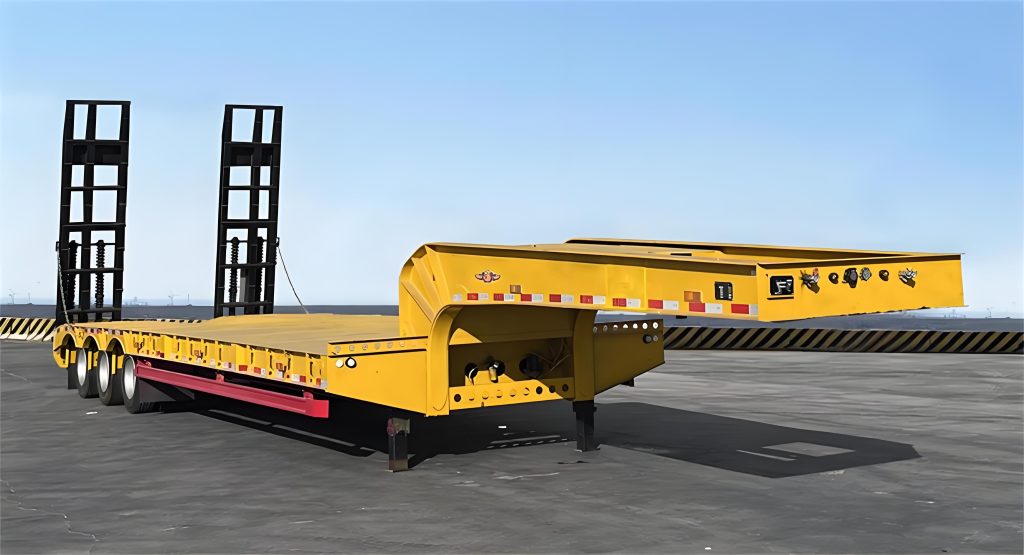
What is a Lowbed semi trailer?
A Lowbed semi trailer is a trailer designed for heavy-duty transport with a very low platform height, typically 800 to 1100 mm above the ground. This special low platform structure allows it to transport equipment exceeding the height limits of a standard lowbed trailer.
Lowbed trailer typically consist of the following components:
Gooseneck (removable or non-removable)
Main deck (working platform)
Rear frame
Heavy-duty axles
Hydraulic or mechanical suspension
Due to their low center of gravity, heavy duty Lowbed trailer offer exceptional stability when transporting extremely heavy or tall equipment.
Why heavy duty lowbed semi trailer are Crucial for Heavy Equipment Transport
2.1 Facilitates the Transport of Large Equipment
Most construction and mining equipment exceeds legal height limits when loaded onto standard flatbed semi trailers.
Truck lowbed trailer solve this problem with their ultra-low chassis, offering advantages such as:
Greater headroom
Safer transport
Capacity to move extremely large machinery
2.2 High Load Capacity
Depending on axle configurations, low-bed trailers can carry loads ranging from 30 to 150 tons or more.
Typical Capacity:
| Axle Configuration | Pay Load Capacity |
| 2 axle lowbed semi trailer | 30–45 tons |
| 3 axle lowbed semi trailer | 50–80 tons |
| 4 Axle Lowbed semi trailer | 80–120 tons |
| Multi-Axle Lowbed semi trailer | 150+ tons |
2.3 Safer on Uneven or Rough Roads
A lower center of gravity enhances 3 axle lowbed trailer stability, especially in situations such as:
cornering
driving on slopes
transporting large machinery
2.4 Durability and Long Service Life
Lowbed trailer are constructed with high-strength steel, such as Q345/Q550, offering advantages such as:
high impact resistance
excellent bending strength
long service life even under harsh conditions.
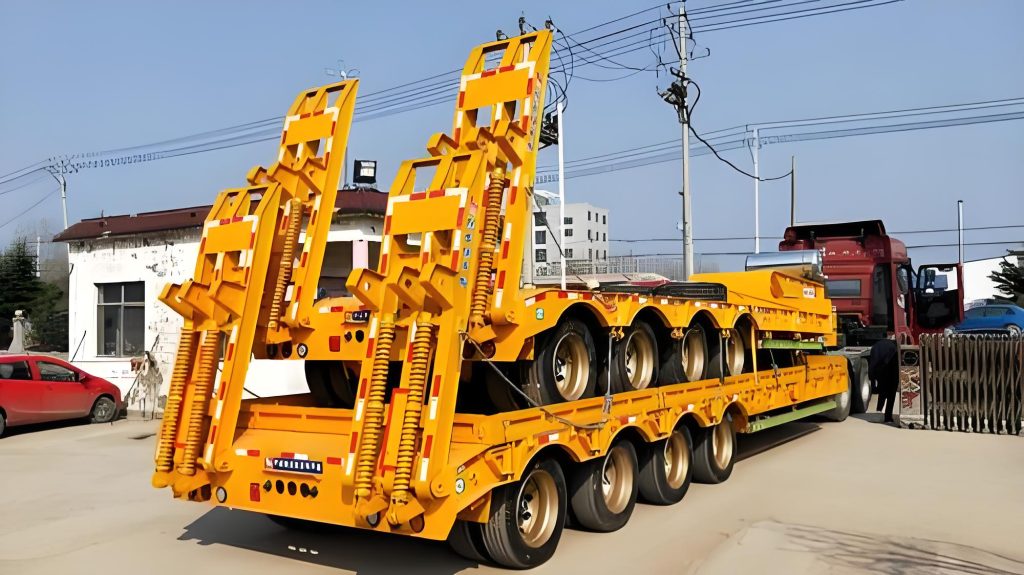
Main Components of lowbed semi trailer
To understand how lowbed trailer work, it’s essential to understand their main components:
3.1 Gooseneck Structure
Types include:
Removable gooseneck trailer(rgn lowbed trailer): Most commonly used for lifting heavy equipment from the front
Fixed neck lowbed trailer: Lower cost, but less convenient for loading
Detachable gooseneck lowbed trailer is ideal for excavators, bulldozers, and loaders.
3.2 Main Deck
This is the work platform specifically designed for loading machinery.
Common Length: 6 to 12 meters
Common Width: 2.8 to 3.5 meters
3.3 Rear Structure
Supports the wheels and suspension system, ensuring vehicle stability and load-bearing capacity.
3.4 Low bed semi-trailer Suspension Type
Mechanical spring suspension (cost-effective, durable)
Air suspension (smooth ride, height adjustable)
Hydraulic suspension (excellent option for heavy loads)
3.5 Low deck semi trailer Ramps
Spring terraces
Hydraulic ramps
Folding ramps
Removable ramps/ladders
These facilitate loading machinery onto the deck.

Types of lowbed semi trailer
4.1 Standard lowbed semi-trailer
Equipped with a fixed gooseneck; suitable for most machinery.
Best for:general machinery transport, most construction loads.
Not ideal for:loading from the front — use a detachable gooseneck.
4.2 Detachable lowbed trailer
Loadable from the front; ideal for large equipment.
Best for:excavators, bulldozers, loaders — drive on from the front.
Not ideal for:budget-focused fleets — slightly higher cost.
4.3 Extendable lowbed semi trailer
With decks extending to 20-30 meters, ideal for:
Wind tower sections
Long beams
Oversized building components
Best for:wind tower sections, long beams, oversized components (deck 20-30 m).
Not ideal for:standard machinery — a fixed model is cheaper.
→ Get an extendable lowbed quote
4.4 Multi Axle lowbed semi trailer,heavy duty lowbed trailer
Designed for extremely heavy loads (suitable for mining equipment, transformers, generators).
Best for:mining equipment, transformers, generators (150+ t).
Not ideal for:light loads — over-spec’d for normal jobs.
→ Get a multi-axle lowbed quote
Common Applications of semi trailer low bed
Lowbed semi trailer are widely used in:
Construction Projects
Transporting bulldozers, graders, excavators, and road rollers
Mining Operations
Moving large ore transport trucks, crushers, and drilling equipment
Energy and Power Projects
Transporting large transformers, turbines, and wind turbine components
Industrial Machinery Transportation
Moving large factory equipment
Agricultural Equipment
Mobile harvesters, tractors, and large agricultural machinery

Typical Technical Specifications
The following are reference specifications for a three axle 60 ton lowbed trailer :
| Item | Specification |
| Overall Length | 13,000 mm |
| Deck Height | 900 mm |
| Loading Capacity | 60 tons |
| Main Beam | Q345B high-strength steel |
| Axles | 3 Axles, 13 ton/axle |
| Suspension | Mechanical or Air |
| Tires | 12R22.5 |
| Ramps | Hydraulic or Mechanical |
| King Pin | 90# / 50# |
| Landing Gear | JOST 28 ton |
Loading Methods for lowbed equipment trailer
7.1 Loading with a Ramp
A rear ramp facilitates loading machinery onto the deck.
7.2 Using a Detachable Gooseneck Connector
Once the gooseneck is detached, the machine can be driven directly onto the deck from the front.
7.3 Using a Crane
For extremely heavy or difficult-to-move loads.
How to Choose the Right Lowbed Semi Trailer
Use this 5-step process — it is how we size a lowbed for a customer.
Step 1 — Your heaviest equipment.
Match deck width, height and load capacity to your largest machine.
Step 2 — Load capacity.
Never choose a “just enough” capacity — leave a 20-30% safety margin.
Step 3 — Gooseneck type.
Removable gooseneck (RGN) → heavy construction machinery, load from front. Fixed neck → more economical.
Step 4 — Steel & suspension.
High-strength steel (Q345/Q550) for durability; mechanical / air / hydraulic suspension per terrain and stability needs.
Step 5 — Local regulations.
Confirm axle weight, total height, and overall length comply with road law.
Not sure? Send your heaviest equipment and routes — we reply with a tailored configuration
and FOB quote.
Advantages of Purchasing lowbed semi trailer from China
China is one of the major exporters of lowbed semi trailer due to:
Competitive pricing
High-quality materials
Customizable axle configurations
Fast production times
Global parts supply
Many global buyers choose Chinese manufacturers because of their cost-effectiveness.
Conclusion
Lowbed semi-trailers are an essential solution for transporting heavy construction, mining, and industrial equipment. Their low chassis height, high load capacity, and robust steel structure ensure the safe, stable, and efficient transport of oversized equipment.
Whether you need a standard three axle lowbed semi trailer, a detachable gooseneck lowbed trailer, or a multi axle heavy-duty lowbed trailer , choosing the right model design can significantly improve your operational efficiency and transport safety.