

Multi-Axle Dump Trailer Tire Scrub on Tight Quarry Roads: Causes and Checks

A loaded six-axle dump trailer can leave a quarry loading face without any obvious problem, travel normally along the bench road, and then drag several tires sideways through one tight bend. In that situation, multi-axle dump trailer tire scrub does not automatically prove that the axles are out of alignment. A long rigid axle group naturally resists a small turning radius. However, pressure differences, suspension movement, road crossfall, sharp aggregate, or chassis geometry can turn ordinary lateral slip into costly and uneven tire wear.
The distinction becomes important during repeated quarry cycles. A trailer may cross long straight sections without leaving unusual marks, yet the rear axle group starts pushing sideways near a crusher entrance, switchback, weighbridge loop, or narrow stockpile lane. Fresh rubber appears on the surface, while selected tread shoulders begin looking polished or feathered.
At first, an alignment adjustment or another set of tires may seem like the obvious response. However, neither action identifies the cause by itself. A useful investigation connects the tread pattern with the exact wheel position, road geometry, cold inflation pressure, and the moment when lateral movement occurs.
That approach also prevents the opposite mistake. Not every scuffed tire can be dismissed as an unavoidable consequence of having many axles. When one wheel deteriorates much faster, feathering continues on straight roads, or the trailer starts tracking differently, the evidence begins pointing beyond ordinary turning geometry.
Start with one practical question
Does the abnormal wear follow a particular quarry maneuver, or does it follow the trailer everywhere? That distinction usually determines whether route geometry or chassis condition deserves attention first.
How Tire Scrub Presents on Tight Quarry Roads
Turning scrub rarely produces one perfect textbook pattern. Quarry surfaces combine lateral sliding, sharp stone, impact, ruts, and changing wheel loads. As a result, the same tire may show smooth polishing on one tread area and rough stone damage elsewhere.
Location therefore matters as much as appearance. When fresh abrasion develops mainly after one switchback or restricted loading turn, the road becomes part of the diagnosis. By contrast, wear that progresses continuously between those locations deserves a closer mechanical check.
Look across the complete axle group
One badly worn tire gives only a partial picture. Instead, corresponding positions on the left and right sides should be compared. Front, middle, and rear axle positions within the rigid group can also show different levels of lateral movement.
For example, several tires may show light transverse polishing while one axle shows much stronger abrasion. That pattern may still begin with the turn, but the unusually severe position deserves additional pressure, suspension, and alignment checks.
Polished tread blocks after repeated corners
Smooth lateral polishing can support a sliding contact pattern, especially when several axle positions show similar evidence.
Directional feathering on one position
A persistent sharp edge on one side of a tread rib deserves more attention around toe, axle position, and wheel-end condition.
Fresh rubber marks at the same corner
Repeated dark lateral marks connect the symptom to a specific operating maneuver and make route observation more valuable.
Irregular cuts and missing tread pieces
Sharp aggregate may be cutting the tire as it moves laterally, so stone damage and geometric scrub can exist together.
Loaded and empty cycles may look different
A laden trailer presses each contact patch more firmly into the quarry surface. Consequently, a tight turn may leave more obvious rubber distortion during the loaded outbound cycle than during the empty return.
Still, load condition alone cannot confirm the cause. Suspension movement can also become more pronounced under load. Therefore, observations should record whether the symptom occurs loaded, empty, or in both conditions.
The road surface should appear in the record as well. Hard compacted ground may leave smooth scrub marks, while coarse crushed stone can create rougher abrasion. That context makes later tire photographs much easier to interpret.
Why Long Rigid Axle Groups Resist a Tight Turn
A tire rolls most cleanly when the wheel points along its direction of travel. During a tight trailer turn, however, every axle wants to follow a slightly different circular path. A long rigid group cannot point every wheel toward its own ideal turning radius.
Instead, the wheels remain broadly aligned with the trailer frame. The contact patches then deform sideways as the trailer rotates through the bend. Some tread must release that deformation by sliding across the road surface.
Axle count is only part of the geometry
A 6 axle dump trailer can create substantial turning resistance when the rigid wheel group occupies a long section of the chassis. An 8 axle dump trailer can present an even more complex set of contact paths. Nevertheless, axle count alone cannot predict how severe the scrub will become.
Axle spacing, effective group length, suspension design, tire loading, road friction, tractor path, and any steering or lifting features all matter. Consequently, two multi-axle trailers with the same nominal axle count may behave differently through the same quarry bend.
Off-tracking can make the real radius smaller
The rear trailer wheels normally track inside the tractor path. Therefore, a bend that appears manageable from the cab may force the rear group much closer to the inside edge.
A late entry often makes the situation worse. The tractor clears the visible apex first, then a sharper steering correction becomes necessary. At that point, the rear group can experience its smallest effective radius even though the road looks wider farther ahead.
6 Axle Geometry Reference
See the Long Rear Axle Group in Context
The BOCA six-axle dump trailer provides a useful visual reference for the geometry discussed here. The image does not diagnose tire wear or establish the steering function of each axle by itself. Instead, it shows the length and concentration of the rear wheel group that should be considered when reviewing turning behavior on a confined quarry road.
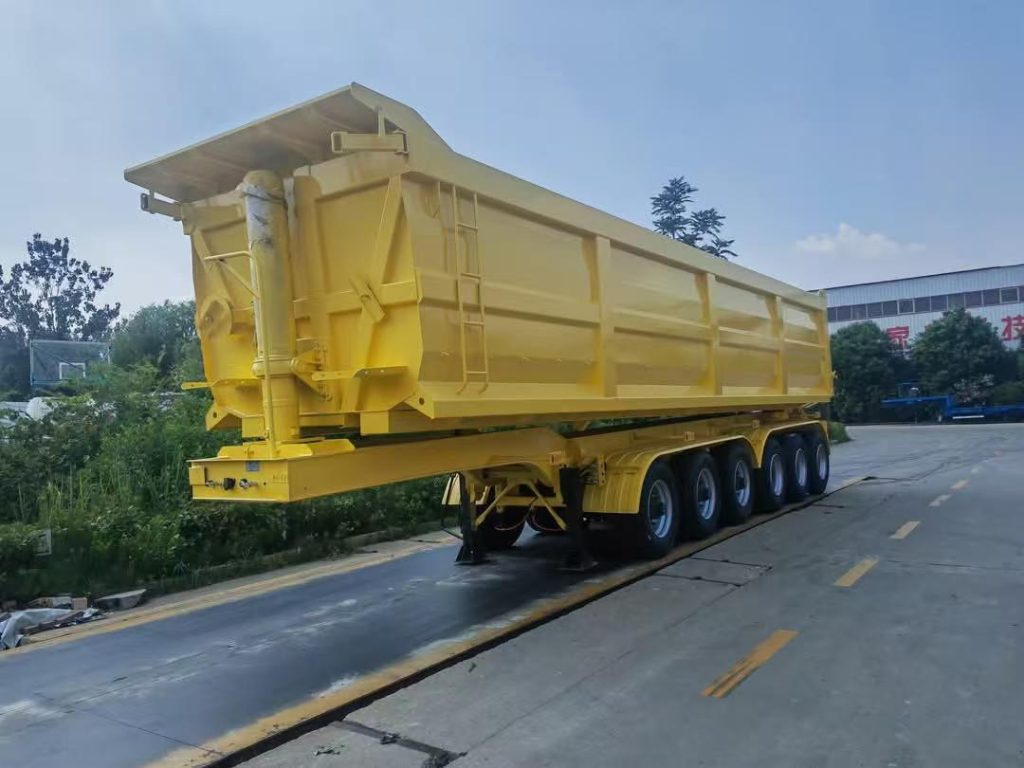
The long rear wheel group makes the turning relationship easier to visualize before route and alignment checks begin.
| View 6 Axle Dump Trailer |
Surface friction changes what the tires show
Hard dry ground resists lateral movement and can create clear polishing across the tread. Loose gravel behaves differently because some of the surface moves beneath the tire. As a result, road disturbance may become obvious even when the rubber looks less polished.
Wet fines create another condition. Lower friction can allow more sliding, while crossfall may shift the trailer outward. Therefore, limited visible abrasion should not be treated as proof that lateral forces are low.
Separate Normal Scrub From Alignment or Suspension Faults
Some lateral movement is a natural result of rigid multi-axle turning. However, persistent abnormal wear should never be explained away solely by axle count. A mechanical fault can add continuous sideways force to a trailer that already faces demanding turning geometry.
The best distinction comes from comparing operating conditions. Route-related scrub normally becomes strongest at specific corners. Alignment-related wear is more likely to continue on straight sections, wider curves, or different sites.
A useful field comparison
Mostly one tight corner: route geometry, surface friction, entry path, and rigid-axle behavior deserve attention.
Continues on straight roads: axle alignment, wheel-end condition, pressure, and suspension control become stronger suspects.
One wheel deteriorates much faster: the isolated position should be investigated instead of being grouped with ordinary turning scrub.
One abnormal axle changes the investigation
A skewed axle can create a thrust angle that pushes tires sideways during normal forward travel. Toe error may create directional feathering as well. In addition, wheel-end play or component looseness can change tire orientation under load.
Turning scrub can still be stronger at one part of the group because individual axle paths differ. Nevertheless, a dramatic difference between neighboring positions is harder to explain through road geometry alone.
Suspension movement may only appear during work
A parked trailer can look straight while worn components allow movement during braking, cornering, or travel across uneven ground. For that reason, suspension condition should be checked alongside static alignment.
Fresh metal contact, displaced paint, rust trails, loose hardware, worn bushings, damaged hangers, or changed ride attitude can all provide useful evidence. These signs matter because an alignment adjustment may not remain stable if the components holding that alignment continue to move.
Loaded and empty comparisons can help here. If one axle behaves differently only when the body is loaded, suspension movement or load sharing may need closer attention. The road condition should still remain part of the same investigation.
Inspect Tread Patterns, Axle Alignment and Tire Pressure
Useful evidence can disappear quickly after maintenance begins. Therefore, the original tire condition should be recorded before rotation, pressure changes, or chassis adjustment. Each image should identify the axle position and trailer side.
A complete tread photograph is more useful than an extreme close-up alone. Neighboring tires should also appear in the record. That comparison helps determine whether the symptom belongs to one wheel or the wider axle group.
Read the tread before changing the setup
- Lateral smearing supports sideways movement through the contact patch.
- Directional feathering can support further toe or alignment investigation.
- Uneven shoulder wear needs pressure, load, alignment, and road-condition context.
- Cupping or scalloping may justify wheel-end and suspension inspection.
- Random cuts and chunks can result from sharp quarry aggregate rather than pure scrub.
Rear Axle Group Reference
Inspect Tire Positions as One Group, Not as Isolated Wheels
This second view of the same six-axle trailer keeps attention on the rear running gear. During an actual tire-wear investigation, equivalent positions should be compared across the group before one damaged tire is treated as the whole diagnosis.
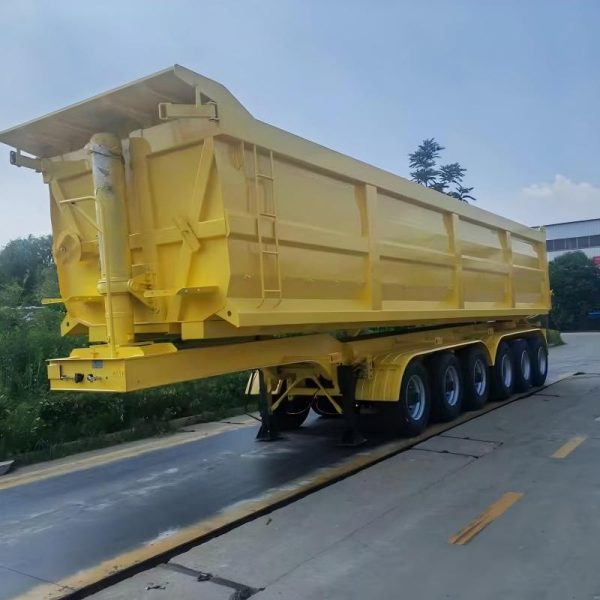
For field diagnosis, photographs should go further than this product view and capture each tread face, wheel position, and any visible suspension movement.
Tread-depth measurements add another layer. Several grooves across the tire should be checked consistently. More importantly, later inspections should use the same wheel positions and comparable measurement points.
One measurement shows condition at that moment. A short series shows the rate and direction of change. That progression can reveal whether a recent route modification, pressure correction, or chassis repair actually affected wear.
Record cold inflation pressure consistently
Inflation changes the contact patch and the way a tire deforms during a turn. Consequently, one low tire can show more shoulder movement than its neighboring positions and make an existing scrub pattern look worse.
There is no useful universal pressure value for every quarry trailer. The correct target depends on tire specification, actual loading, speed, and manufacturer guidance. Equivalent positions should therefore be compared under consistent cold conditions.
Slow pressure loss also deserves attention. A tire may still look inflated while operating differently for several haul cycles. Regular records often reveal that change before the visual wear becomes severe.
Do not diagnose chassis alignment from tread appearance alone
Tires can suggest where to look, but they cannot prove whether the trailer is square. Repeated directional wear may justify physical measurement of axle parallelism, thrust angle, wheel positions, trailer centerline relationships, and suspension mounting points.
Wheel ends deserve inspection at the same time. Bearing movement, rim damage, brake-related heat, or loose hardware can distort the wear picture. Therefore, a tire problem should not become an isolated tread-only inspection.
Where acceptable tolerances or safety-critical component condition are uncertain, the relevant chassis, suspension, axle, wheel, and tire manufacturer procedures should control the decision. Qualified measurement is preferable to assumed generic values.
Review Road Radius, Surface and Turning Technique
A mechanically sound trailer can still consume tires quickly on an unsuitable quarry route. Therefore, the road needs the same attention as the running gear. The useful measurement is the space the tractor and trailer can actually use, not simply the nominal width of the graded road.
A drainage channel can remove part of the outside approach. Likewise, a stockpile can narrow the exit while deep ruts force the wheels into one path. The result is a much smaller effective radius than a site drawing may suggest.
Observe the complete path through the corner
A safe observation point can reveal where the tractor starts turning, where the trailer begins off-tracking, and when lateral tire distortion becomes strongest. Often, the critical moment occurs after the tractor has already passed the visual apex.
Video can make this easier to review. A side or elevated view may capture the tractor entry line, the inside trailer path, braking, steering corrections, and visible tire deflection during the same maneuver.
Observation should never require standing inside an active vehicle path. Quarry traffic rules, exclusion zones, berm requirements, and site safety procedures remain controlling.
Surface condition can change during the same working week
A corner may behave differently after grading, heavy rain, or repeated loaded traffic. Hard compacted stone can increase friction, while loose material can shift beneath the tread. Deep ruts may also create sudden load transfers between neighboring axles.
Crossfall adds another influence. Tires on the lower side of the trailer can experience different loading as the combination moves through the bend. Consequently, one-side wear does not automatically prove that the axle is laterally misaligned.
Turning technique can intensify an already difficult corner
Late entry and abrupt steering corrections can reduce the effective radius available to the rear axle group. Likewise, nearly stationary pivoting can force the tread to twist strongly against a high-friction surface.
A smoother planned approach may reduce unnecessary corrections where the site layout permits. However, route markings, traffic separation, visibility, safe speed, and vehicle control always take priority over tire preservation.
Heavy braking while the tires are already moving laterally may add another source of tread stress. The observation record should therefore include braking and stop-start movement instead of treating steering angle as the only operating variable.
Reduce Exposure Through Route and Operating Controls
Once the strongest cause becomes clear, the most effective correction may not involve the tire itself. When the abrasion repeatedly follows one corner, reducing geometric severity at that location can address the source more directly.
The objective is to increase usable turning space rather than simply make the road appear wider. Extra width provides little benefit if drainage, berms, parked equipment, or the approach line prevent the tractor from using it safely.
Target the highest-frequency problem areas first
A moderately tight corner repeated throughout every haul cycle can create more cumulative abrasion than one extreme maneuver used occasionally. Therefore, frequency should be considered alongside severity.
The complete cycle should be mapped from loading to discharge. Crusher entrances, weighbridge approaches, stockpile loops, reversing areas, workshop access, and discharge points can all add smaller scrub events.
Practical route controls worth checking
- Restore usable corner width where ruts or eroded shoulders force a tighter path.
- Repair potholes near the apex that create sudden axle load transfer.
- Keep temporary stockpiles outside the intended turning envelope.
- Review whether queue positions restrict the tractor approach.
- Use clear approach guidance where a repeatable path improves the effective radius.
- Recheck critical corners after rain, grading, drainage work, or major surface changes.
Do not turn operating technique into the default explanation
A smoother path can reduce unnecessary lateral movement, but driving technique cannot correct a skewed axle or worn suspension mounting. Therefore, a single abnormal tire position still deserves mechanical investigation even when the corner itself is difficult.
Similarly, route improvement should produce evidence. Representative tread depths, photographs, pressures, and wheel positions should be recorded before the change. Later inspections can then show whether the wear rate actually decreased.
For broader configuration context, the BOCA dump semi trailer range provides a useful reference for mining, quarry, aggregate, and construction transport. Axle configuration and payload planning remain separate decisions from diagnosing an existing tire-wear problem.
When Repeated Scrub Requires Chassis Measurement
Light scuffing through an unusually tight corner may be consistent with rigid-axle geometry. However, rapid, concentrated, or changing wear needs a different response. Replacing tires repeatedly without measurement can hide a developing running-gear problem.
A sudden change is especially important. When the same trailer previously worked the same route without unusual wear, new feathering or tracking behavior indicates that something in the route, tire condition, chassis, or suspension has changed.
One axle wears much faster than neighboring positions
Alignment, suspension control, pressure, and wheel-end condition deserve direct measurement rather than an assumption about ordinary scrub.
Directional feathering continues on straight haul roads
Persistent straight-line wear increases concern around toe, axle parallelism, thrust angle, or movement under load.
The trailer begins tracking differently
A new off-center running tendency deserves checks around axle position, chassis reference, coupling geometry, and suspension condition.
Heat, looseness, noise, cracking, or visible movement appears
The issue has moved beyond ordinary tread abrasion and should follow the appropriate maintenance and technical inspection procedure.
Measure relationships, not one convenient distance
A useful chassis check considers how the axle group relates to the trailer structure. Depending on the configuration, that can include kingpin reference, trailer centerline, axle-to-axle parallelism, wheel positions, thrust angle, and suspension mounting locations.
Diagonal measurements can also help identify squareness concerns. Still, basic field measurements should not replace accurate alignment equipment when tire wear has become significant.
Inspect the structure holding the alignment
Alignment cannot remain stable if mounting components are moving. Bent brackets, worn bushings, displaced hardware, cracked mounting areas, or visible chassis deformation therefore change the priority of the investigation.
Any structural concern should follow the applicable manufacturer information and competent technical assessment. Generic repair dimensions or assumed tolerances are not suitable for safety-critical chassis work.
Tire condition can create an immediate stop point as well. Exposed cords, bulges, major cuts, tread separation, repeated pressure loss, or abnormal wheel-end heat require action under the relevant tire guidance, maintenance procedure, and local operating rules.
Field Investigation
Collect Enough Evidence to Connect the Tire, Trailer and Corner
A useful investigation does not need excessive paperwork. However, the information should make it possible to reconstruct what happened after the trailer leaves the site or reaches a workshop.
- Axle count and approximate axle spacing
- Exact affected wheel positions
- Full tread and close wear photographs
- Cold inflation pressure by position
- Loaded or empty operating condition
- Surface material and visible road condition
- Tightest recurring corner or switchback
- Direction of travel through the problem turn
- Any recent alignment, suspension, wheel-end, or route work
- A safe operating video showing the axle group through the turn
FAQ
Read the Wear Pattern Together With the Quarry Road
A tight quarry bend can create genuine geometric scrub even when the trailer remains mechanically sound. However, that explanation becomes weaker when one axle feathers continuously, inflation differs repeatedly, suspension components move, or abnormal wear continues away from the problem corner.
A strong diagnosis therefore connects tire evidence with actual operating conditions. Three actions provide a practical starting point:
- Document before changing anything: record wheel position, tread condition, cold pressure, load state, and clear photographs.
- Observe the actual turn: record the usable radius, surface condition, crossfall, steering correction, and visible lateral movement.
- Escalate when the pattern stops looking route-specific: sudden, directional, concentrated, or straight-line wear requires chassis and suspension measurement.
Quarry Duty Review
Match the Tire Evidence to the Actual Axle Group and Quarry Turn
A useful technical review starts with the information that changes the diagnosis: axle count and spacing, affected wheel positions, tread photographs, cold pressure records, road surface, load condition, and the tightest recurring bend.
A safe operating video adds important context because it can show trailer off-tracking, tire deformation, steering corrections, and the point where lateral movement becomes strongest. These details are more useful than a general description that the trailer is wearing tires.
For recurring multi-axle dump trailer tire scrub, the next step is to compare the wear map with chassis condition and the actual quarry maneuver. That comparison helps determine whether route control, tire maintenance, suspension inspection, or formal chassis measurement deserves priority. If a six-axle replacement or new-trailer configuration is also being evaluated, the product page below provides the relevant BOCA model reference.
| View 6 Axle Dump Trailer |