

5/7/8 Axle Lowboy Trailer: How Axle Spacing Changes Off-Tracking and Jobsite Turning Space

A heavy-haul combination can clear the highway and still fail at the final construction entrance. The tractor nose passes the gate, yet the rear axle group cuts toward a curb, drainage edge, barrier, or soft shoulder. That is where multi-axle lowboy off-tracking becomes a practical dispatch issue rather than a drawing-room detail. On 5, 7, and 8 axle layouts, axle spacing, tractor wheelbase, kingpin position, rear overhang, steering behavior, cargo projection, and usable site width all affect the path. The real question is whether the complete loaded combination can enter, turn, straighten, position, and leave without using space that the site cannot safely provide.
Why More Axles Change the Trailer Path Through a Turn
More axles change more than tire count. They can lengthen the rear running-gear group and change how that group follows the tractor through a bend. Two trailers with a similar overall length can therefore occupy noticeably different areas during the same entrance maneuver.
A long lowboy semi trailer does not simply copy the tractor path. The kingpin follows the tractor, while the trailer axle lines follow tighter arcs farther inside the bend. Meanwhile, the deck corners, rear structure, ramps, and cargo can create another envelope outside those tire paths.
A five-axle layout can already require careful planning when the effective axle group sits far behind the kingpin. The axle number alone cannot predict the result: a compact five-axle group and a widely spaced five-axle group can behave differently through the same gate.
The same principle becomes more obvious with seven- and eight-axle arrangements. A longer group may need more space to rotate through a sharp change in direction, while steering capability can alter that response. A route review therefore needs the real axle layout rather than a generic drawing labelled only by axle count.
What actually changes between 5, 7 and 8 axle layouts?
Moving from five to seven or eight axles does not create a fixed increase in turning space. A five-axle trailer with a stretched rear group may demand more inside room than another layout whose axles are arranged more compactly. What matters is where the group sits behind the kingpin and how far that group extends along the trailer.
On seven- and eight-axle configurations, steering architecture becomes even more important. A fixed group and a steerable or hydraulic-steering arrangement can follow noticeably different paths through the same entrance. That is why axle count is useful context for a buyer, but it is not a substitute for the actual geometry.
For a real project, the better comparison is whether each candidate layout can carry the required load while keeping inside cut-in, outside swing and straightening space within the site area that is genuinely usable. That keeps the discussion tied to the jobsite instead of turning five, seven and eight axles into a simplistic ranking.
The tractor can clear while the trailer still runs out of room
Consider a construction entrance beside a narrow access road. The tractor swings toward the far side, the front bumper clears the first gatepost, and the cab begins entering the site. From the front of the combination, the maneuver can already look successful.
The rear axle group, however, remains farther back on the original road. As the trailer rotates, the inside tires move toward the gate corner while the trailer tail can swing toward obstacles on the opposite side. Tractor clearance alone says very little about the full combination.
Cargo can enlarge this occupied area. An excavator counterweight, bucket, boom section, industrial frame, or other projection may become the widest point during the maneuver. In practice, the loaded outline can matter more than the nominal trailer width.
Axle count is context; geometry decides the turn
The useful dimensions are the kingpin position, tractor wheelbase, individual axle centers, overall axle-group spread, rear overhang, steering behavior, and loaded outer envelope. A simple axle number cannot replace those measurements.
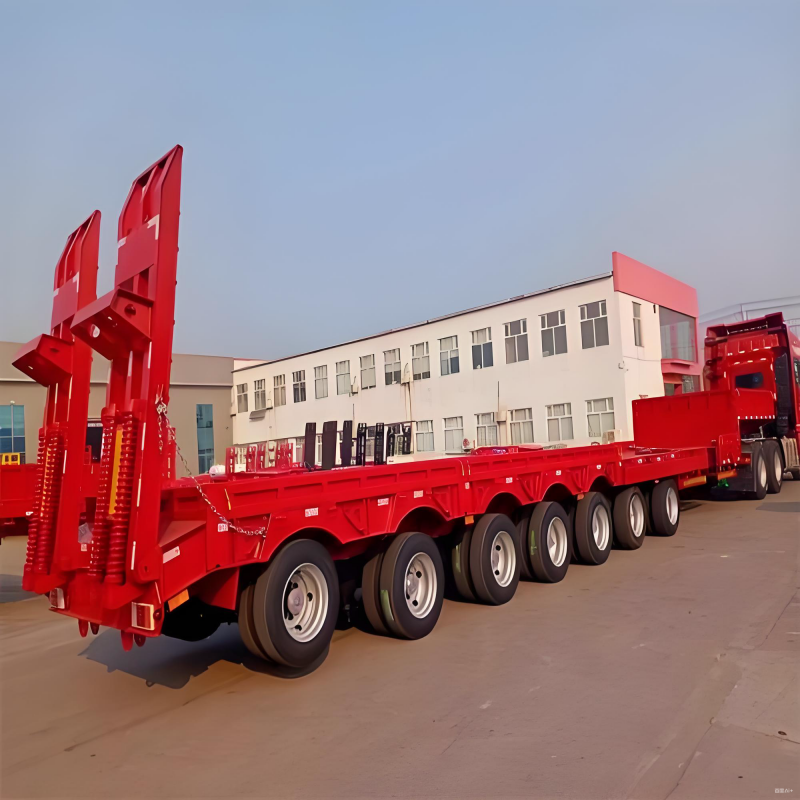
Define Off-Tracking for a Long Multi-Axle Combination
Off-tracking describes the difference between the path followed by the tractor and the path followed by the trailer. During a slow, tight turn, the trailer wheels normally cut toward the inside of the tractor path. This inward movement often turns an apparently generous entrance into a restrictive one.
A long multi-axle combination creates several paths at once. The tractor steer axle traces one arc, the drive axles follow another, and each trailer axle moves through a slightly different line. Meanwhile, the body and cargo occupy space beyond those tire tracks.
Inside cut-in is only half of the swept path
At a right-angle entrance, attention usually goes first to the innermost trailer tire. That makes sense because the tire may approach a curb, drain, soft edge, gate motor, fence base, or temporary barrier.
The opposite side of the trailer is moving too. Rear overhang can swing away from the turn direction, while the gooseneck or deck shoulder may sweep across additional space as articulation increases.
Turning radius and swept path are related but different concepts. A tractor can achieve a certain steering radius while the trailer still needs additional inside and outside clearance. A site plan showing one circle does not describe the complete movement.
The most restrictive point may come after the gate
Some entrances have enough room for the first steering movement but almost no distance for the combination to straighten afterward. The tractor passes the posts while the trailer remains highly articulated.
Then a stockpile, parked excavator, temporary office, building corner, or second bend appears ahead. In that situation, the first turn and the next movement cannot be assessed separately because the trailer carries its existing articulation into the next section.
Reverse positioning can increase the challenge further. Small tractor corrections may create larger angle changes farther back in the combination, so a planned reverse turn belongs in the route geometry rather than being treated as an informal correction after entry.
Collect Wheelbase, Axle Spacing and Steering Information
A reliable turning review begins with the actual dispatched combination. A drawing from a similar trailer can help with preliminary planning, but it should not become the final reference when clearance is limited.
Start with tractor wheelbase, overall tractor envelope, and fifth-wheel position. Steering information matters as well because a replacement tractor can change the entry setup even when the same lowboy remains assigned to the move.
Record the longitudinal position of each trailer axle from the kingpin. Individual axle spacing matters, not only the distance to the final axle. The overall spread between the first and last axle also helps explain how much road area the group may occupy while rotating.
Tractor geometry
Record wheelbase, overall length and width, fifth-wheel position, and the steering information relevant to the planned maneuver.
Trailer geometry
Record kingpin-to-axle dimensions, each axle center, total axle-group spread, trailer width, and rear overhang.
Loaded envelope
Add the real cargo position, maximum width, front projection, rear projection, and any attachment outside the normal trailer outline.
Site geometry
Measure clear gate width, usable approach width, opposite roadside limits, internal bends, straightening distance, surface edges, and temporary obstacles.
Measure usable space, not apparent space
A paved area may look wide in an aerial image while only part of it can support the planned maneuver. Open drains, weak shoulders, retaining edges, bollards, parked machinery, vegetation, and temporary fencing can all reduce usable width.
Gate width also needs context. A wide opening can still be difficult when the gate sits close to the opposite road edge. The distance available for the tractor to establish its turn can matter as much as the opening itself.
Photographs help explain details that measurements miss. A ground-level image can reveal a raised curb, soft gravel shoulder, drainage headwall, or sloping entrance. An overhead view can then show how those details relate to the road centerline and gate position.
Steering information can change the path completely
A fixed-axle group and a steerable multi-axle arrangement should not share the same path assumption. Where trailer axles steer, the actual control method and intended operating condition must be known before modelling the route.
Any axle operating condition must comply with destination-country regulations, permit requirements, manufacturer guidance, and applicable site procedures. Turning convenience cannot justify an operating configuration that is not permitted.
If critical dimensions remain unknown and the available margin appears small, the planning process has reached a clear stop point. Additional measurement, a scaled drawing, a controlled trial, or a competent swept-path review should come before dispatch.
Trace the Inside Path at Gates and Tight Bends
The inside path usually creates the first serious restriction at a construction entrance. For that reason, route planning should begin with the tightest gate or bend rather than the easiest section of the journey.
Mark the intended tractor approach and identify how much outside space exists before the turn starts. The tractor must move the coupling point far enough forward before the trailer begins cutting toward the inside corner.
Turning too early sends the trailer closer to the inside post. Turning too late may place the tractor nose against the opposite roadside limit. Entrance clearance depends on the complete setup movement rather than one steering angle.
Follow more than the last axle
Within a long rear group, the first, middle, and final axles do not follow exactly the same line. A drawing that represents every trailer tire with one rear reference point can hide part of the actual occupied area.
Instead, the review should trace the critical inside tire positions and then add the physical trailer outline. Cargo projection comes next. This order shows whether a tire, trailer structure, or cargo component becomes the limiting point.
The same logic applies at quarry switchbacks, mine roads, industrial yards, port approaches, and temporary civil works. A roadway may look broad between bends but narrow sharply at the inside apex.
Consecutive turns should be checked as one movement
A combination may clear the first corner but remain heavily articulated when the second corner begins. That retained angle changes the next tire path, so two bends separated by only a short straight section should be reviewed together.
The same problem occurs after a gate. If the tractor must immediately turn around a material pile before the trailer straightens, the entrance maneuver has not really finished.
Approach direction can change the available margin too. One direction may provide a broad shoulder for the tractor setup, while the opposite direction places a ditch beside the steer axle. The shortest route is not always the easiest route.
Four questions at every tight corner
- Where does the innermost trailer tire travel?
- Which trailer or cargo point creates the widest outer sweep?
- Can the tractor straighten before the next restriction?
- Does every planned tire path remain on suitable ground?
Check Swing-Out, Roadside Objects and Jobsite Surfaces
Inside cut-in receives most attention, yet outside swing can stop the maneuver just as quickly. As the trailer rotates, rear overhang can move toward fencing, barriers, parked machinery, an adjacent traffic lane, or a pedestrian area.
Cargo can enlarge that sweep. A machine attachment or industrial component may extend beyond the trailer side or rear, so the real loaded envelope should remain visible throughout the turning review.
Objects outside the tire path can still stop the move
Utility poles, gate motors, signs, lamp posts, retaining walls, security cabins, trees, and stored materials may stand well outside the planned tire path, yet the trailer structure or cargo can still sweep toward them as articulation increases.
Vegetation sometimes hides harder obstacles. A hedge may conceal a concrete post or drainage headwall, and loose material can cover the true pavement edge. A ground-level route walk remains useful even when aerial imagery is available.
Open ground is not automatically usable turning space
The swept path only works when the mapped area can physically support the maneuver. A tire line across structural pavement is very different from a line across wet fill, loose gravel, a drainage edge, or an unsupported shoulder.
Visible rutting, settlement, standing water, cracking, or loose ground should trigger closer review, but appearance alone cannot establish bearing capacity. If the route depends on uncertain soil or temporary support, qualified technical review should determine whether that surface can be used.
Crossfall and ramp transitions also matter. A low-deck trailer may clear the horizontal turn but approach a sharp surface break while still articulated. Ground clearance and turning geometry can become one combined site problem.
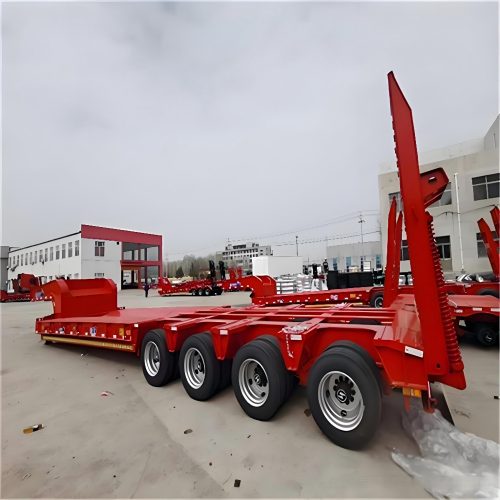
Operational conditions can reduce usable width further. A road that works on paper may become too narrow when parked equipment, active traffic, stored material, or pedestrian controls occupy part of the swept area.
Any planned use of public lanes, shoulders, or controlled site areas must follow applicable local regulations, permit conditions, traffic-management requirements, and site procedures. Geometry can show how much space the combination needs, but it does not authorize use of that space.
Use a Route Trial or Swept-Path Review Where Needed
Not every entrance requires formal vehicle simulation. A broad gate with generous clearance can often be screened with accurate measurements and a current site inspection, while tight margins and unusual multi-axle geometry deserve stronger verification.
A swept-path review models the tractor, coupling point, trailer geometry, axle positions, steering behavior, and loaded envelope through the proposed route. Its main value is showing where several constraints interact at the same time.
For example, the inside axle group may clear a curb only when the tractor uses most of the opposite side of the road. At that same point, rear swing may approach a fence. The route therefore works only if both clearances remain acceptable together.
Good modelling depends on accurate inputs
A precise-looking path can still be wrong when tractor wheelbase, kingpin location, axle spacing, or cargo outline is inaccurate. An aerial image without reliable scale may also place a curb or gatepost in the wrong position.
Constrained locations should use verified measurements or suitable survey data. The dispatched tractor and trailer should also match the geometry used during the review.
The broader BOCA lowbed trailer range provides useful reference points for different heavy-haul layouts. Even so, route analysis should use the dimensions of the actual project configuration.
A controlled trial can answer questions that drawings leave open
On a controlled private site, a planned route trial can show how the combination approaches a gate, where the critical inside tires travel, and how much space remains for straightening. Reference markers and photographs can also document the actual movement.
A route trial should not be used to discover whether weak ground, live traffic, an unprotected edge, or an unknown structural surface can tolerate the move. Those uncertainties need resolution before the trailer enters the restricted area.
An empty-trailer trial also requires interpretation. Cargo projection and loaded trailer attitude can change the real envelope, so the final cargo outline still belongs in the review even when a physical trial uses an unloaded combination.
Escalate the review when these conditions appear
- The gate leaves little margin after preliminary plotting.
- The axle group must run close to a curb, ditch, or weak shoulder.
- Rear swing approaches a fixed structure or traffic area.
- Two tight turns occur before the trailer can straighten.
- The cargo extends beyond the normal trailer envelope.
- A multi-point reverse maneuver forms part of the access plan.
- Site drawings are outdated, unscaled, or incomplete.
- Steerable trailer axles require configuration-specific modelling.
Prepare a Turning-Space Checklist Before Dispatch
A route review only remains useful while its assumptions still match the dispatched combination. Tractor substitutions, a changed cargo position, moved barriers, wet shoulders, or new construction activity can remove margin that existed during planning.
The final check should confirm both vehicle identity and current site condition. The goal is not to repeat the complete analysis; it is to confirm that the route has not changed in a way that affects the critical movement.
Confirm the exact combination first
The assigned tractor should match the wheelbase and coupling geometry used during planning. Likewise, the trailer should match the recorded axle arrangement and rear overhang. Any last-minute equipment change deserves another look at the tightest turns.
Cargo position also needs confirmation after loading. A machine moved rearward, a boom stored differently, or an attachment left in another transport position can change the swept envelope without changing the trailer itself.
Protect the turning area before arrival
A technically workable entrance can fail when a service vehicle parks in the tractor swing area or construction material appears beside the inside corner. The route should be cleared before the heavy-haul combination arrives.
The same-day surface check also matters. Rain, excavation, grading work, or repeated vehicle traffic may change a road edge quickly. If the planned line depends on a shoulder or temporary surface, suitability should be reconfirmed before movement.
Pre-dispatch turning-space check
- Confirm the exact tractor and tractor wheelbase.
- Confirm fifth-wheel and coupling position.
- Confirm the trailer axle arrangement.
- Confirm individual axle spacing and overall group spread.
- Confirm steering-axle operating condition where applicable.
- Confirm trailer width and rear overhang.
- Confirm final cargo width and projection.
- Recheck the gate opening and usable approach width.
- Keep the tractor’s outside setup area clear.
- Keep the inside trailer tire path clear.
- Check trailer and cargo swing on the opposite side.
- Confirm enough space remains for straightening.
- Inspect shoulders, drains, pavement edges, and temporary surfaces.
- Remove or control temporary obstacles before arrival.
- Set a stop point before the tightest constraint.
A defined stop point is especially useful. If the actual route no longer matches the plan, stopping before the gate preserves more recovery options. Once the long axle group enters a constrained area, reversing the complete combination can require more space than the original approach.
For repeated movements, route dimensions can become a useful baseline, but the baseline should not replace a current condition check. Construction, mining, industrial, and port environments can change much faster than the trailer specification.
FAQ
The complete path matters more than the axle number
A five-, seven-, or eight-axle lowboy can only be judged properly when the tractor, coupling point, trailer axles, rear overhang, cargo outline, and site geometry are considered together. Inside tire cut-in explains one part of the problem. Outside swing, surface limits, and straightening space explain the rest.
Before dispatch, three actions provide the strongest practical starting point:
- Record the exact tractor wheelbase, coupling position, trailer axle spacing, rear overhang, and final cargo envelope.
- Measure the entrance, usable approach width, tightest bend, straightening space, surface edges, and current obstacles.
- Escalate narrow or uncertain locations to a controlled route trial or competent swept-path review before the combination enters the constrained area.
When the entrance itself is the limiting factor, compare candidate trailer layouts against the same measured route rather than assuming that fewer axles will automatically solve the problem. A compact axle group, different kingpin-to-group geometry, or a steerable arrangement may change the path; if cargo projection or rear overhang creates the real restriction, axle count may not be the first thing to change.
Jobsite Turning Review
Match the Trailer Geometry to the Actual Entrance and Route
Useful project information includes axle count and axle spacing, tractor wheelbase, fifth-wheel position, trailer rear overhang, cargo width and projection, a current site plan, entrance width, the tightest bend, available straightening distance, and clear photographs of critical access points.
Those details allow candidate trailer layouts to be compared against the actual maneuver rather than a generic turning-radius assumption. They help identify whether the limiting factor is the tractor setup, inside axle path, rear swing, cargo envelope, usable ground, or the distance available to straighten before the next restriction.
Most importantly, multi-axle lowboy off-tracking should be resolved before the combination reaches the first restrictive gate. Planning the geometry in advance leaves far more options than discovering the problem after the rear axle group has already entered the turn.