
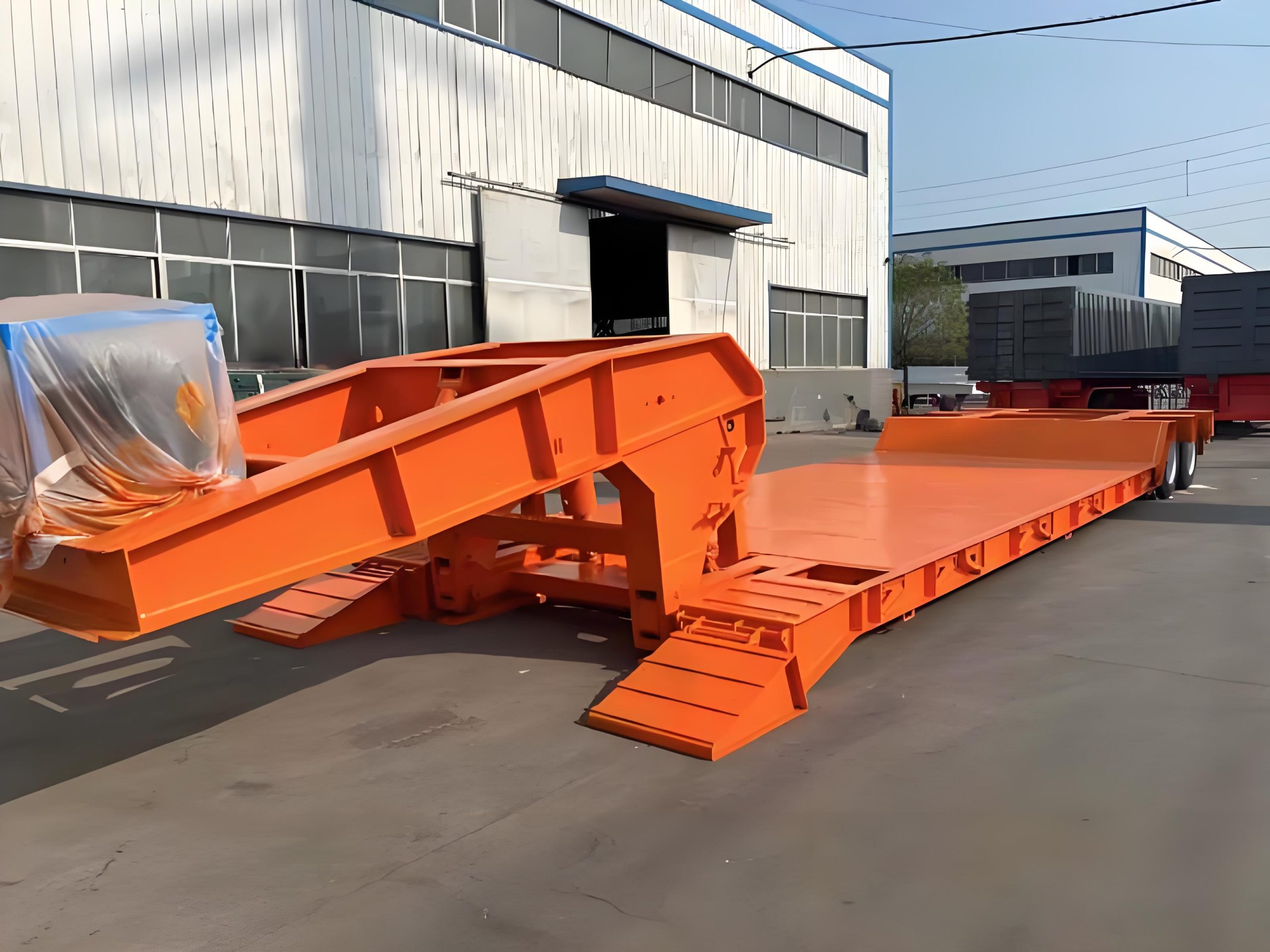
What Is RGN Trailer? The Complete Guide to Removable Gooseneck Trailers

Transporting oversized and overweight equipment requires specially designed trailers to ensure safety, stability, and efficiency. Among the many heavy duty transport trailer options available today, RGN trailer have become one of the most popular solutions for transporting construction machinery, mining equipment, agricultural machinery, and industrial parts.
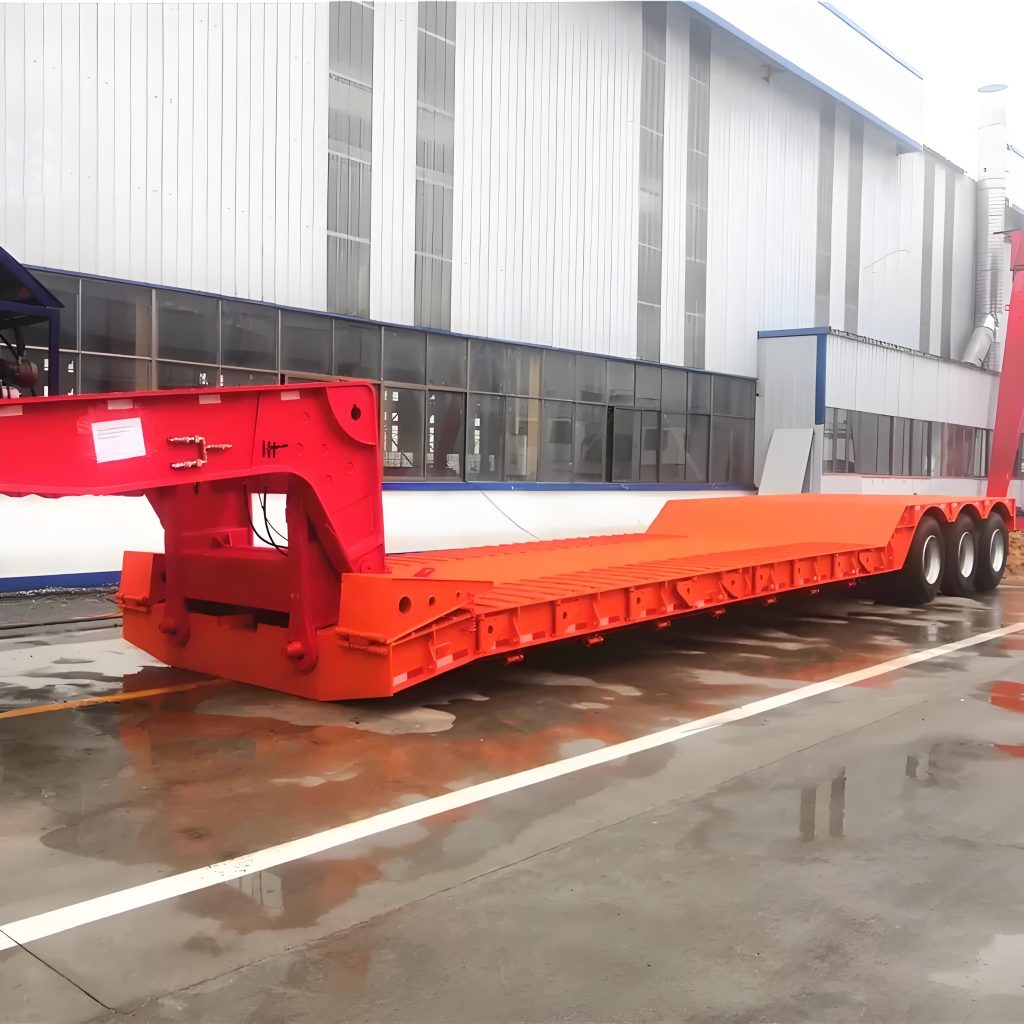
Removable gooseneck trailer, also known as detachable gooseneck trailer, feature a unique front gooseneck design that can be removed from the trailer chassis. This innovative design allows heavy equipment to be driven directly into the trailer from the front without having to climb steep loading ramps.
Compared to traditional lowbed trailers, RGN trailers load faster, at lower loading angles, offer greater operational safety, and are more efficient in transporting tall, heavy machinery.
Whether you are a fleet owner, equipment rental company, construction contractor, or heavy-duty transport logistics provider, understanding how rgn trailer for sale work will help you choose the right trailer for your transport needs.
In this comprehensive guide, you will learn everything about RGN trailers, including how they work, their structural components, advantages, applications, load capacity, and how to choose the most suitable detachable gooseneck trailers for your business.
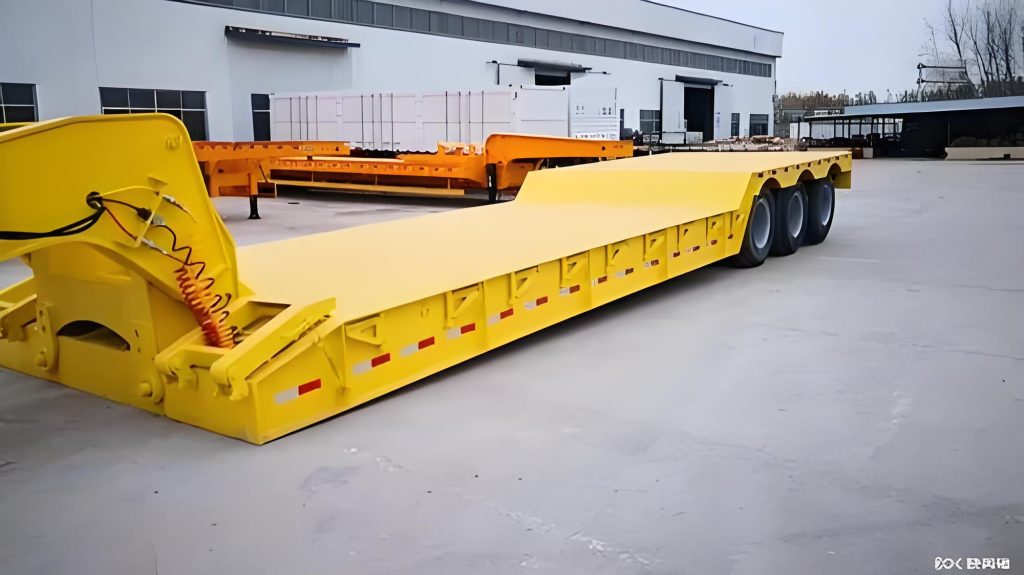
What Does RGN Mean?
RGN is an abbreviation for Removable Gooseneck Trailers.
The name comes from the trailer’s removable front structure (called the gooseneck), which connects the trailer deck to the towing truck. Unlike traditional fixed-neck trailers, RGN trailer allow the gooseneck section to be completely removed.
With the neck removed:
The front of the trailer is in direct contact with the ground.
Heavy equipment can be driven directly onto the deck.
No loading/unloading ramps are required.
Loading and unloading is safer and more efficient.
Due to this unique design, removable gooseneck trailer rgn are widely used in the heavy transport industry.
Many customers also use other names to refer to RGN trailers, including:
Removable Gooseneck Trailer
Detachable Gooseneck Trailer
Detachable Neck Trailer
RGN Lowboy Trailer
Hydraulic Gooseneck Trailer
Mechanical Gooseneck Trailer
Although these terms differ slightly, they generally describe the same trailer concept.
What Is an RGN Trailer?
RGN trailer are low profile heavy duty semi trailer designed specifically for transporting oversized and overweight equipment.
Their most distinctive feature is the detachable gooseneck design, which allows the trailer deck to be lowered to ground level for self-unloading.
Unlike standard flatbed semi trailer or fixed lowboy trailer detachable gooseneck trailer for sale eliminate the need for external cranes or loading/unloading ramps in many situations.
RGN trailer typically transport equipment including:
Hydraulic excavators
Bulldozers
Wheel loaders
Motorized graders
Road rollers
Asphalt pavers
Mobile cranes
Forestry equipment
Agricultural tractors
Mining machinery
Wind turbine components
Industrial transformers. Depending on the axle configuration, detachable trailer can transport cargo ranging from 30 tons to over 200 tons.
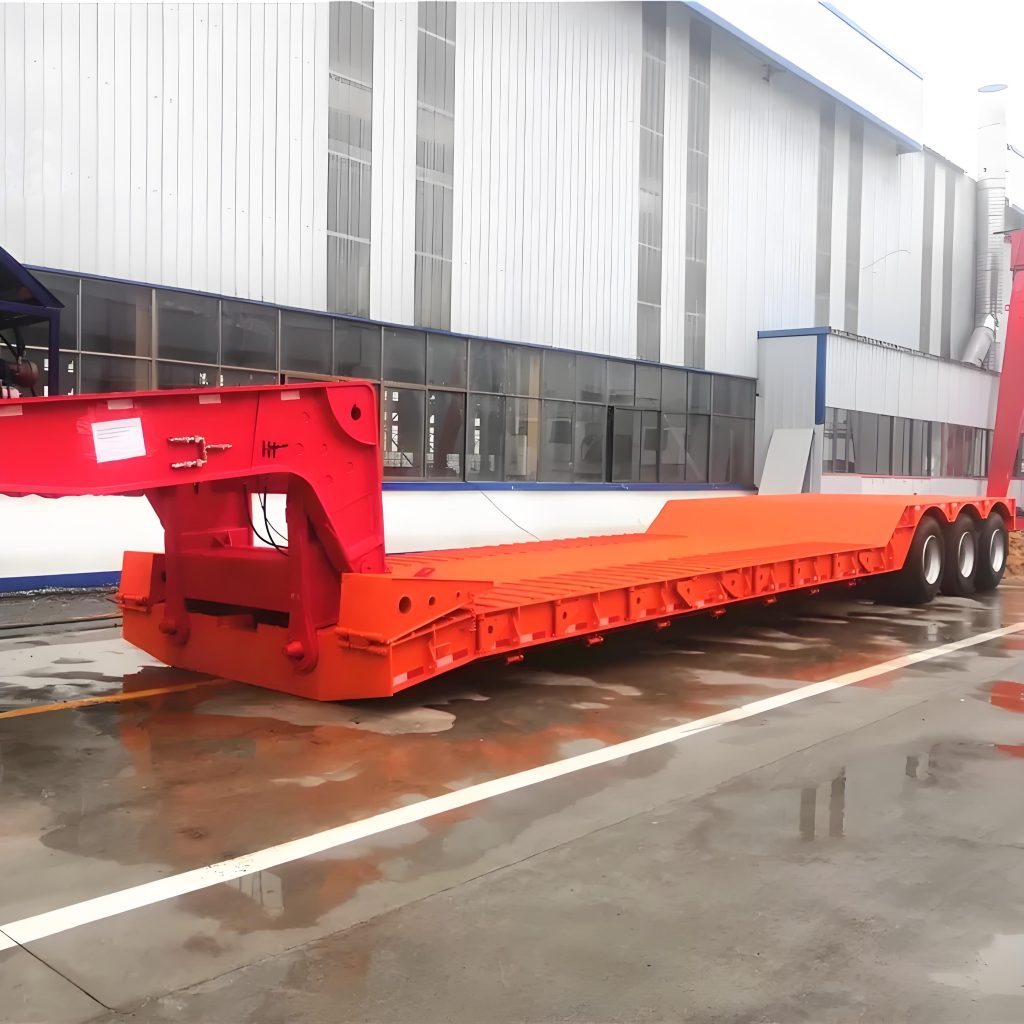
Why Is an RGN Trailer So Popular?
Heavy equipment transportation faces numerous challenges:
Large machine weight
High overall height
Large size
Safety during loading
Road regulation compliance
High transportation efficiency
The detachable gooseneck trailer solves all of these problems.
Compared to conventional trailers, it offers the following advantages:
Lower loading height
Lower center of gravity
Better stability
Easier equipment loading
Faster turnaround time
Higher load capacity
Reduced accident risk
These advantages make the rng trailer one of the most widely used heavy duty transport trailers in industries such as construction, mining, energy, and infrastructure development.
How Does a Removable Gooseneck Trailer Work?
The working principle of the detachable gooseneck trailers for sale is surprisingly simple, yet extremely efficient.
Instead of using a loading ramp at the rear, the trailer detaches from the tractor at the front.
The trailer deck is then lowered until it touches the ground.
Heavy machinery drives directly onto the deck.
Once loading is complete, the tractor reconnects the gooseneck boom and lifts the trailer back to its transport position.
This process significantly reduces loading time while improving operational safety.
Step 1: Parking the Trailer
The tractor places the RGN trailer on a flat and stable surface.
The hydraulic or mechanical locking system is ready to be released.
A safety check is performed before removing the neck.
Step 2: Removing the Gooseneck Boom
The operator disconnects the gooseneck boom using:
Hydraulic cylinder
Mechanical locking pin
After the neck is removed:
The trailer deck slowly lowers to the ground.
The tractor drives away.
The loading platform is fully accessible.
This is precisely where the detachable lowboy trailers for sale differs significantly from traditional low-bed trailers.
Step 3: Loading the Equipment onto the Trailer
Heavy machinery is driven directly from the ground onto the trailer deck.
No ramps are required.
Examples include:
Excavators
Bulldozers
Crane
Pavers
Wheel loaders
Due to the extremely shallow loading angle, the risk of equipment touching the ground or slipping is minimal.
This also protects the chassis and tracks from damage.
Step 4: Securing the Equipment
After loading:
Operator uses:
Heavy-duty chains
Ratchet straps
Wheel stops
Securing straps
Proper cargo securing ensures compliance with transport regulations and improves road safety.
Step 5: Reinstalling the Gooseneck
The tractor truck reconnects the detachable neck.
Hydraulic cylinders are used to lift the trailer.
The locking mechanism can be operated automatically or manually.
The trailer is now ready for road transport.
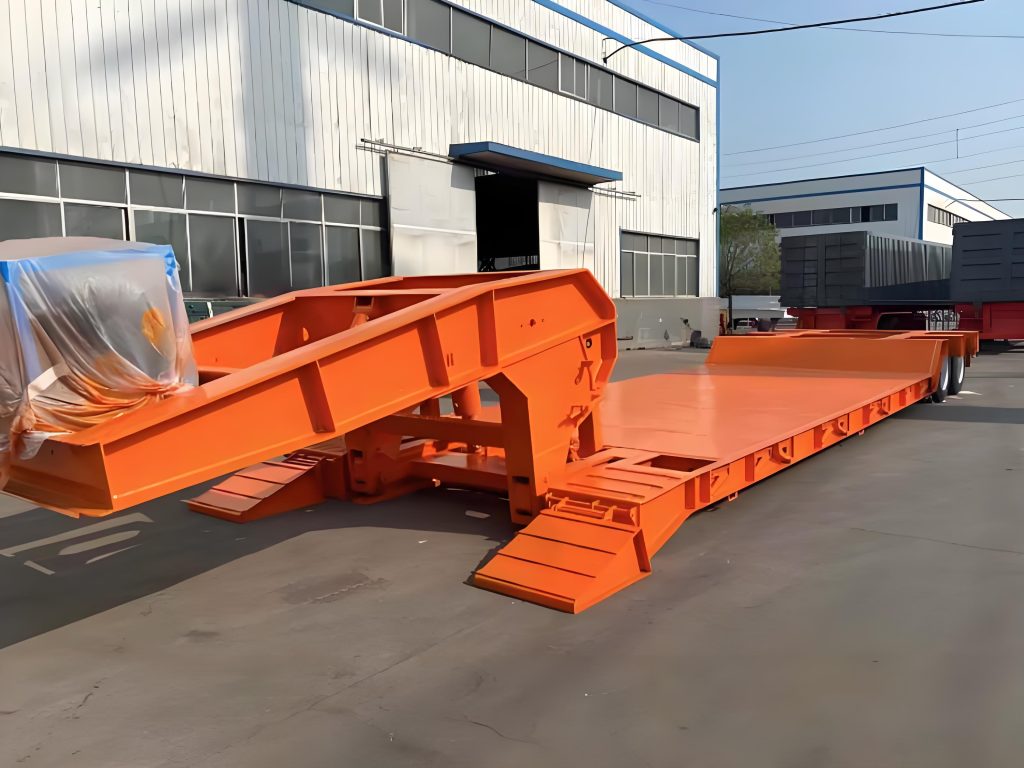
Main Components of an RGN Trailer
While different manufacturer offer customized designs, most RGN trailer share the same structural foundation.
Understanding these components helps buyers assess the trailer’s quality and durability.
Gooseneck
The gooseneck connects the trailer to the tractor.
This is a key feature of every detachable gooseneck lowboy trailer.
Types include:
Hydraulic Gooseneck
Advantages:
Quick operation
Low labor intensity
Remote control
Higher efficiency
Suitable for frequent loading
Mechanical Gooseneck Design
Advantages:
Lower procurement cost
Easier maintenance
Reliable mechanical locking
Suitable for light-load applications
Main Beam
The main beam is the structural support frame of the trailer.
It can bear the full weight of the cargo.
High-end manufacturers typically use:
High-strength Q550 steel
Q690 steel
T700 high-strength steel
High-strength steel offers:
Greater load capacity
Reduced trailer weight
Enhanced fatigue resistance
Longer service life
For heavy-duty RGN trailers, welded I-beam structures are typically used to maximize bending and torsional strength.
Low Deck
The lower deck is where heavy machinery is loaded.
A lower deck offers several advantages:
Lower center of gravity
Enhanced stability
Higher legal transport height
Easier loading
Improved road safety
Many rgn lowboy for sale are equipped with hardwood decks or high-strength steel floors with anti-slip surfaces.
Axles
Axle configuration determines the trailer’s load capacity.
Common configurations include:
| Axles | Typical Capacity | Typical Applications |
| 2 Axles | 30–40 Tons | Small equipment |
| 3 Axles | 50–70 Tons | Excavators, Loaders |
| 4 Axles | 80–100 Tons | Bulldozers |
| 5 Axles | 100–120 Tons | Large construction equipment |
| 6 Axles | 120–150 Tons | Mining machinery |
| 7–10 Axles | 150–250+ Tons | Extreme heavy haul |
Suspension System
The suspension system absorbs road impacts, protecting the trailer and cargo.
Common options include:
Mechanical Suspension
Advantages:
Simple design
Low maintenance
Affordable
Air Suspension
Advantages:
Better ride quality
Enhanced cargo protection
Reduced vibration
Extended tire life
Hydraulic Suspension
Typical for multi axle heavy duty lowbed trailer.
Advantages:
Automatic load balancing
Superior stability
Adjustable ride height
Excellent performance on uneven surfaces
Braking System
Safety is paramount when transporting heavy loads.
Most modern detach lowboy trailer are equipped with:
Dual-line air brakes
ABS (Anti-lock Braking System)
WABCO brake components
Emergency parking brake
Automatic tension adjuster
These systems ensure reliable braking performance even when carrying extremely heavy equipment.
Tires and Wheels
Heavy-duty radial tires are typically used to withstand high axle loads and long-haul transport.
Common tire sizes include: 235/75R17.5, 245/70R17.5, 275/70R22.5, and 315/80R22.5.
For special heavy-duty transport applications, some detach lowboy trailers for sale also feature hydraulic axles with independent wheel suspension to distribute weight more evenly.
RGN Trailer Dimensions
One of the biggest advantages of detached trailer is their flexibility. Manufacturers can customize trailers to suit different transport needs, equipment dimensions, and local road regulations.
While dimensions vary between models and axle configurations, most detachable gooseneck trailers adhere to standard heavy-duty transport specifications.
Standard RGN Trailer Dimensions
| Specification | Typical Size |
| Overall Length | 13–22 m (43–72 ft) |
| Overall Width | 2.5–3.5 m (8.2–11.5 ft) |
| Deck Length | 7–12 m (23–39 ft) |
| Deck Width | 2.5–3.2 m |
| Loaded Deck Height | 450–650 mm |
| Ground Clearance | 150–300 mm |
| King Pin | 2″ or 3.5″ |
| Gooseneck Length | 3–4.5 m |
One reason for the popularity of removable gooseneck trailer for sale is their extremely low platform height.
The lower deck offers several advantages:
Transporting tower crane machinery while adhering to legal height restrictions.
Improved vehicle stability during transport.
Lower center of gravity, enhancing safety during turns.
Reduced route permit requirements due to excessive height.
For oversized cargo such as drilling platforms or large mining equipment, every centimeter of transport height is crucial. gooseneck rgn trailers can typically transport machinery exceeding the legal height limits of standard flatbed trailers.
Types of Removable Gooseneck Trailer
Different transport tasks require different trailer configurations. Today, manufacturers offer a variety of rgn lowboy for sale designed for specific industries and applications.
Mechanical RGN Trailers
Mechanical detachable gooseneck trailer use a combination of manual locking pins and a mechanical system to detach the gooseneck.
Advantages
Low purchase cost
Simple structure
Easy maintenance
Reliable performance
Suitable for occasional heavy-load transport
Applications
Construction companies
Equipment rental companies
Local transport
Hydraulic RGN Trailers
Hydraulic detachable gooseneck trailer utilize hydraulic cylinders to quickly detach and reattach the gooseneck.
Advantages
Faster loading
Less manual labor
Higher efficiency
Better safety
Ideal for frequent loading operations
Applications
Heavy transport fleets
Mining companies
Infrastructure contractors
Wind energy transport
Extendable RGN Trailer
Some oversized cargo exceeds the length of a standard trailer.
RGN stretch trailer allow the deck to extend, providing additional loading space.
Typical cargo includes: Wind turbine blades, steel beams, bridge trusses, large pipelines, and industrial storage tanks. Trailer lengths can typically be extended by 5 to 20 meters depending on the design.
Multi-axle RGN trailer:
Additional axles are required when transporting equipment weighing over 150 tons.
Multi axle detachable gooseneck trailer offer:
Greater load capacity, better weight distribution, lower axle load, and greater road adaptability. These trailers are commonly used in:
Mining, Petrochemical projects, Power plants, Shipbuilding, and Offshore engineering.
RGN Trailer vs Fixed Lowboy Trailer
Many buyers are hesitant between choosing an removable goose neck or a traditional lowboy trailer.
While both have lower deck heights, they differ significantly in loading methods and operational efficiency.
| Feature | RGN Trailer | Standard Lowboy Trailer |
| Gooseneck | Removable | Fixed |
| Front Loading | ✔ Yes | ✘ No |
| Rear Loading | Optional | ✔ Yes |
| Loading Ramps Required | No | Yes |
| Loading Angle | Very Low | Steep |
| Loading Speed | Fast | Moderate |
| Safety | Excellent | Good |
| Suitable for Tall Equipment | Excellent | Good |
| Heavy Equipment Transport | Excellent | Good |
| Purchase Cost | Higher | Lower |
| Maintenance | Moderate | Lower |
When to Choose an RGN Trailer
If you frequently transport the following items, choose an removable gooseneck trailer:
Bulldozers
Excavators
Crawler loaders
Pavers
Large cranes
Mining machinery
The front-mounted design significantly reduces loading time and the risk of equipment damage.
When to Choose a Lowboy Trailer
A standard fixed lowbed trailer may be more suitable if:
Infrequent equipment loading
Limited budget
Relatively small cargo
Sufficient rear ramp.
RGN Trailer vs Step Deck Trailer
Although both trailers are commonly used in freight transportation, they serve completely different purposes.
| Feature | RGN Trailer | Step Deck Trailer |
| Deck Height | Very Low | Medium |
| Gooseneck | Removable | Fixed |
| Heavy Machinery | Excellent | Limited |
| Self-Loading | Yes | No |
| Loading Ramps | Not Required | Usually Required |
| Payload | 40–300+ Tons | 20–40 Tons |
| Oversized Cargo | Excellent | Limited |
| Construction Equipment | Ideal | Not Recommended |
| Agricultural Machinery | Excellent | Moderate |
| General Freight | Limited | Excellent |
Step deck semi trailers primarily suitable for palletized cargo, building materials, and machinery that load by forklifts.
On the other hand, RGN trailers design and manufacture specifically for transporting large and self-propelled equipment.
If your cargo includes towed machinery, an RGN trailer is almost always the best choice.
Which trailer is right for your business?
Choosing a detachable gooseneck trailer, a fixed lowbed trailer, or a step deck trailer depends on your operational needs.
Consider the following questions:
Do you frequently transport trailers?
Is loading and unloading speed a priority for you?
Do you need to transport oversized or overweight cargo?
Are there legal height restrictions on your transport routes?
How many times will the trailer be used?
If you answered yes to most of these questions, then investing in a detachable gooseneck trailer will significantly improve efficiency, safety, and long-term operating costs.