

Side Loader Container Trailer: How Yard Layout Affects Self-Loading Efficiency

A side loader can reach the correct container and still lose time before lifting begins. The tractor may need several corrections to straighten, a nearby container row may block stabilizer deployment, or a drainage edge may remove usable ground from the working area. In practice, a well-planned side loader yard layout determines whether self-loading becomes a repeatable transport process or a sequence of small delays. The useful question is not simply whether the trailer fits. It is whether the complete approach, setup, lift, recovery, and exit cycle fits without improvisation.
The yard has to fit the whole cycle, not only the trailer
Approach angle, stabilizer space, container position, ground support, surrounding traffic, and the departure route all influence the same self-loading cycle. A bay that works only after nearby equipment moves is not truly independent.
Why Yard Geometry Controls Self-Loading Productivity
Self-loading uses more space than the trailer footprint suggests. The tractor needs room to approach and straighten. Meanwhile, the trailer needs a stable lifting position with enough lateral space for the lifting system and stabilizers.
A lane can be wide enough for ordinary driving but still be inefficient for container self-loading. The difference often appears during the final alignment. The tractor enters comfortably, yet the trailer cannot become parallel with the container without repeated forward and reverse corrections.
A familiar depot situation illustrates the problem. Containers sit neatly along one boundary, while an internal traffic lane runs beside them. On paper, the arrangement looks compact and efficient. During pickup, however, a parked chassis narrows the steering area just as the tractor starts to straighten.
The lift has not started, but the cycle is already longer. Another vehicle may now be waiting behind the combination. A small geometry problem has become a traffic-flow problem.
Measure the operating envelope, not only the parking bay
A useful yard review separates the operation into several spaces. These include the approach lane, tractor turning area, final trailer position, stabilizer area, container movement zone, exclusion area, and departure path.
Each space needs to remain available during the same cycle. For example, a wide exit road provides little benefit if stabilizer deployment blocks the only internal lane used by other vehicles.
Storage density needs the same context. More containers per square metre may appear efficient. But dense rows can lower actual throughput when another container, empty chassis, forklift, or parked tractor must move before every pickup.
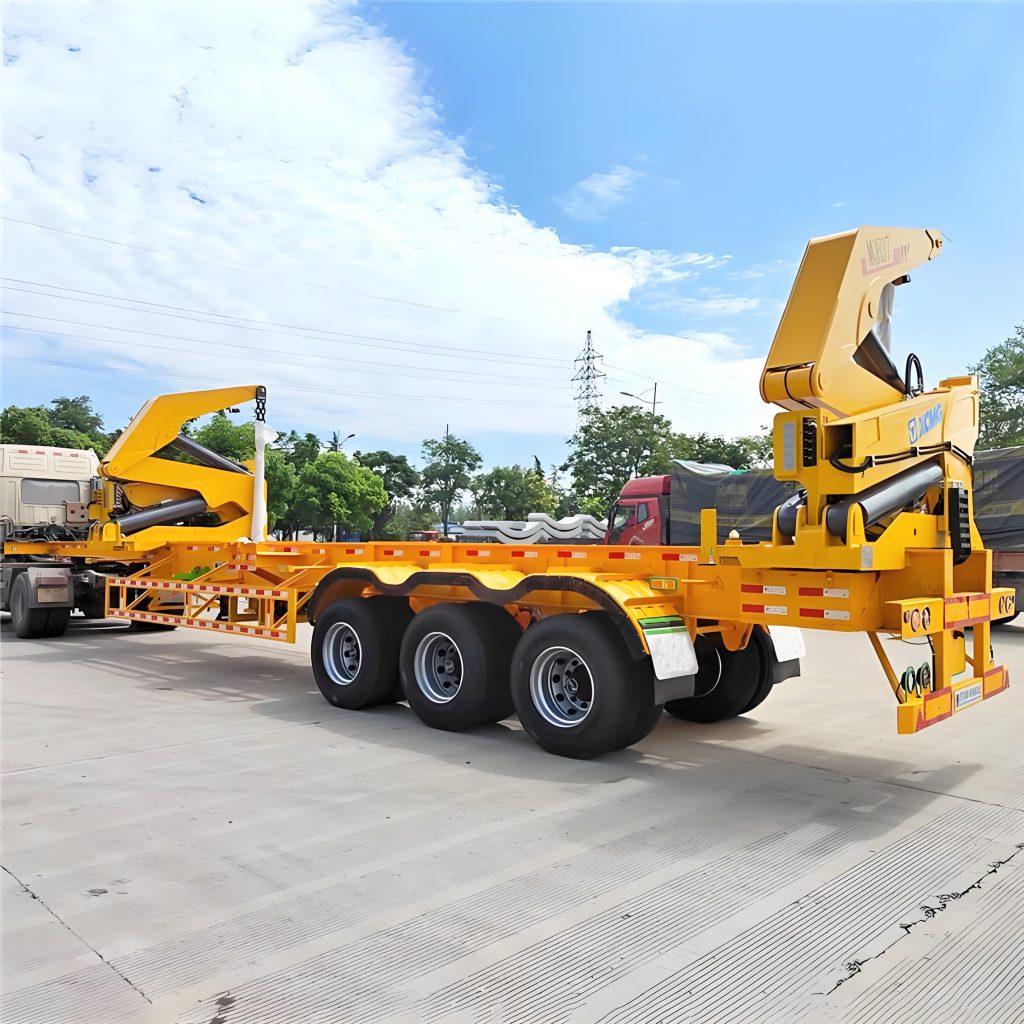
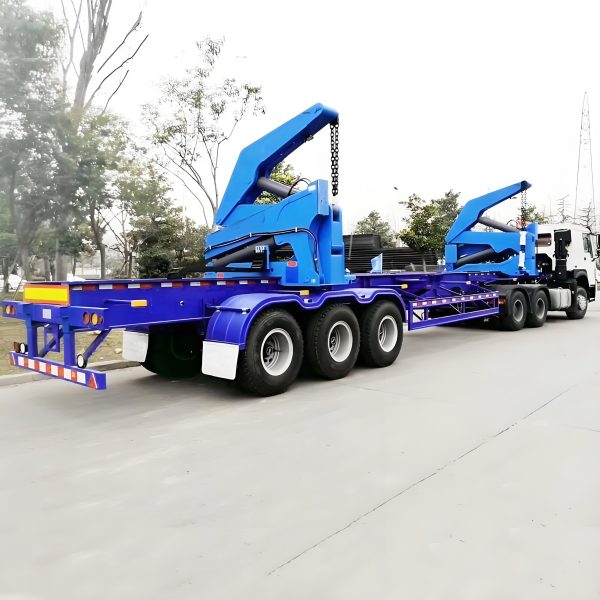
For operations considering side loader container trailer solutions, the operating site should be considered together with the equipment. The trailer, container position, access lane, lifting space, and traffic pattern have to function as one system.
Map the Container Position, Approach Lane and Exit Path
A practical layout review starts at the container position and works outward. First, mark the actual container orientation and intended lifting side. Then trace the tractor path backward toward the yard entrance.
This method quickly exposes difficult final approaches. A combination may have enough space to reach the area but still lack the angle required to straighten beside the container.
The last part of the approach often controls the cycle
Long straight lanes rarely create the biggest problem. Instead, difficulties appear near the pickup point. A building corner, curb, fence, opposite container row, or parked equipment can remove the steering space needed for the final correction.
Effective lane width matters more than nominal pavement width. Drainage channels, pedestrian separation, wheel stops, lighting columns, barriers, and no-parking areas all reduce the surface actually available for maneuvering.
Container position affects the same decision. When units sit at different angles or orientations, each pickup needs a slightly different approach. Over repeated daily movements, those corrections can become a meaningful source of lost time.
Plan the departure before approving the lifting position
A convenient lifting position can still create a poor exit. After the container reaches the trailer, the combination should be able to leave through a predictable route without immediately reversing into another working area.
Where site geometry allows, a drive-through pattern generally creates simpler flow. The tractor enters, aligns, completes the transfer, and continues toward the exit. In contrast, a dead-end bay adds reversing, visibility, traffic-control, and queue-management requirements.
Peak operating conditions should also appear on the yard plan. A lane that looks open during a quiet inspection may carry terminal tractors, forklifts, empty chassis, warehouse traffic, or gate queues during the normal dispatch period.
For that reason, the proposed self-loading route should be checked during a representative busy period. A loading zone that functions only when surrounding activity stops may not deliver the intended operating flexibility.
Reserve Stabilizer and Lifting-Side Clearance
The lifting side is not ordinary parking clearance. It is an active working zone. During a transfer, the stabilizers, lifting equipment, lifting connections, and container all require controlled space.
Clearance should never be estimated from trailer width alone. Final working requirements need to follow the operating envelope and instructions for the actual side-loading configuration.
A common layout mistake is to leave an apparently generous strip beside the trailer while overlooking a low obstruction. A guardrail, curb, drain, concrete barrier, service box, or container corner can interfere with stabilizer placement even when the trailer body clears it easily.
The reverse can happen above ground. A clear pavement area may still sit beneath a roof projection, tree branch, cable, or adjacent container stack. Both plan view and vertical clearance matter.
Keep temporary yard activity outside the lifting envelope
Temporary obstacles often create more difficulty than permanent structures. Pallets, maintenance equipment, waste bins, parked tractors, empty chassis, construction materials, and mobile equipment can gradually occupy space that originally belonged to the lifting operation.
Pedestrian and vehicle routes need deliberate separation as well. A shortcut beside the trailer may cross the stabilizer or container movement zone. Likewise, forklifts or terminal tractors should not pass through the active lifting envelope during a transfer.
Clear space also improves repeatability. When the stabilizer area remains predictable, the tractor can settle into the intended position without several small corrections.
By contrast, marginal clearance encourages repeated forward and reverse movements before setup. Those movements extend cycle time and may temporarily block nearby traffic.
Check Surface Strength, Slope and Overhead Obstacles
Horizontal space is only one part of the setup. The same bay also needs suitable ground support and a clear vertical operating envelope.
Stabilizers transfer lifting reactions into defined ground contact areas. Ordinary truck traffic across a pavement does not by itself confirm that every point is suitable for stabilizer loading.
Look beneath the apparent surface
Visible pavement condition provides an initial screening point. Cracking, settlement, rutting, soft shoulders, damaged concrete, repaired trenches, drainage structures, and utility covers deserve closer attention.
Unpaved areas can change even faster. Rain, repeated vehicle movement, excavation, grading, or weak drainage may alter a previously firm operating area.
If ground capacity remains uncertain, lifting should stop until competent technical assessment confirms a suitable setup. Any ground-support arrangement should follow the relevant equipment guidance and qualified engineering advice.
A broadly level yard can still contain a poor setup point
Crossfall, drainage crowns, ramps, gutters, repaired patches, and pavement transitions may place wheels and stabilizer points at different elevations. Slope should be evaluated at the actual operating position rather than across the yard in general.
Permitted operating conditions must come from the relevant equipment documentation and site procedures. If the actual slope or support condition cannot be confirmed, that position should not become a routine lifting bay.
Look upward before the lifting system moves
Power lines, communication cables, lighting structures, roofs, trees, signs, pipe racks, canopies, and temporary construction can all enter the lifting envelope.
Electrical conductors require particular control. Applicable local regulations, utility requirements, site procedures, and competent technical guidance remain controlling. If safe clearance cannot be verified, the lift should not proceed.
Stop the setup when the site cannot explain the support condition
Unknown ground capacity, visible settlement, unsuitable slope, restricted stabilizer deployment, unclear electrical clearance, or an obstacle inside the required lifting envelope should trigger reassessment rather than a tighter operating compromise.
Sequence Tractor Positioning and Container Pickup
A strong yard arrangement removes decisions from the middle of the lift. Container identity, bay availability, traffic status, and ground condition should already be understood before the tractor occupies the working lane.
In practice, the cleanest sequence begins with route preparation. The assigned container and lifting side are confirmed first. Then the tractor approaches through the planned lane and starts straightening before reaching the final pickup position.
Once the trailer reaches the intended alignment, the setup conditions can be checked under the applicable operating procedure. Only after the working area is controlled should the lifting cycle continue.
Avoid turning the active bay into a waiting area
Queueing vehicles often occupy the exact space required for steering and alignment. A waiting position away from the lifting bay can produce smoother individual cycles than placing several tractors beside the container row.
The same principle applies after loading. Once the lifting equipment and stabilizers return to transport condition, the combination should have a clear path away from the bay.
Reversing deserves special attention. Frequent reversing around container rows increases maneuvering time and may require additional traffic controls. Where reversing cannot be eliminated, the path should be planned rather than improvised for each pickup.
Keep container orientation consistent where practical
A consistent lifting side allows the same approach pattern to repeat across several containers. Mixed orientation, however, can send the tractor through different turns and stopping positions for every move.
Simple bay markings, container position lines, and protected no-parking areas can reduce that variation. Their value comes from making good alignment easier to repeat rather than adding more procedure.
Reduce Repositioning, Blocked Lanes and Waiting Time
The lifting phase is not always the slowest part of the cycle. Instead, delays accumulate during approach, alignment, container searching, traffic waiting, obstacle removal, and departure.
Breaking total cycle time into smaller stages makes the source of delay easier to see. This makes it easier to identify whether the constraint comes from the equipment or from the way the yard is organized.
Several steering corrections before most lifts
Check the approach angle, container alignment, opposite-side steering space, and whether temporary parking is reducing effective lane width.
The internal road closes whenever lifting begins
Review bay orientation, traffic direction, alternative routes, and whether the lifting position sits too close to a critical yard lane.
Containers need restaging before pickup
Review container orientation and whether self-loading-ready positions should be separated from general storage positions.
Loaded combinations wait before leaving the bay
Check the departure path, crossing traffic, gate sequence, and queue position rather than concentrating only on lifting speed.
A small amount of operating data can make these patterns clearer. Useful checkpoints include arrival near the bay, final alignment, start of setup, completion of the container transfer, transport-ready status, and departure.
The purpose is not to create complicated reporting. Several observed cycles are often enough to show where time repeatedly disappears.
For example, a bay may show consistent lifting time but highly variable approach time. That pattern points toward geometry, container staging, or traffic rather than the lifting equipment.
Repeated setup delays can indicate marginal stabilizer clearance or inconsistent trailer positioning. Those conditions deserve a layout correction before they become accepted as normal operating delay.
Efficiency improvements should remove unnecessary movement and waiting. They should never depend on reducing required clearances, bypassing inspection, or accepting uncertain support conditions.
Measure the Yard Before Selecting a Side Loader
Equipment discussions become more useful when the operating site is documented first. A dimensioned yard plan can provide more decision value than a long list of preferred trailer features.
Record these seven measurements before discussing a configuration
Do not start with a universal minimum-yard-width number. Start with the real constraints at the intended pickup position, then compare those measurements with the operating envelope of the specific side loader configuration.
- Minimum effective approach-lane width: measure the narrowest usable width after curbs, drains, barriers, wheel stops, parked equipment, pedestrian separation, and no-parking zones are excluded.
- Container-row spacing and lifting-side clearance: record the distance from the container lifting side to the nearest fixed or routinely occupied obstruction.
- Tractor turning and straightening space: measure the usable area available before the trailer reaches its final parallel position beside the container.
- Final trailer-position clearance: note the usable space ahead of and behind the combination for the last alignment corrections and for recovery after the transfer.
- Stabilizer contact area: identify the actual deployment zone and mark curbs, drains, manholes, trenches, soft shoulders, repaired pavement, and other features that may affect support.
- Slope and elevation changes: record crossfall, ramps, drainage crowns, gutters, and level changes at the wheel and stabilizer locations rather than describing the yard only as “flat” or “sloped.”
- Overhead clearance: record the position and available height around roofs, cables, lights, trees, signs, pipework, and other obstacles along the approach, lifting position, and exit route.
These measurements do not replace equipment-specific operating instructions. Their purpose is to make the supplier review concrete: the actual side loader geometry and required clearances can be checked against a site plan instead of an empty-yard assumption.
Start with the container area. Record where containers normally sit, their orientation, lifting-side access, and the space between rows. Then add the tractor approach, turning area, waiting location, and departure route.
Next, document the operating surface. Pavement type, visible damage, drainage, slope, utility covers, repaired areas, and known underground structures help identify locations that may need further technical review.
Add real workflow information as well. Daily container movements, peak periods, vehicle crossings, forklift traffic, reversing, and regular waiting points show how the yard behaves when activity is high.
Container position
Record container sizes, orientation, row spacing, lifting-side availability, pickup sequence, and any regular restaging requirement.
Vehicle access
Record usable lane width, gate position, turning areas, reversing zones, waiting positions, and the loaded departure route.
Ground condition
Note surface type, visible damage, slope, drainage, repairs, manholes, trenches, soft edges, and known underground structures.
Overhead environment
Mark electrical lines, roofs, trees, lights, signs, pipes, canopies, and temporary structures around proposed lifting positions.
Operating flow
Include daily volume, peak movement periods, forklift routes, pedestrian routes, queue locations, and recurring congestion points.
Photographs should explain the measurements
Useful views include the approach lane, container row, lifting side, ground surface, turning area, overhead environment, and departure path. However, photographs should supplement dimensions rather than replace them.
A wide-angle image can make a constrained area appear larger. A marked yard drawing remains important when the available operating clearance is close.
Include transport conditions beyond the yard
Expected container weights, tractor configuration, destination country, route conditions, and road environment should accompany the yard information. Axle-load requirements, road rules, operating permits, and other compliance requirements can influence the final transport configuration.
Applicable destination-country regulations, site procedures, cargo-owner requirements, equipment documentation, and competent technical guidance remain controlling. Structural, electrical, geotechnical, or lifting uncertainties should be assessed by appropriately qualified personnel.
Useful information for a configuration review
A dimensioned yard plan, approach-lane width, container positions, representative photographs, ground notes, expected container weights, tractor information, route conditions, destination market, and daily handling volume provide a practical starting point.
Planned future changes should also be included. New container rows, buildings, fencing, drainage work, or additional storage may alter a lifting area that appears suitable today.
FAQ
Before You Change the Yard or Select a Side Loader
Use the yard plan to prove that the complete operating cycle works under normal traffic, not only when the site is empty. The next decision should be based on measured constraints and observed delays rather than on trailer footprint alone.
Before comparing configurations or changing the site, complete these three actions:
- Draw the actual approach, lifting position, stabilizer area, container position, and departure path on one dimensioned plan.
- Observe several peak-period cycles and record where repositioning, blocked lanes, or waiting repeatedly occur.
- Escalate uncertain ground, slope, overhead clearance, structural conditions, or compliance questions before routine lifting begins.
Self-Loading Configuration Review
Match the Side Loader Configuration to the Real Yard
Before requesting a quotation, prepare the minimum effective lane width, container-row spacing, lifting-side clearance, tractor turning space, final trailer-position clearance, stabilizer contact-area notes, slope and overhead-clearance information, expected container sizes and weights, tractor configuration, route conditions, destination country, and daily handling volume.
Add a dimensioned yard sketch and representative photographs of the approach, container row, lifting area, ground surface, and departure route. Those inputs make it possible to compare the required operating envelope with the real site instead of selecting a side loader from capacity and price alone.
Once those measurements are ready, review the relevant BOCA side loader container trailer specifications and use the product inquiry form to submit the site conditions that may affect configuration. The goal is a side loader yard layout and equipment combination that supports the full approach, setup, lift, recovery, and exit cycle without routine repositioning or blocked working space.
View Side Loader Specifications & Inquiry Options