

Skeletal Container Trailer Landing Gear Wear in High-Cycle Drop-and-Hook Operations

A trailer can complete the morning shift without an obvious landing gear failure, yet the first warning signs may already be present. One crank begins to feel rough, one foot leaves a deeper mark, or the front of the chassis settles slightly after a tractor pulls away. In high-cycle drop-and-hook work, skeletal trailer landing gear wear often develops through these small repeated changes long before the support system becomes unusable.
The problem is especially easy to miss in port lanes, inland depots, and staging yards. A chassis may travel only a short distance between exchanges. Meanwhile, its support legs extend, meet the ground, accept the front load, release that load, and retract again.
During road movement, the tractor carries the front of a skeletal container trailer through the fifth-wheel connection. Once the tractor leaves, however, the landing gear becomes the front support. Therefore, repeated coupling and uncoupling moves the same structure between two very different load conditions.
The useful inspection question is not simply whether the crank handle still turns. Instead, the feet, legs, gearbox, bracing, mounting points, ground contact, and operating sequence should tell one mechanically consistent story.
Mileage can hide a high landing-gear workload
A chassis may cover relatively little road distance while completing many loaded support cycles. For that reason, landing gear condition should be compared with actual drop-and-hook activity rather than mileage alone.
Why Drop-and-Hook Cycles Accelerate Landing Gear Wear
Each drop transfers part of the trailer load away from the tractor and into the landing gear. Later, another tractor reverses that transfer before the legs return to travel position. As a result, a high-cycle chassis repeatedly loads the same mechanical interfaces even when road mileage remains modest.
The repeated movement affects more than the telescoping legs. The crank system turns, gears mesh, braces control movement, feet meet the pavement, and mounting points carry changing forces. Consequently, a small operating inconsistency can repeat often enough to become a recognizable wear pattern.
A Short Yard Move Can Still Create a Demanding Duty Cycle
Consider a chassis working between a terminal stack and a nearby staging lane. The road portion may last only minutes. However, dispatch changes can cause the trailer to be dropped, parked, collected, repositioned, and dropped again during the same operating period.
In that setting, mileage-based maintenance can underestimate support-system use. A long-haul chassis may remain coupled for several hours. By contrast, a terminal chassis can complete several landing gear cycles during the same period.
Contamination Turns Repeated Movement Into Abrasive Movement
Container yards rarely stay clean. Fine dust, mud, water, road grit, and corrosion products can reach exposed components. Once contaminants mix with lubricant, previously smooth movement may begin to feel rough or inconsistent.
A small increase in effort may initially seem harmless. However, the same rough section repeated throughout every shift can become a maintenance trend. Therefore, changes from the trailer’s normal feel deserve more attention than one isolated hard crank.
Side Loading Can Leave Stronger Clues Than Vertical Wear
Landing gear primarily supports vertical load, but real yards can introduce sideways movement. A sloped parking position, uneven foot contact, rushed tractor pull-away, or poor alignment can push the assembly away from a clean vertical load path.
Over time, this can appear as polished contact marks, altered foot angles, brace movement, or rubbing along one side of a leg. Consequently, wear should always be interpreted alongside the operating conditions that produced it.
Symptoms Operators Notice Before a Failure
Landing gear problems often announce themselves during ordinary yard work. A new noise, a harder crank section, or a trailer that settles differently after uncoupling may provide an earlier warning than the next scheduled workshop inspection.
However, a note such as “landing gear feels stiff” gives little diagnostic value. The stage of operation, ground condition, side affected, load condition, and repeatability make the observation much more useful.
Crank resistance returns at the same position
Repeated resistance can point toward binding, leg alignment, contamination, or drive-mechanism wear. The direction of travel and approximate extension position should be recorded.
One foot reaches the ground first
Ground level, leg extension, foot shape, and trailer attitude should be compared before unequal landing gear loading is assumed.
A new click, grind, or repeated knock appears
The useful detail is when the sound occurs: lowering, raising, initial ground contact, loaded support, or final retraction.
The trailer nose continues settling after uncoupling
The ground may be compressing, or the support system may be moving under load. Those causes require different corrective actions.
Changing Crank Effort Is More Useful Than a Vague Stiffness Complaint
A mechanism may naturally feel different as the support load changes. Even so, a new hard point appearing at roughly the same leg position deserves attention. Repeatability makes a mechanical cause more likely.
Forcing the handle usually reduces the quality of the diagnosis. Extra leverage can damage the handle or internal drive components. Meanwhile, the original problem becomes harder to separate from secondary damage.
One Foot Telling a Different Story Matters
After a normal drop on stable ground, both support feet should form a mechanically understandable pattern. If one side consistently leaves a deeper impression, contacts mainly on an edge, or stands at a different angle, the difference deserves explanation.
The cause may still be the yard rather than the trailer. Nevertheless, a repeated left-to-right difference narrows the inspection toward surface condition, leg alignment, frame attitude, or previous impact damage.
Inspect Feet, Legs, Gearbox and Bracing
A useful inspection follows the support load from the ground upward. Starting with the feet makes it easier to understand how the trailer was actually supported. From there, the inspection can move through the legs, crank mechanism, braces, mounting brackets, and nearby chassis structure.
Before close inspection, the chassis should be secured under the applicable maintenance and site procedure. If support integrity is uncertain, suspect landing gear should not remain the only protection for personnel working around the trailer.
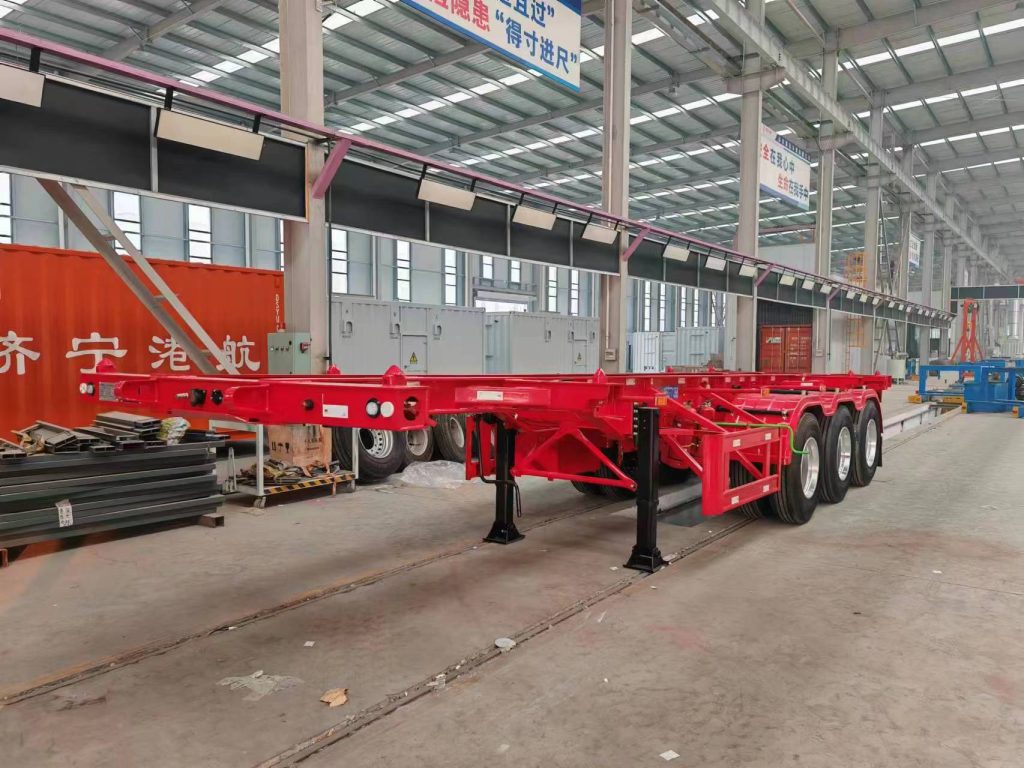
| View Skeletal Semi Trailer |
Start at the Footplates
Footplates record how the chassis has met the ground. Bent edges, dishing, unusual polishing, directional scraping, or damaged pivot areas can indicate impact, dragging, poor ground contact, or repeated edge loading.
The two sides should be compared rather than inspected as unrelated components. Similar wear can suggest one operating pattern. In contrast, strong asymmetry can point toward unequal support or a recurring parking-location problem.
The underside also matters when it can be viewed safely. A long directional scrape suggests a different event from normal vertical ground contact. Likewise, fresh metal on one edge can show where the plate has repeatedly accepted load.
Look Along the Complete Leg, Not Only at Lubrication Points
A leg can remain lubricated and still suffer from alignment problems. Therefore, straightness, dents, corrosion around sliding areas, rubbing marks, and uneven coating loss all deserve attention.
A narrow polished line along one side can be particularly useful evidence. It may show consistent contact between telescoping members. If the same travel position also produces higher crank resistance, both symptoms should be investigated together.
Dents deserve similar attention. Even a localized deformation can affect telescoping movement when it reaches the overlapping section. Continuing to crank through that restriction can turn a visible external problem into internal damage.
Read the Gearbox Through Feel, Sound, and Repeatability
The crank system provides useful feedback before any disassembly begins. Excessive free movement, skipped engagement, a repeating click, rough rotation, or a sudden increase in effort can justify deeper inspection.
However, lubrication should not become the automatic response to every complaint. Fresh grease can temporarily change the feel while leaving a bent leg, worn drive component, or poor alignment untouched.
The stage of movement also matters. Resistance only near final retraction may point toward a different issue from resistance across the full travel. Similarly, a mechanism that feels normal unloaded but rough while supporting the chassis needs that loaded behavior preserved in the maintenance record.
Bracing Often Exposes Lateral Movement Early
Brace connections deserve particular attention in repeated drop-and-hook work. Fresh paint cracking, moved washers, polished metal, enlarged-looking holes, or a changed brace angle can indicate movement that is not obvious while the trailer stands still.
The surrounding chassis structure should be inspected at the same time. Visible cracking, deformation, or shifted attachment points moves the problem beyond ordinary lubrication or adjustment.
Check Uneven Loading and Poor Ground Contact
A landing gear problem does not always begin inside the landing gear. In many yards, the first cause sits underneath it. Repaired asphalt, cracked concrete, gravel, soft shoulders, drainage channels, or a local slope can change the force carried by each side.
For example, one foot may land on solid concrete while the opposite side partly overlaps a patched edge. As the tractor pulls away, the weaker surface compresses and the front of the chassis moves. That lean can easily be mistaken for internal leg failure.
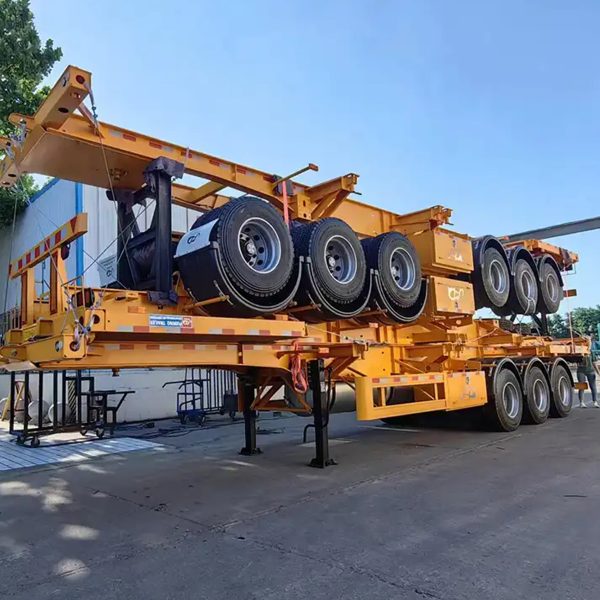
| View 4 Axle Container Chassis |
Read the Footprint Left by the Support Feet
The surface around the legs can reveal as much as the component itself. A deep impression on one side, a long scrape, broken pavement, or a sharply defined footplate depression provides evidence of how the trailer transferred its weight.
Repeated marks in the same parking lane can also expose a site problem. If several chassis show similar contact there, repeated parts replacement will not remove the underlying ground condition.
Weather can also change an otherwise familiar parking area. Rain can soften unsealed ground, while damaged pavement can deteriorate under repeated support loads. Consequently, an old parking position should not automatically be assumed to provide the same support every day.
Uneven Support Can Become Asymmetric Wear
When one foot reaches firm support first, that side begins carrying load before the other. The opposite leg joins later as the tractor releases the remaining front weight. Over many exchanges, this sequence can create different wear on each side.
The evidence may appear in several places at once. One plate shows heavier edge contact, one brace develops stronger witness marks, and one leg feels rougher during extension. Together, those signs provide a more useful diagnosis than one isolated defect.
Loaded and Empty Drops Are Not Identical Support Events
Trailer condition at uncoupling affects the support demand. An empty chassis and a chassis carrying a container do not place the same load through the front support system. Therefore, inspection records should distinguish the basic loading condition when symptoms change with load.
Container cargo distribution can also influence the front support demand. This inspection does not replace cargo loading or axle-load analysis, but repeated support problems associated with a particular load condition should not be ignored.
Where abnormal loading or structural behavior is suspected, applicable cargo procedures, destination-country requirements, site rules, and qualified technical judgment should govern the next decision.
Review Coupling Height and Operating Habits
Some landing gear wear patterns begin during the few seconds when a tractor enters or leaves the chassis. Fifth-wheel height, tractor suspension condition, yard level, and trailer attitude can make this transfer less consistent than it appears from a normal operating position.
The objective is a controlled transfer of load. Repeatedly using the landing gear to make large height corrections adds cycles and may hide an underlying tractor-to-trailer mismatch.
A Successful Coupling Does Not Prove the Transfer Was Gentle
A tractor can eventually couple after a poor approach. However, a sharp frame movement, visible sideways shift at the support legs, or sudden unloading of the footplates may still have occurred before the connection was complete.
Consequently, recurring landing gear damage should trigger a review of the operating sequence as well as the hardware. The cause may be mechanical, operational, or a combination of both.
Dragging Marks Often Point Back to Timing
Directional scraping across a footplate is different from ordinary vertical contact. It can indicate that the chassis moved before the landing gear was adequately relieved or before the feet had enough clearance from the surface.
One rushed movement may be an isolated event. Repeated scrape direction, however, suggests a process pattern. Tractor positioning, operating sequence, and site practice then belong in the maintenance discussion.
Repeated Height Correction Deserves Investigation
If the same tractor group regularly requires unusual landing gear adjustment, the pattern should be recorded. Likewise, one chassis that consistently sits differently from comparable units deserves closer inspection.
A useful record can identify the tractor group, parking location, approximate chassis attitude, and whether the trailer was loaded. Over several shifts, that information can reveal whether the height problem follows the tractor, trailer, or parking location.
For fleet expansion or replacement discussions, these operating details should become part of the technical brief. The BOCA container chassis range provides the appropriate product starting point, while the final specification still needs to reflect actual container work, tractor interface, road conditions, and local requirements.
Build a Cycle-Based Inspection Record
Calendar maintenance remains necessary because corrosion, lubrication condition, and environmental exposure continue even during light use. Nevertheless, a high-cycle support system needs an activity measure as well.
A practical record does not need to count individual crank turns. Instead, the operation can define one consistent drop-and-hook cycle and use that definition across the fleet. Consistency is more valuable than false precision.
Record the workload
Capture the approximate number of drops or complete support cycles during the operating period.
Record the surface
Note whether the regular drop area is stable concrete, repaired pavement, gravel, sloped ground, or another recurring condition.
Record the symptom
Capture crank resistance, abnormal sound, settling, dragging, uneven foot contact, or visible brace movement.
Record the context
Add loaded or empty condition, affected side, relevant tractor pairing, and photographs taken from repeatable angles.
Trend Data Is More Useful Than One Perfect Inspection
A workshop inspection captures one moment. In contrast, several short field records can show that crank effort has increased gradually, one foot has begun sinking more often, or the same brace connection keeps developing fresh movement marks.
Photographs strengthen that record. A wide view provides geometry, while closer images capture footplates, brace joints, mounting areas, and new wear marks. Repeating similar camera angles makes changes easier to identify later.
Preserve the Original Symptom After Repair
A work order that only states “landing gear serviced” loses useful context. The original complaint may have been resistance halfway through lowering on level concrete during loaded drops.
Connecting symptom, diagnosis, repair, and return-to-service result makes repeated faults easier to investigate. If the same behavior returns, the record can show whether the mechanical cause was actually removed.
Use Cycle History to Decide Which Chassis Deserves Attention First
Not every trailer in a fleet experiences the same workload. A unit assigned to intensive port shuttling can accumulate far more support cycles than another chassis assigned to longer road movements.
Cycle information therefore helps prioritize inspection. A trailer with increasing crank resistance and heavy drop frequency deserves closer attention than an otherwise similar unit with stable condition and low support activity.
No single cycle limit applies to every landing gear assembly. Installed equipment requirements, maintenance history, site conditions, manufacturer guidance, and qualified technical judgment should determine the actual intervention schedule.
When Wear Requires Service or Professional Repair
The maintenance decision should not depend on whether the handle can still be forced through a full movement. Stable and predictable support matters more than temporary operability.
Stop Normal Cycling When Support Becomes Uncertain
Uncontrolled settling, visible leg movement under load, a foot that no longer provides dependable contact, or a mechanism that slips rather than holding position requires escalation. The trailer should be secured according to the applicable site procedure before further inspection.
Likewise, a mechanism that jams while loaded should not be released through improvised leverage. Approved support and recovery procedures should stabilize the chassis first.
Cracks and Deformation Change the Repair Decision
Visible cracking around a leg, foot, brace, mounting bracket, or adjacent chassis structure moves the issue beyond ordinary cleaning and lubrication. Bent structural members require similar caution because their alignment and remaining strength may no longer be obvious.
Improvised welding, heating, or straightening should not substitute for an approved repair. Component material, damage location, load path, manufacturer guidance, local rules, and competent technical assessment should govern the repair method.
Repeated Gearbox Skipping Deserves Inspection
A drive mechanism that skips, locks, kicks back, or produces severe internal noise should be inspected before another high-cycle shift. Additional handle force may create damage in gears, shafts, linkage, or the crank itself.
The same principle applies to increasing free play. If engagement becomes progressively less predictable, the maintenance record should show that progression rather than accepting it as normal aging.
Fastener Movement Should Not Be Treated as a Cosmetic Issue
Landing gear and braces depend on secure attachments. Fresh movement around bolts, brackets, washers, or mounting plates can show that the load path has changed.
Simply tightening an apparently loose connection may not identify the cause. Wear, enlarged holes, damaged threads, deformation, or repeated side loading can exist behind the visible symptom.
A Repair Should Solve the Original Operating Symptom
After service, the original complaint should be checked again under an appropriate controlled condition. A mechanism that feels smooth with no support load may still behave differently when the trailer weight begins transferring onto the legs.
Return-to-service should therefore confirm stable support, secure bracing, normal movement, and resolution of the original symptom. Otherwise, the maintenance loop remains incomplete.
FAQ
The Useful Pattern Appears Before Complete Failure
High-cycle landing gear should be judged through changes in behavior, not only through visible breakage. Crank feel, foot contact, brace movement, ground condition, tractor interaction, and repeatable symptoms together provide a much clearer maintenance picture.
Meanwhile, cycle records help separate an isolated yard incident from progressive deterioration. They also give maintenance personnel more context when repair decisions are required.
- Record drop frequency together with loading condition and the regular parking surface.
- Photograph both support legs, feet, braces, and mounting areas when a new symptom appears.
- Remove the chassis from routine cycling when support becomes unstable, structural damage appears, or the drive mechanism no longer operates predictably.
Skeletal Trailer Configuration Review
Match the Chassis to the Real Drop-and-Hook Operation
Useful project information includes daily drop-and-hook frequency, container size, loading condition, regular parking surface, common tractor pairing, road environment, landing gear photographs, and recurring sound or crank-resistance patterns.
Those details allow the chassis discussion to reflect the real operating environment instead of a generic specification. Existing damaged equipment should still receive proper inspection and repair rather than treating a replacement decision as a substitute for maintenance.
For operations seeing recurring skeletal trailer landing gear wear, combining cycle history, clear support-leg photographs, yard conditions, abnormal sounds, and the normal coupling process provides the most useful starting point for a configuration discussion.
| View Skeletal Semi Trailer | Compare Container Chassis |