

Essential Components of a shipping container flatbed trailer

Introduction
Shipping container flatbed trailer are one of the most widely used types of trucks in the logistics and transportation industries.Widely favored for their versatility and durability, they play a vital role in transporting a wide variety of cargo, including steel coils, containers, heavy machinery, and construction materials.shipping container flatbed trailer is a heavy-duty transport trailer designed to carry ISO containers such as 20ft, 40ft, and 45ft units.
Unlike a skeleton chassis trailer, a flatbed trailer has a full steel deck, making it suitable for both containers and general cargo transport.
It is widely used in logistics, construction, and port transportation industries.
What components of shipping container flatbed trailer?
Understanding each component and its function can help ensure better maintenance, safety, and performance, especially when purchasing a flatbed semi trailer from a manufacturer or using it for daily operations.
In this comprehensive guide, we’ll explore the key components of a shipping container flatbed trailer, explain their functions, provide technical specifications, and help you identify what to look for when purchasing or maintaining a trailer.
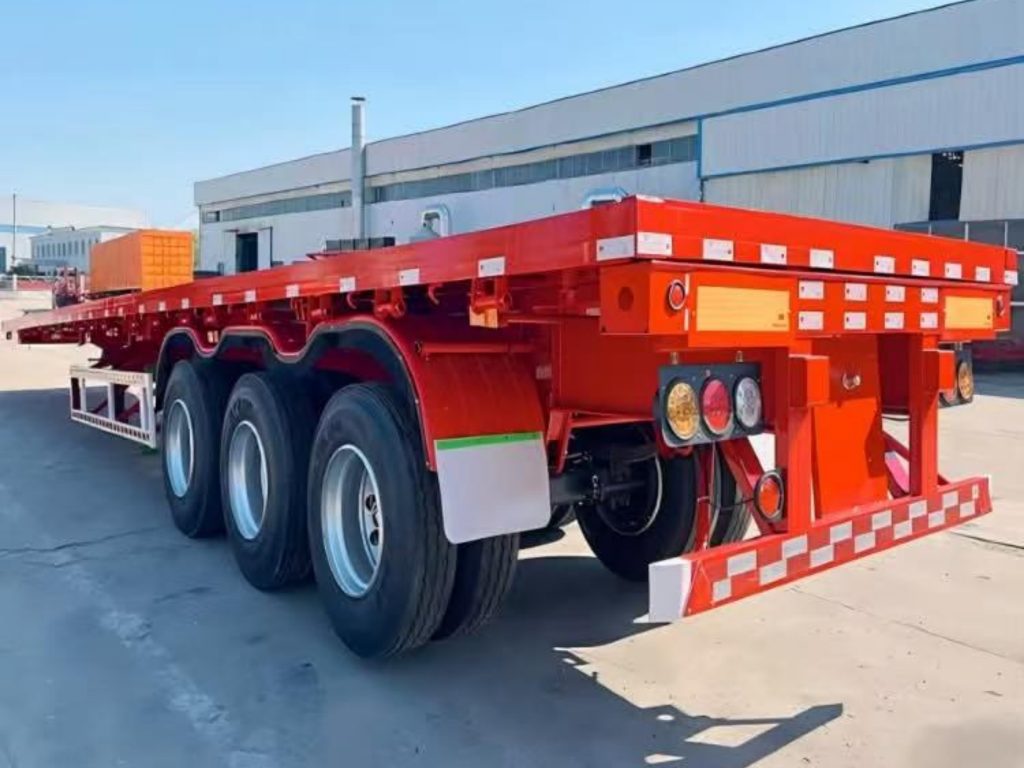
Main Frame Structure
The main frame is the primary structure of a container flatbed trailer, supporting the entire load and absorbing stress during transport.
It consists of main beams, side beams, cross beams, and the platform floor—all constructed from high-strength steel.
Main Frame Components
| Component | Material | Function | Specification Range |
| Main Beam | Q345 / T700 steel | Main load-bearing frame | Height: 500–550 mm; Thickness: 14 mm |
| Side Beam | 16# channel / reinforced steel | Lateral support | 160–180 mm |
| Cross Member | Rectangular tube (80×40×4 mm) | Distributes load evenly | Spacing: 500–600 mm |
| Platform Floor | Checkered steel / wood | Cargo support surface | Thickness: 3–4 mm |
Tip: The higher the strength of the steel (T700 or higher), the stronger and lighter the trailer will be.

Kingpin and Fifth Wheel Connection
The coupler is the key connecting component between the truck tractor and flatbed container trailer. It connects to the truck’s fifth axle connector, enabling smooth towing and rotation.
| Parameter | Details |
| Type | Bolted / Welded |
| Diameter | 50 mm (2 inches) or 90 mm (3.5 inches) |
| Material | 42CrMo / Alloy steel |
| Standard | ISO 337, SAE J700 |
| Load Capacity | 16–20 tons vertical |
Maintenance Tip: Lubricate the steering shaft regularly to reduce friction and prevent wear. Always inspect for cracks or rust before long journeys.
Suspension System
The shipping container flatbed trailer suspension system absorbs vibrations, maintains stability, and ensures smooth transport of cargo, especially on uneven surfaces.
Types of Suspension Systems Used in flatbed trailer for shipping container
| Type | Description | Advantages |
| Mechanical (Leaf Spring) | Traditional, simple design with leaf springs | Durable, easy to maintain, low cost |
| Air Suspension | Uses air bags and valves | Better shock absorption, protects cargo, smoother ride |
| Hydraulic Suspension | Hydraulic cylinders for height adjustment | Ideal for specialized and heavy-duty applications |
Suspension Technical Parameters
| Parameter | Value |
| Axle Load Capacity | 13 tons per axle |
| Leaf Spring Size | 90×16 mm × 10 leaves |
| Airbag Type | 250–300 mm diameter |
| Axle Brand Options | BPW, FUWA, YORK |
Tip: Air suspension is suitable for export markets or transporting fragile items, while mechanical suspension is more suitable for use on rough terrain.
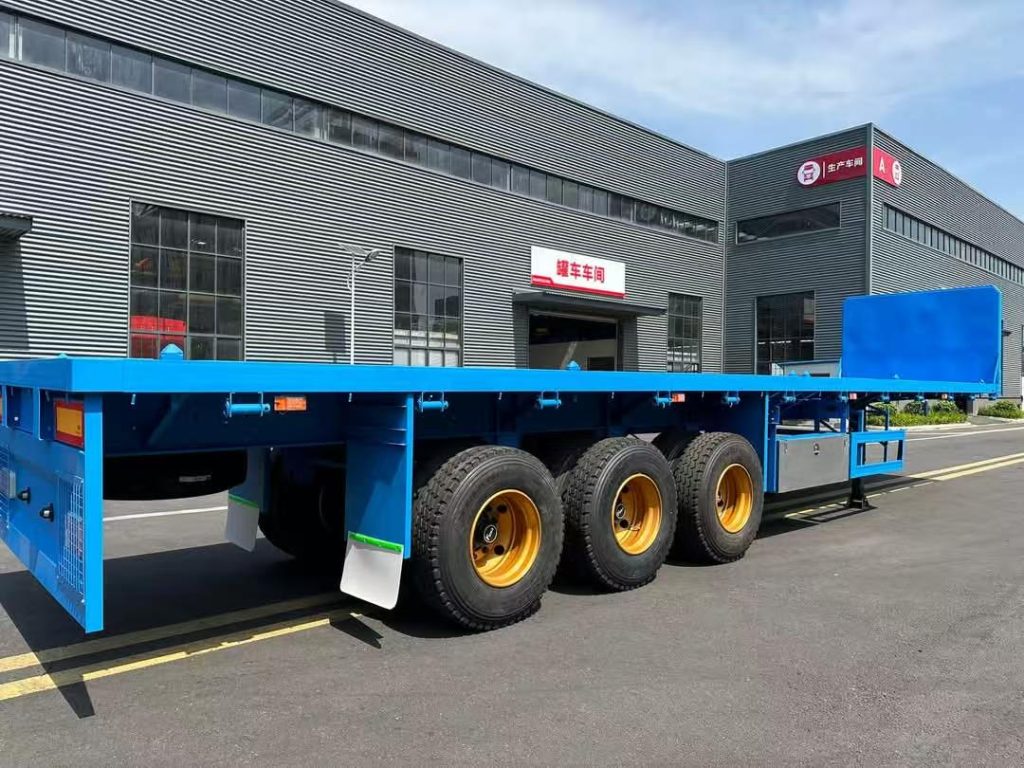
Axles and Wheels
The shipping container flatbed trailer axle system bears the weight of the trailer and cargo.shipping container flatbed semi trailer typically have two to four axles, depending on the required cargo capacity.
shipping container flatbed trailer Axle and Wheel Specifications
| Parameter | Standard Range |
| Axle Brand | FUWA / BPW / York |
| Axle Capacity | 13T / 16T per axle |
| Number of Axles | 2, 3, or 4 |
| Tire Size | 12R22.5 / 11.00R20 |
| Rim Size | 9.0×22.5 / 8.25×22.5 |
| Wheel Type | Tubeless steel / alloy |
Axle Configuration Examples
| Configuration | Load Capacity | Use Case |
| 2 axle container chassis | 30–35 tons | Light cargo |
| 3 axle container chassis | 40–60 tons | Standard heavy-duty |
| 4 axle container chassis | 70–80 tons | Oversized cargo |
Maintenance Tips: Regularly check axle bearings and brake drums. When replacing tires, replace them in pairs to maintain balance.
Braking System
A reliable braking system for the container flatbed semi trailer ensures safe driving on highways and mountain roads. Most flatbed trailers are equipped with dual air brakes and an anti-lock braking system (ABS) or electronic braking system (EBS).
shipping container flatbed trailer Brake System Components
| Component | Function |
| Air Reservoir (Tank) | Stores compressed air for braking |
| Brake Chamber | Converts air pressure into braking force |
| Relay Valve | Distributes air to each wheel brake |
| ABS/EBS Module | Prevents wheel lock and improves control |
| Emergency Brake Valve | Applies brakes automatically in case of air pressure loss |
Technical Data
| Working Pressure | 0.8 MPa |
| Air Tank Capacity | 40–60 L |
| ABS Brand | WABCO / Haldex |
| Brake Lining Thickness | 16–20 mm |
Tip: Regularly check the air hose and valve for leaks. Ensure the air pressure is at the correct level before each trip.
Electrical System
The shipping container flatbed trailer electrical system provides power for lighting, indicators, and safety devices. It is crucial for road visibility, especially at night or during long hauls.
shipping container flatbed trailer Electrical System Specifications
| Component | Specification |
| Voltage | 24V system |
| Cable Type | Copper-core waterproof cables |
| Connector Socket | 7-pin or 15-pin |
| Lighting | LED front/rear lights, reflectors |
| Wiring Protection | PVC conduit or spiral wrap |
| Accessories | Side marker lights, license plate lamp, turning indicators |
IP: LED lights have a longer lifespan and consume less energy. Ensure the wiring harness is properly sealed to prevent water intrusion.
Landing Gear
The undercarriage supports the container flatbed semi trailer when it is not connected to the truck. It is used to raise or lower the front end of the trailer during loading or parking.
Undercarriage Specifications
| Type | Specification |
| Brand | JOST / FUWA / China local |
| Capacity | 25–28 tons (per pair) |
| Operation | Manual crank / two-speed gear |
| Lift Stroke | 420–450 mm |
| Static Load Capacity | Up to 80 tons |
Tires and Rims
Tires are crucial to a vehicle’s stability, traction, and fuel efficiency. The type of tire affects not only flatbed container trailer performance but also safety.
Tire Specifications
| Parameter | Description |
| Type | Tubeless radial tire |
| Size | 12R22.5 or 315/80R22.5 |
| Brand Options | Double Coin, Linglong, Triangle, Goodyear |
| Ply Rating | 16PR / 18PR |
| Inflation Pressure | 120–130 psi |
Tip: Rotate your tires every 10,000 kilometers and check tire alignment to prevent uneven wear.
Deck and Platform Design
The cargo bed is where the cargo is placed.shipping container flatbed trailer use different materials and structures depending on the type of cargo.
Deck Options
Platform Features
Safety buckles or D-rings for cargo securing
Side loops for ropes or chains
Locks for 20 foot and 40 foot containers (rotating locks)
Optional staked bulkheads or removable side panels
Tip: Before loading, always inspect the platform for rust or cracks.
Rear Bumper and Lighting System
The rear bumper provides safety and visibility, preventing the vehicle from rolling under the trailer.
It also features taillights, turn signals, and reflectors that comply with international traffic regulations.
Rear System Specifications
| Component | Details |
| Bumper Height | 550–600 mm from ground |
| Material | High-strength steel with reflective tape |
| Tail Light Type | LED (E-mark certified) |
| Reflectors | Rear and side-mounted |
| License Plate Bracket | LED-illuminated |
Compliance Requirements: Must meet DOT, ADR, or ECE R70 standards depending on the region of export.
Tool Box, Spare Tire Rack, and Accessories
Additional components for the flatbed container trailer can enhance the functionality and convenience of your shipping container flatbed trailer.
| Accessory | Purpose |
| Toolbox | Store tools, chains, or straps |
| Spare Tire Carrier | Holds one or two spare tires |
| Water Tank (optional) | For long-distance trips |
| Ladder / Climbing step | Access to platform |
| Fire Extinguisher Bracket | Safety compliance requirement |
Tip: Keep a tool kit stocked with spare bolts, straps, and air interface parts for emergency repairs on the road.
Paint and Surface Coating
Proper surface preparation can protect your flatbed trailer for shipping container from rust and corrosion, extending its life.
Surface Coating Process
| Step | Description |
| 1. Sandblasting | Removes rust, grease, and dirt |
| 2. Primer Coating | Anti-rust zinc-based primer |
| 3. Color Coating | Polyurethane / epoxy paint |
| 4. Baking / Drying | Ensures adhesion and durability |
Paint Options
Custom colors available (red, blue, green, black)
Optional hot-dip galvanizing for coastal or humid areas
Tip: Immediately repaint any scratched areas to prevent rust.
Container Twist Lock
Flatbed cotnainer semi trailers commonly use to transport 20ft and 40ft containers, requiring a twist lock to ensure secure attachment.
| Type | Specification |
| Standard Twist Lock | ISO 1161 compliant |
| Material | Cast steel |
| Load Capacity | 25–30 tons each |
| Position | 8 pcs for 40ft, 4 pcs for 20ft |
Tip: Regularly inspect the rotary lock for wear or deformation. If any lock no longer rotates smoothly, replace it.
Flatbed Trailer vs Container Chassis Trailer
Many buyers often confuse flatbed trailers with container chassis trailers because both use in logistics and freight transport. However, their structure and application are quite different, and each design for specific transport needs.
Key Differences
| Feature | Flatbed Trailer | Container Chassis Trailer |
|---|---|---|
| Structure | Full flat platform deck | Skeleton frame design |
| Primary Use | General-purpose cargo transport | Dedicated container transport |
| Cargo Flexibility | High (steel, machinery, pallets, etc.) | Limited to shipping containers |
| Weight | Heavier due to full deck | Lighter, more fuel-efficient |
| Loading Method | Side, crane, or forklift loading | Container locked via twist locks |
| Efficiency | Versatile but less specialized | Highly efficient for container logistics |
Flatbed Trailer – Multi-Purpose Flexibility
Flatbed trailers feature a full platform structure, making them suitable for a wide variety of cargo types.
Can transport steel, machinery, construction materials, and palletized goods
Easy loading from multiple directions using cranes or forklifts
Ideal for mixed cargo operations where flexibility is required
Container Chassis Trailer – Specialized Efficiency
Container chassis trailers design specifically for standardized shipping containers.
Lightweight skeleton structure reduces fuel consumption
Uses twist locks for fast and secure container fixing
Optimized for intermodal transport (port, rail, highway)
Highly efficient for large-scale container logistics operations
Dimensions and Technical Overview
| Parameter | Typical Value |
| Overall Length | 12.5m – 16.5m |
| Width | 2.5m – 2.6m |
| Height (deck) | 1.3m – 1.6m |
| Payload Capacity | 30–60 tons |
| Tare Weight | 6–8 tons |
| Axle Quantity | 2–4 |
| Suspension Type | Mechanical / Air |
| Material | Q345 / T700 Steel |
| Braking System | Dual-line air brake + ABS |
| Electrical Voltage | 24V system |
Maintenance Checklist
| Component | Maintenance Frequency | Action |
| Kingpin & Coupling | Weekly | Grease & inspect for cracks |
| Axles & Bearings | Every 5,000 km | Check and re-lubricate |
| Suspension | Monthly | Inspect bushings and bolts |
| Brake System | Weekly | Test air pressure & valves |
| Electrical System | Monthly | Inspect lights & wiring |
| Platform Surface | Quarterly | Remove rust & repaint if needed |
How to Choose the Right Flatbed Trailer
Selecting the right flatbed semi trailer is essential for ensuring safe transportation, efficient loading, and long-term operational reliability. The best choice depends on your cargo type, working environment, and transport requirements.
Load Capacity
Load capacity is one of the most important factors when choosing a flatbed trailer.
Heavy cargo requires reinforced chassis and stronger axle systems
Proper load rating helps prevent structural damage and improves safety
Always match the trailer capacity with your maximum expected cargo weight
Container Size Compatibility
Flatbed trailers often use for container transport, so size compatibility is critical.
Ensure the trailer can properly accommodate 20ft, 40ft, or 45ft containers
Incorrect sizing may lead to instability or unsafe loading conditions
Some flatbed models offer adjustable or extended designs for flexibility
Road Conditions
Operating environments greatly affect trailer performance and durability.
Rough or unpaved roads require stronger suspension systems
High-quality tires and reinforced frames improve stability on uneven terrain
Urban or highway use may prioritize fuel efficiency and smoother handling
Type of Usage
Understanding your cargo type helps determine whether a flatbed trailer is suitable.
Ideal for mixed cargo transport, including machinery, steel, and palletized goods
Offers more flexibility compared to container-only chassis trailers
Suitable for businesses that handle diverse logistics requirements
Conclusion
Flatbed trailer for shipping container is more than just a platform—it’s a meticulously engine machine comprised of dozens of interconnected components.
Each component—from the main frame and suspension to the axles, steering axle, and electrical system—plays a vital role in ensuring safety, durability, and performance.
For transport companies or flatbed container trailer owners, understanding these key elements can help facilitate more efficient maintenance, improve cost-efficiency, and make smarter purchasing decisions.
When purchasing from flatbed semi trailer manufacturers, especially from China, it’s important to request technical drawings, material certificates, and brand details for key components such as axles, undercarriage, and suspension systems. This ensures you receive a high-quality, long-lasting trailer that meets your specific logistics needs.
FAQ – Shipping Container Flatbed Trailer
What is a shipping container flatbed trailer?
It is a flat platform trailer designed to transport ISO containers and other heavy cargo using twist locks or lashing systems.
What containers can a flatbed trailer carry?
It can carry standard 20ft, 40ft, and 45ft containers depending on trailer length and configuration.
What is the difference between a flatbed trailer and a container chassis trailer?
A flatbed trailer has a full deck and can carry containers and general cargo, while a container chassis is designed only for containers.
How are containers secured on a flatbed trailer?
Containers are fixed using twist locks, chains, or lashing points to ensure safe transport during movement.
What is the load capacity of a flatbed container trailer?
Most models can carry 30–60 tons depending on axle configuration and structural design.
What industries use flatbed container trailers?
They are widely used in logistics, shipping ports, construction, and heavy equipment transportation.