
Low-Deck Heavy-Haul Trailer Pros & Cons: Know the Wins Before a Spec Is Locked

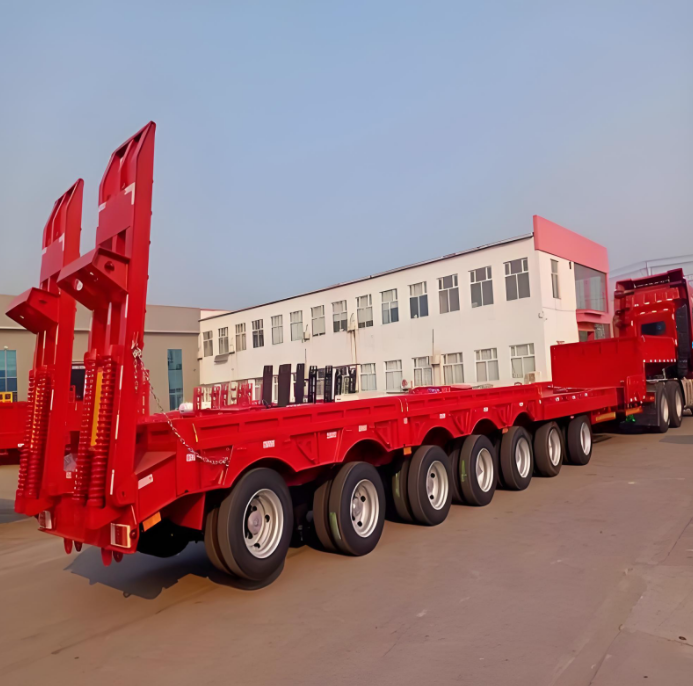
Height limits do not negotiate on real roads. Therefore, deck geometry often decides whether a move stays simple. A lowboy semi trailer lowers the deck and reshapes the load’s center of gravity. Meanwhile, that lower stance can reduce route fragility and improve stability. As a result, tall equipment moves become easier to plan across mixed corridors.
Why low-deck geometry changes the entire move
First, deck height sets the baseline for total loaded height. Consequently, a small reduction can open up many viable routes. In practice, overhead constraints appear at bridges, wires, and plant corridors. Therefore, the trailer becomes a clearance tool, not just a platform.
Meanwhile, stability improves in a simple, physical way. The load sits closer to the road and reduces leverage in turns. As a result, the combination feels calmer on ramps and uneven pavement. Moreover, stable motion supports consistent braking and steering control.
However, a lower deck also shifts which risks matter most. Overhead clearance becomes easier, yet transition clearance can become the limiter. Therefore, dips, rail crossings, and yard entrances deserve early attention. In other words, planning moves from “overhead risk” to “transition risk.”
The biggest wins that show up on real routes
Win 1: clearance margin without constant equipment tear-down
To begin, lower deck height reduces total height without changing the machine. Therefore, many attachments can remain installed during transport. Additionally, fewer removals reduce handling time and staging complexity. As a result, schedules stay tighter and more predictable.
Moreover, clearance margin improves route resilience. A route that barely works on paper often fails in the field. Consequently, extra margin absorbs road crown, suspension movement, and minor detours. Meanwhile, fewer last-minute reroutes reduce downtime and coordination noise.
Win 2: stability improves because physics shifts toward control
Next, a lower center of gravity reduces sway and rocking. Therefore, cornering feels more controlled under tall or top-heavy loads. Additionally, the trailer resists pitching over expansion joints and rough patches. As a result, the load experiences less cumulative vibration.
At the same time, stability supports securement performance over distance. When the load moves less, chains and binders hold tension longer. Consequently, retension checks become more consistent and less corrective. Moreover, anchor points experience fewer shock loads over repeated cycles.
Win 3: loading workflow becomes more flexible across job sites
In many operations, loading time decides daily productivity. Therefore, loading method should match the real site environment. Rear ramp loading works well when space behind the deck stays open. However, low-clearance equipment can scrape at breakover points.
In contrast, detachable gooseneck designs allow front loading from ground level. Consequently, approach angles become gentler and more repeatable. Meanwhile, alignment becomes simpler because the climb can stay straight. As a result, loading depends less on perfect ramp placement.
Win 4: concentrated loads get a stronger foundation
Tracked machines place weight in concentrated contact patches. Therefore, deck structure and crossmember density matter more than they first appear. Additionally, a well-designed frame spreads stress through the main beams. As a result, deflection stays controlled under repeated climbs.
Furthermore, concentrated-load performance affects long-term durability. Repeated cycles can fatigue weak transitions and weld zones. Therefore, reinforcement strategy becomes a reliability feature, not an upgrade. In practice, better structure reduces early deck damage and crack risk.
Win 5: planning becomes steadier in mixed environments
Construction corridors, industrial roads, and rural entrances rarely share the same geometry. Therefore, flexibility matters more than a single spec line. Meanwhile, low-deck designs often pair with varied ramps and axle layouts. Consequently, one platform can cover more job types without constant workaround planning.
Also, predictable behavior supports safer operational routines. Smooth loading reduces sudden shocks into the frame. Therefore, component wear becomes easier to manage over long schedules. As a result, reliability improves with fewer “unknown” daily variables.
Planning considerations that protect uptime and reduce surprises
Consideration 1: heavier structure influences payload planning
Low-deck frames often use heavier beams and reinforcements. Therefore, empty weight can rise compared with lighter platforms. Additionally, higher tare weight can reduce net payload under certain legal limits. Consequently, axle strategy and corridor planning should be part of early selection.
Meanwhile, heavier combinations change tractor requirements. Cooling capacity, gearing, and braking performance must match the total mass. Therefore, system pairing should be planned together with the trailer spec. As a result, “spec mismatch” surprises become far less likely.
Consideration 2: detachable systems require disciplined inspection routines
Detachable goosenecks introduce pins, lock faces, and hydraulic interfaces. Therefore, routine inspection and lubrication become essential. Additionally, clean coupling practices protect seals and reduce contamination. Consequently, uptime improves when maintenance rhythm stays consistent.
However, fixed-neck configurations reduce moving interfaces and simplify checks. Therefore, stable yards with consistent rear loading may benefit from that simplicity. Meanwhile, detachable designs earn their place when front loading solves real site constraints. As a result, the choice becomes operational rather than aesthetic.
Consideration 3: transition clearance becomes the quiet limiter
Even with excellent overhead clearance, belly clearance can still cause problems. Therefore, breakover angle planning should happen early. Additionally, yard entrances and ramps can create sharp transitions. Consequently, ramp length and beavertail geometry deserve careful review.
Meanwhile, turning geometry can tighten depending on neck style and tractor setup. Fifth wheel height influences deck attitude and swing clearance. Therefore, geometry checks should happen before finalizing connection layouts. As a result, hose strain and paint damage become less common.
Four configuration visuals from the low-bed category
For reference, these images come from the low-bed semi trailer category page.
Each image sits inside the most relevant topic to avoid visual stacking.
Detachable gooseneck for front loading
Meanwhile, detachable gooseneck layouts support ground-level front loading. Consequently, approach angles stay gentler for tracked machinery and low-clearance frames. Additionally, straight-line climbs reduce alignment errors at the ramp.
However, neck interfaces add inspection points. Therefore, pin fit, lock engagement, and coupling cleanliness deserve routine checks. As a result, repeated cycles stay reliable under dust and frequent site changes.
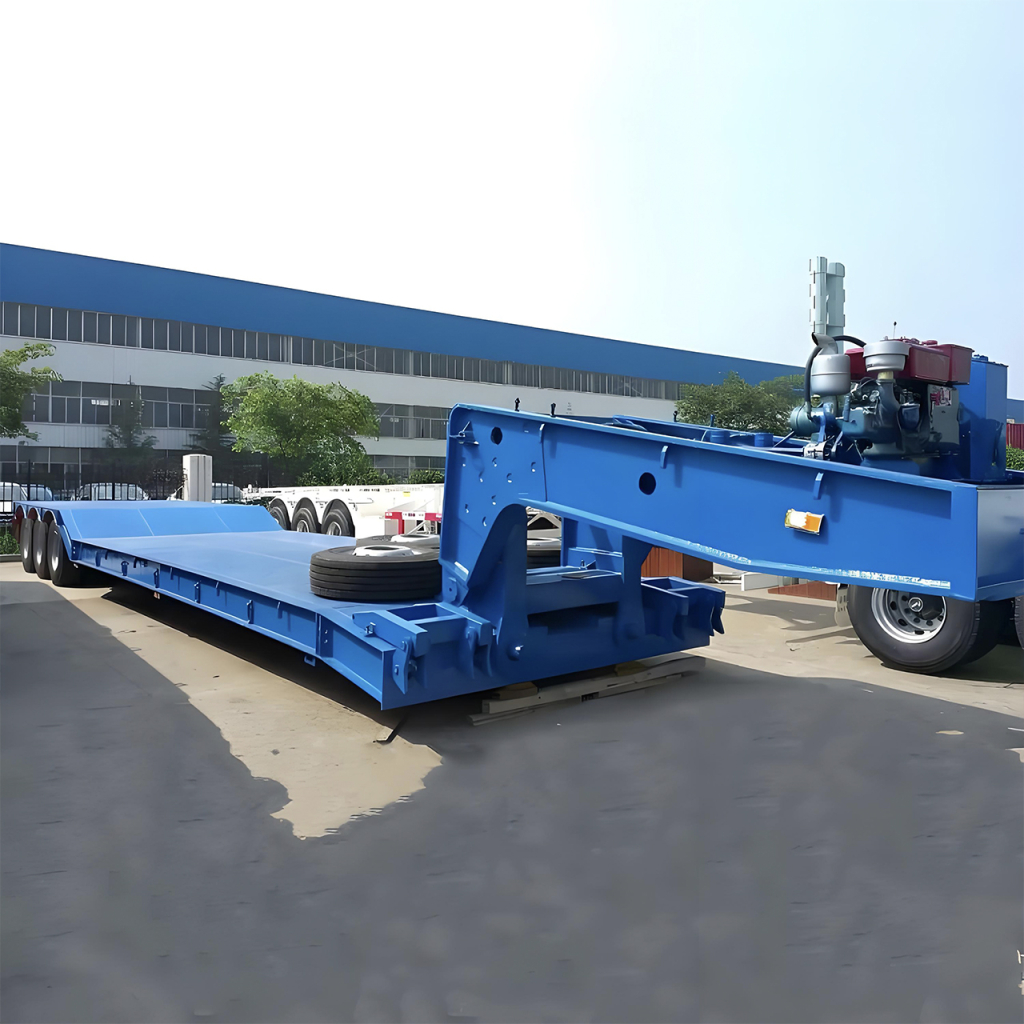
Caption: Detachable gooseneck design supports front loading and smoother approach geometry.
Moreover, detachable layouts can reduce reliance on rear staging space. Consequently, tight yards become easier to manage with consistent sequencing. Additionally, smoother climbs reduce undercarriage contact risk on difficult transitions.
Multi-axle layout for load distribution and braking stability
Additionally, axle strategy drives how weight spreads into the road. Therefore, multi-axle layouts can reduce per-axle stress and tire heat. Moreover, distributed braking can feel steadier during long, heavy cycles.
At the same time, more axles can increase tire scrub in tight turns. However, that trade-off can be managed through realistic turning plans and yard pathways. As a result, distribution benefits can be captured without excessive wear.
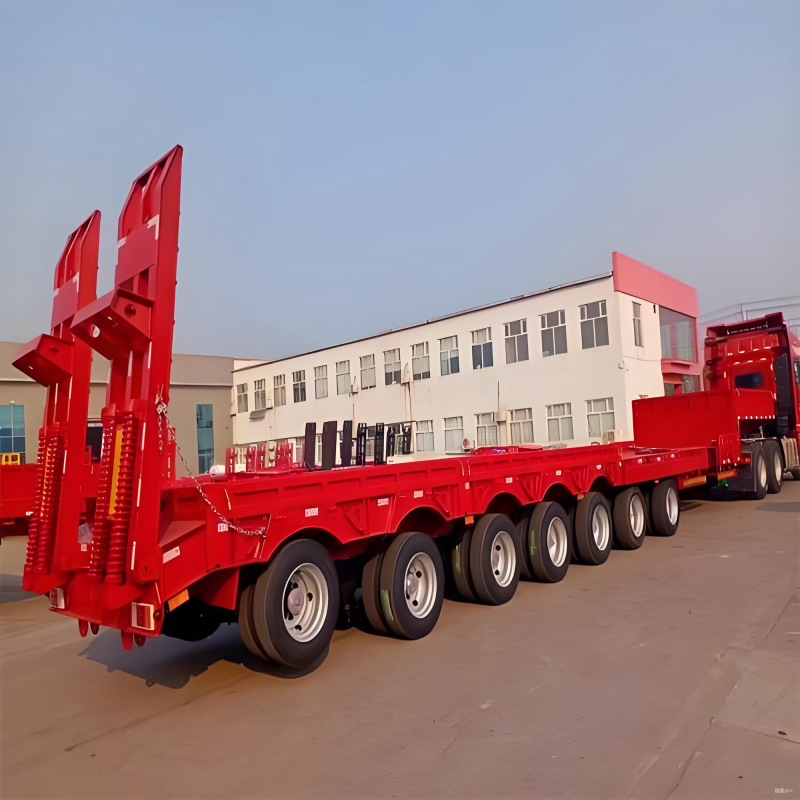
Caption: Multi-axle configuration supports distribution, stability, and heavy-haul control.
Meanwhile, distribution improves securement consistency as well. Consequently, balanced loading reduces “see-saw” motion across the deck. Additionally, stable motion supports longer-lasting chain tension under vibration.
Defined-duty two-axle layout for specific route profiles
For some corridors, a simpler axle count fits a defined payload set. Therefore, a two-axle low-deck layout can work well with stable, repeatable duties. Additionally, simpler running gear can reduce complexity in daily checks.
However, axle count should not be chosen by habit. Consequently, payload height, footprint, and terrain should guide the decision. As a result, the final layout remains stable across the most common jobs.
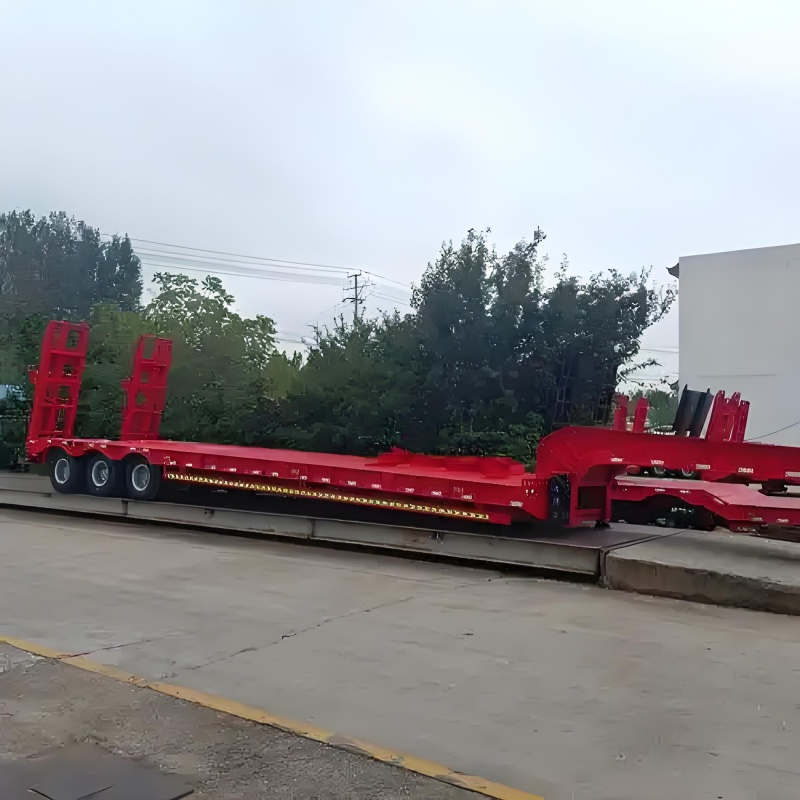
Caption: A two-axle layout can match specific route profiles and routine operations.
Moreover, defined-duty setups can support standard loading routines. Therefore, consistent placement and securement patterns become easier to repeat. Additionally, repeatability reduces daily variability across crews and shifts.
Heavy-duty deck and ramp package for frequent loading cycles
Finally, ramp structure and deck stiffness shape loading confidence every day. Therefore, ramp length and stiffness should match the heaviest climbing machine. Additionally, strong rear structure reduces ramp deflection during track climbs.
At the same time, transition clearance remains important. Consequently, beavertail geometry and ramp placement should match real yard entrances. As a result, repeated undercarriage contact can be reduced significantly.
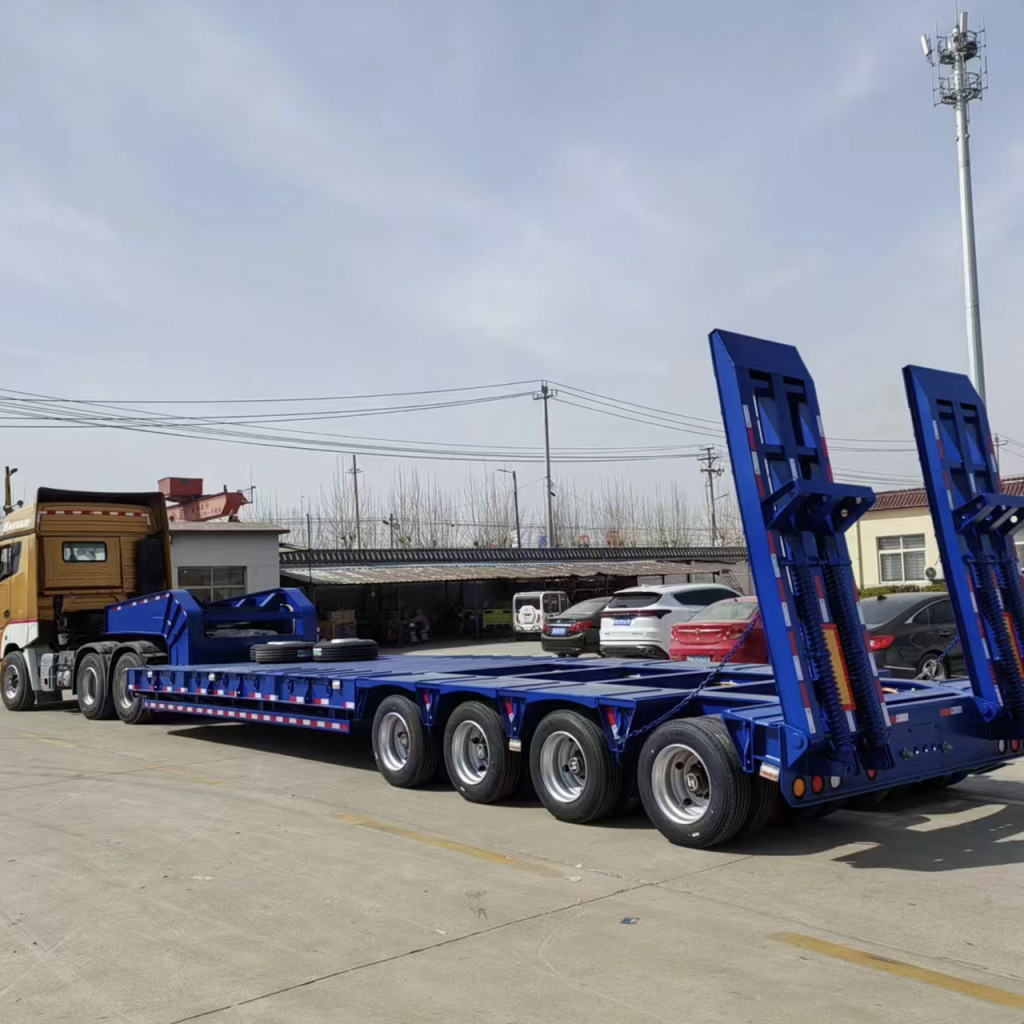
Caption: Reinforced deck and ramps support repeatable loading cycles on mixed job sites.
Moreover, stronger ramps can reduce “micro-damage” from repeated climbs. Therefore, long-term deck condition often stays better under heavy schedules. Additionally, smoother climbs reduce stress into both equipment and trailer components.
Where low-deck transport fits best
Construction rotation and infrastructure work
First, rotating job sites demand repeatable loading and stable travel. Therefore, predictable loading angles and deck height reduce daily friction. Additionally, equipment like excavators, dozers, rollers, and pavers often run tall or concentrated. As a result, clearance and stability benefits show up quickly.
Meanwhile, site entrances vary more than roadways. Consequently, ramp placement and approach space become daily constraints. Additionally, a flexible loading method reduces time spent “re-positioning” for alignment. As a result, cycle time improves without changing equipment.
Mining, quarry, and heavy earthmoving corridors
Next, harsh corridors punish weak components through repeated heavy cycles. Therefore, robust running gear and predictable frame behavior matter. Additionally, rough surfaces increase vibration that loosens fasteners over time. Consequently, inspection access becomes a practical advantage.
Meanwhile, concentrated track loads demand a deck that resists localized stress. Therefore, crossmember placement and reinforcement zones should match typical track paths. Additionally, controlled deflection reduces long-term deformation. As a result, the platform stays consistent through repeated service.
Industrial relocation and energy equipment
Additionally, industrial modules often carry high value and irregular geometry. Therefore, securement access and anchor placement must match real tie-down paths. Moreover, a lower center of gravity reduces rocking over long distances. As a result, the load experiences less cumulative vibration.
However, industrial corridors can include tight turns and height constraints. Consequently, clearance planning and turning geometry should be evaluated together. Additionally, front loading can reduce approach angle for long modules. As a result, the overall loading plan stays simpler.
Agriculture and seasonal oversized equipment
Meanwhile, agricultural equipment can be tall, wide, and delicate underneath. Therefore, approach angle and breakover clearance matter for safe climbs. Additionally, seasonal timelines reduce tolerance for repeated disassembly. Consequently, low-deck geometry can reduce staging steps.
However, rural entrances can include soft shoulders and uneven ground. Therefore, traction planning and ramp seating need attention. Additionally, steady alignment reduces slip events on dusty surfaces. As a result, loading remains safer under variable site conditions.
Core configuration types and how they change workflow
Fixed-neck low-deck designs
First, fixed-neck designs keep interfaces simple and consistent. Therefore, fewer moving joints reduce inspection points and service steps. Additionally, rear ramp loading works well when rear staging space is available. As a result, workflow stays straightforward in stable yards.
However, rear loading depends heavily on ramp angle and transitions. Consequently, ramp length and beavertail geometry deserve careful review. Additionally, low-clearance machines can scrape at breakover points. As a result, ramp selection often matters as much as deck height.
Detachable gooseneck designs
Next, detachable gooseneck designs allow ground-level front access. Therefore, approach angles can become gentler and safer for tracked loads. Additionally, straight-line climbs improve alignment and reduce repositioning. As a result, mixed sites gain real flexibility.
However, detachable systems require disciplined routines. Consequently, pins, locks, and hydraulic fittings need consistent checks. Additionally, contamination control supports seal life and smooth engagement. As a result, the design rewards steady maintenance rhythm.
Step-deck and other nearby options
Meanwhile, step-deck platforms lower only part of the deck. Therefore, they can fit medium-height loads that need some clearance margin. However, true low-deck platforms sit lower and handle taller equipment profiles. Consequently, the correct choice depends on real height constraints and loading methods.
Additionally, nearby options can simplify certain freight mixes. Therefore, selection should reflect the most frequent transport category. Moreover, route constraints should be measured rather than assumed. As a result, the platform matches real duty rather than theoretical versatility.
The design elements that drive performance
Main beams and frame architecture
First, main beams carry the majority of bending stress. Therefore, beam depth and reinforcement placement matter for long life. Additionally, stress transitions near the neck and rear frame deserve special attention. As a result, fatigue risk can be reduced over repeated cycles.
Meanwhile, frame stiffness affects securement behavior. Consequently, reduced flex can keep tie-down angles more consistent. Additionally, controlled stiffness improves ride feel under concentrated loads. As a result, the platform behaves predictably over rough segments.
Crossmembers and concentrated load control
Next, crossmembers spread load from tracks into the main structure. Therefore, crossmember density and weld quality matter for heavy cycles. Additionally, reinforced zones under common track paths reduce localized damage. As a result, deck deflection stays controlled during climbs.
However, extremely dense layouts can add weight. Consequently, design must balance stiffness and tare mass. Additionally, the best balance depends on the payload set. As a result, the right structure matches real duty rather than a single extreme case.
Deck surface and traction behavior
Additionally, deck surface affects friction during loading and travel. Therefore, surface texture and wear strategy matter for safe climbs. Moreover, traction influences how tracks behave on ramps. As a result, controlled friction supports smoother loading.
However, deck durability also matters for long schedules. Consequently, repeated track turns can gouge weaker surfaces. Additionally, wear plates or protective zones can extend service life. As a result, deck condition remains stable across frequent cycles.
Ramp system and approach geometry
Finally, ramp length sets approach angle directly. Therefore, longer ramps reduce stress on tracks and undercarriage. Additionally, ramp stiffness reduces deflection under heavy climbs. As a result, the climb feels more stable and predictable.
However, ramp length can influence rear overhang and yard clearance. Consequently, ramp selection should reflect real entrances and transitions. Additionally, handling aids like spring assist can improve daily safety. As a result, ramp workflow becomes smoother under frequent use.
Axle strategy, suspension, and what they change on the road
Axle count and distribution logic
First, axle count changes how weight distributes into pavement. Therefore, more axles can reduce per-axle load and heat. Additionally, balanced distribution often improves straight-line control during braking. As a result, long-haul behavior becomes steadier.
However, additional axles can increase tire scrub in tight yards. Consequently, turning environment should be assessed honestly. Additionally, axle spacing affects maneuverability and wear. As a result, layout should balance distribution with real movement paths.
Suspension choice and ride control
Next, mechanical suspension often fits harsh corridors with straightforward service. Therefore, it remains common in heavy-cycle environments. Additionally, predictable behavior supports repeated loading routines. As a result, reliability stays high when maintenance is consistent.
In contrast, air suspension can improve ride control for sensitive equipment. Therefore, vibration transfer can be reduced over long distances. However, air systems require strict leak control and regular checks. Consequently, the choice depends on service readiness and payload sensitivity.
Moreover, hydraulic suspension can support specialized heavy moves. Therefore, leveling and load-control features can be part of the solution. Additionally, specialized systems require careful maintenance planning. As a result, they often fit targeted applications rather than general-purpose cycles.
Braking stability and connection protection
Additionally, heavy loads create high inertia under braking. Therefore, braking system consistency matters across the axle group. Moreover, balanced braking supports straighter stops and better downhill control. As a result, stability improves in high-demand events.
Meanwhile, air lines and wiring need protection from debris and pinch points. Consequently, routing and strain relief matter on rough sites. Additionally, protected connections reduce downtime from damaged hoses. As a result, small routing details can save large repair hours.
Loading methods and how to choose between them
Rear loading: simple when geometry fits the site
First, rear loading works well with adequate space behind the deck. Therefore, stable yards and wide entrances support straightforward cycles. Additionally, many wheeled machines climb ramps smoothly under steady alignment. As a result, workflow stays consistent.
However, rear loading can challenge low-clearance machines at breakover points. Consequently, ramp length and beavertail design become critical. Additionally, uneven ground can twist the frame during climbs. As a result, site preparation remains essential.
Front loading: smoother angles with detachable neck systems
Next, front loading starts at ground level and reduces approach angle. Therefore, tracked equipment with low clearance often climbs more safely. Additionally, straight climbs reduce alignment issues on varied surfaces. As a result, loading becomes more repeatable across mixed sites.
However, detachable neck operation requires careful sequencing. Consequently, lock engagement and pin inspection cannot be skipped. Additionally, hydraulic cleanliness supports long-term reliability. As a result, disciplined routines protect uptime.
Site workflow and staging discipline
Meanwhile, staging space affects loading speed and safety. Therefore, approach paths should be planned before ramps are deployed. Additionally, slow, steady climbs reduce slip and sudden shocks. As a result, both trailer and equipment experience less cumulative stress.
However, weather changes traction quickly. Consequently, wet decks and dusty ramps require conservative loading pace. Additionally, ramp seating should be stable on firm ground. As a result, predictable climbs become easier to maintain.
Pairing strategy: trailer, tractor, and interfaces as one system
Fifth wheel height and deck attitude
First, fifth wheel height sets deck angle. Therefore, mismatched height can tilt the deck and change clearance. Additionally, deck tilt changes loading angles and transition risk. As a result, geometry checks should happen early.
Meanwhile, swing clearance matters in tight turns. Consequently, the tractor must clear the neck and hose routing. Additionally, clearance checks protect lines and avoid rubbing damage. As a result, yard maneuvering becomes smoother.
Powertrain and thermal planning
Next, heavy combinations demand steady torque at low speeds. Therefore, gearing should match the grades and typical corridors. Additionally, cooling capacity supports long pulls under high loads. As a result, thermal margin reduces overheating risk.
Meanwhile, traction features matter at ramps and soft entrances. Consequently, driveline setup influences reliability during loading. Additionally, approach planning can reduce wheel spin events. As a result, ramp climbs stay controlled.
Connection standards and hose management
Additionally, air, electrical, and hydraulic interfaces must match the trailer design. Therefore, standard fittings and protected routing matter. Moreover, strain relief reduces connector fatigue over repeated turns. As a result, connections remain reliable on rough corridors.
However, hose length should be managed carefully. Consequently, excess slack can snag during tight maneuvers. Additionally, short routing can strain under articulation. As a result, balanced routing protects both flexibility and durability.
Accessories that improve daily efficiency and safety
Storage for securement organization
First, securement gear needs a clean home. Therefore, chain trays and toolboxes reduce clutter on the deck. Additionally, organized gear reduces trip hazards around ramps. As a result, daily routines become faster and safer.
Meanwhile, consistent placement supports repeatable securement patterns. Consequently, standard sequences become easier to follow across shifts. Additionally, fewer improvised steps reduce mistakes. As a result, securement becomes more consistent.
Deck protection and wear management
Next, protective zones can reduce deck wear from repeated track turns. Therefore, wear plates or reinforced areas can extend service life. Additionally, edge protection can reduce strap abrasion at contact points. As a result, consumable wear declines.
However, add-ons should match real loads and tie-down paths. Consequently, placement should reflect common machine footprints. Additionally, unnecessary add-ons add weight without benefit. As a result, options should be chosen purposefully.
Ramp handling aids
Additionally, ramp handling can create daily strain and risk. Therefore, spring assist or hydraulic ramp aids can improve safety. Moreover, ramp stiffness reduces deflection under heavy climbs. As a result, loading becomes smoother and more predictable.
Meanwhile, longer ramps reduce approach angle and contact risk. Consequently, ramp selection should match the lowest-clearance machine in routine use. Additionally, correct ramp geometry prevents repeated undercarriage scrapes. As a result, ramp choices pay back quickly.
Securement thinking that protects equipment and improves consistency
Anchor layout and tie-down geometry
First, anchor points should match machine tie-down locations. Therefore, anchor placement matters as much as anchor quantity. Additionally, strong angles resist movement in multiple directions. As a result, securement remains stable under braking and cornering.
Meanwhile, consistent anchor layouts support repeatable routines. Consequently, standard chain patterns can be applied across common machines. Additionally, less improvisation reduces time and risk. As a result, securement becomes safer and faster.
Chain strategy for tracked equipment
Next, tracked equipment often needs strong fore-and-aft restraint. Therefore, chain angles should stay steep enough to hold securely. Additionally, contact points should avoid sharp edges and pinch zones. As a result, chains last longer and hold better.
However, routing should avoid interference with moving parts. Consequently, tie-down points should remain clear of rollers and link paths. Additionally, edge protection can reduce abrasion. As a result, securement stays effective without premature damage.
Retension routine and travel checks
Additionally, loads often settle during the first distance segment. Therefore, an early retension check restores tension after initial movement. Moreover, rough corridors justify periodic checks to maintain safety. As a result, securement remains reliable over long distances.
Meanwhile, consistent check intervals reduce surprises. Consequently, routines can follow time markers or distance markers. Additionally, structured routines reduce reliance on memory. As a result, risk drops across repeated trips.
Maintenance planning that preserves service life
Daily walkarounds that catch issues early
First, daily walkarounds catch small issues before they grow. Therefore, tires, brakes, and air leaks deserve attention. Additionally, lights and wiring should be checked for damage. As a result, minor fixes prevent major downtime.
Meanwhile, ramps and hinge points often show early wear. Consequently, checking for play and cracks matters. Additionally, loose fasteners can signal vibration issues. As a result, early detection protects frame integrity.
Lubrication for high-load joints
Next, lubrication protects pivots, locks, and sliding interfaces. Therefore, a scheduled grease plan supports long-term fit. Additionally, clean grease practices reduce contamination in dusty sites. As a result, wear slows and engagement stays smooth.
However, excess grease can attract grit. Consequently, wiping excess and protecting fittings helps. Additionally, consistent intervals simplify planning. As a result, joints stay healthy with less guesswork.
Tire wear, heat, and alignment discipline
Additionally, tires often represent a major operating cost. Therefore, pressure checks and tread monitoring matter. Moreover, alignment checks prevent uneven wear across the axle group. As a result, tire life improves and heat risk drops.
Meanwhile, tight turns increase scrub, especially with more axles. Consequently, yard planning influences wear as much as hardware. Additionally, slow turning reduces stress into tires and hubs. As a result, habits can reduce wear significantly.
Frame inspection and fatigue prevention
Finally, heavy cycles create fatigue over time. Therefore, inspections should focus on high-stress transitions and weld zones. Additionally, cracks often start small and grow under repeated loads. As a result, early repairs prevent major failures.
Meanwhile, an inspection log improves consistency. Consequently, recurring hotspots can be tracked and addressed proactively. Additionally, planned reinforcement is cheaper than emergency repair. As a result, uptime stays higher across long schedules.
A selection framework that keeps specs clean and practical
A strong selection process starts with the payload set. Therefore, the goal becomes matching real work, not a single move. Additionally, a stable sequence prevents feature chasing. As a result, the final spec stays purposeful.
Step 1: define the payload set with real measurements
First, list the heaviest and tallest routine loads. Therefore, both extremes shape deck height and axle needs. Additionally, record footprints and track widths for deck planning. As a result, usable space can be sized correctly.
Meanwhile, travel configurations should be included. Consequently, boom positions and attachments should reflect typical moves. Additionally, height changes should be measured rather than assumed. As a result, clearance planning becomes steadier.
Step 2: choose loading method based on real sites
Next, loading method should reflect job-site entrances and yard space. Therefore, rear loading fits open staging and stable ramp placement. However, front loading fits tight sites and low-clearance tracked equipment. Consequently, the decision should follow the most common constraint.
Meanwhile, loading frequency matters as much as load type. Consequently, high-frequency loading amplifies small efficiency differences. Additionally, smoother workflows reduce cumulative wear. As a result, loading method becomes a core decision.
Step 3: lock axle strategy around corridor realities
Additionally, axle strategy should match weight and operating environment. Therefore, distribution needs should align with typical corridors and legal expectations. Moreover, turning space and scrub should be considered early. As a result, layouts remain practical in tight yards.
Meanwhile, braking behavior depends on distribution balance. Consequently, stable distribution supports controlled stops. Additionally, tire heat often signals imbalance or overloading. As a result, axle strategy supports both safety and cost control.
Step 4: confirm deck geometry for usable working area
Next, usable deck length matters more than nominal length. Therefore, the platform should fit the footprint plus securement space. Additionally, side clearance supports safe walking space and anchor access. As a result, daily securement becomes easier.
Meanwhile, deck width affects over-width exposure. Consequently, width should match typical machine footprints. Additionally, outriggers should be reserved for frequent wide-duty needs. As a result, width decisions remain grounded.
Step 5: plan securement infrastructure as a design feature
Finally, securement should be designed into the platform. Therefore, anchor placement should match real tie-down points. Additionally, storage options reduce clutter and improve safety. As a result, securement becomes faster and more repeatable.
For added internal reference while shaping specs, these pages can be used for structure and model browsing:
FAQ
Which loads benefit most from a low deck?
First, tall equipment and top-heavy profiles benefit strongly. Therefore, excavators, cranes, and high cab machinery are common matches. Additionally, lower deck height reduces overhead constraint pressure. As a result, route planning becomes simpler.
When does front loading matter the most?
Next, front loading matters when approach angle is the limiting factor. Therefore, tracked machines with low clearance often climb more safely. Additionally, tight rear staging space makes front access practical. As a result, loading becomes more repeatable.
Does more axle count always improve performance?
Additionally, more axles can improve distribution and braking stability. Therefore, per-axle load can drop and heat can reduce. However, more axles can increase scrub in tight turns. Consequently, the best choice balances distribution with yard geometry.
Which suspension choice fits rough corridors best?
Meanwhile, mechanical suspension often suits rough corridors with simple service routines. Therefore, it remains common in heavy-cycle environments. Additionally, air suspension can improve ride control for sensitive equipment. Consequently, the best choice depends on payload sensitivity.
Why do ramps matter so much for tracked equipment?
Next, ramps control approach angle and deflection during climbs. Therefore, short ramps increase stress and contact risk. Additionally, longer ramps reduce harsh transitions. As a result, correct ramp geometry prevents repeated undercarriage damage.
What deck features matter most for repeated heavy cycles?
Additionally, main beam strength and crossmember layout matter significantly. Therefore, the deck must resist localized track loading. Moreover, reinforcement under common track paths improves durability. As a result, the platform stays consistent over time.
How often should securement tension be checked?
Meanwhile, loads often settle early in the first segment. Therefore, an early retension check restores tension quickly. Additionally, rough routes justify periodic checks. As a result, securement remains reliable across long distances.
What causes avoidable deck damage most often?
Next, uneven loading surfaces and sharp turns under high point loads cause many issues. Therefore, site preparation and slow alignment matter. Additionally, stable ramp seating reduces twist and gouging. As a result, wear can drop noticeably.
Which pairing detail gets overlooked most often?
Finally, fifth wheel height is commonly underestimated. Therefore, deck attitude can shift and change clearance unexpectedly. Additionally, swing clearance can affect hose routing. As a result, geometry checks should happen early.
Conclusion
Overall, low-deck heavy-haul performance depends on geometry, workflow, and discipline. Therefore, the strongest results come from measured payload data and repeatable loading routines. Meanwhile, axle strategy, ramp geometry, and tractor pairing should be treated as one system. Consequently, reliability improves and route planning becomes less fragile across changing sites.
Three actionable next steps:
- First, build a payload list with height, weight, and footprint measurements.
- Next, choose a loading method based on real entrances and staging space.
- Finally, lock axle strategy and deck geometry before selecting accessory packages.
In that context, a lowboy semi trailer can anchor stable planning when clearance and stability drive the work.
thanks for info.