
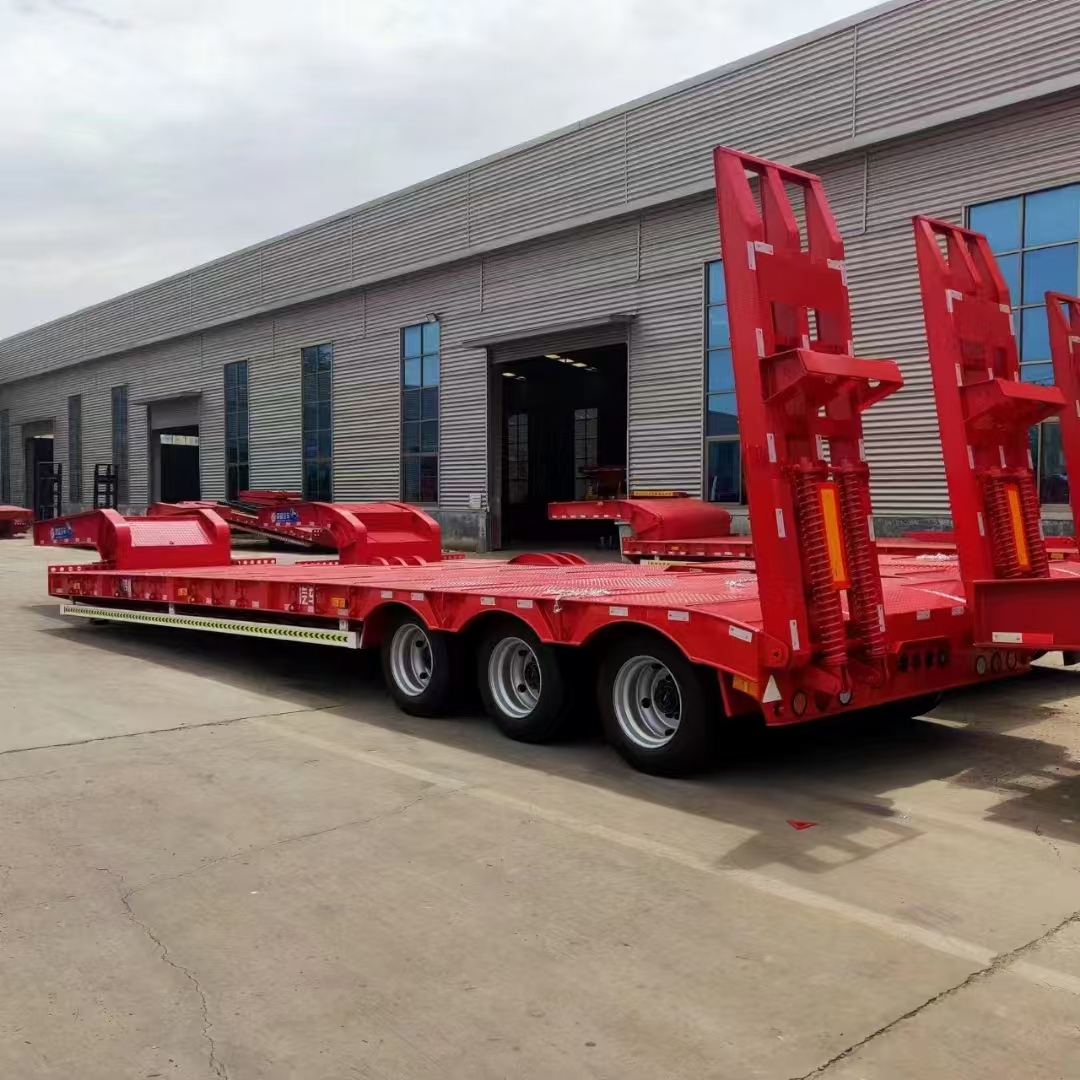
Lowboy Trailer For Sale: The core semi trailer for heavy and large scale equipment transportation

In the heavy industries such as construction machinery, power equipment, wind power energy, and steel metallurgy, lowboy trailer for sale undertake key tasks in national infrastructure construction.
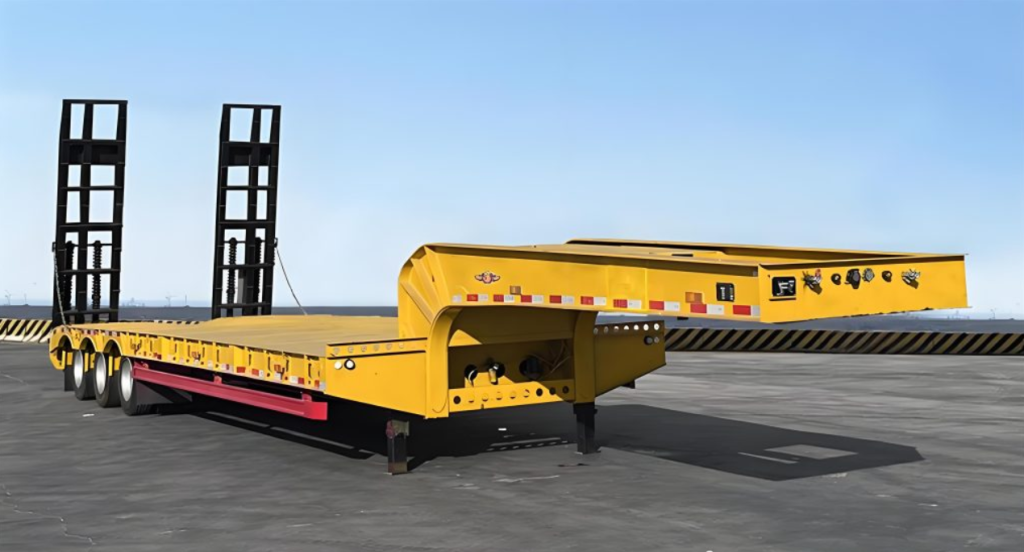
What is heavy duty lowboy trailer?
Lowboy Semi Trailer is a specialized transportation vehicle with a loading platform that is significantly lower from the ground than flatbed semi trailer.
Its typical features include:
Cargo platform height: Usually ranging from 0.8 meters to 1.2 meters (Flatbed Trailer: 1.3–1.6 meters), and for hydraulic type can reduced to 0.6 meters.
Structural composition: It consists of a front gooseneck , cargo platform , rear ramp , multi axle and so on.
Strong Points: By lowering the center of gravity, it solves the problem of high cargo clearance when passing through bridges, tunnels, and under traffic signals, and at the same time improves driving stability.
Key Feature of gooseneck lowboy trailer:
1. Extremely low platform height
When combined with air suspension or hydraulic suspension, the platform height can be as low as 650mm.
One 4.5m high excavator, when using a flatbed truck trailer, the total height is close to 6 meters (exceeding the limit), total height can control within 4.2 meters by heavy lowboy trailer.
2. Powerful carrying capacity
The semi truck lowboy trailer frame is made of high-strength steel (Q550/Q690), with a yield strength of 550–690 MPa, much more stronger than Q235 steel.
The single axle carrying capacity can reach over 20 tons, the entire vehicle loading capacity around 40–150 tons, suitable for the transportation needs of large construction machinery, wind power equipment, and special equipment.
Flexible number of axles: Commonly 2 axles (load ≤ 30t), 3 axles (≤ 40t), 4 axles (≤ 60t), 5 axles, or even 6 axles (up to 150t+).
Each axle equip with multiple or few spring suspensions, or hydraulic independent suspensions, evenly distributing the load and avoiding local overload.
3. Excellent driving stability
Low center of gravity
Reduced side inclination angle
Significantly improved safety in emergency turns or in crosswinds.
4. Flexible loading and unloading adaptability
The rear ladder can hydraumatic or mechanical type , with an angle as low as 12°–18°.
Some gooseneck can be hydraulically raised and lowered.
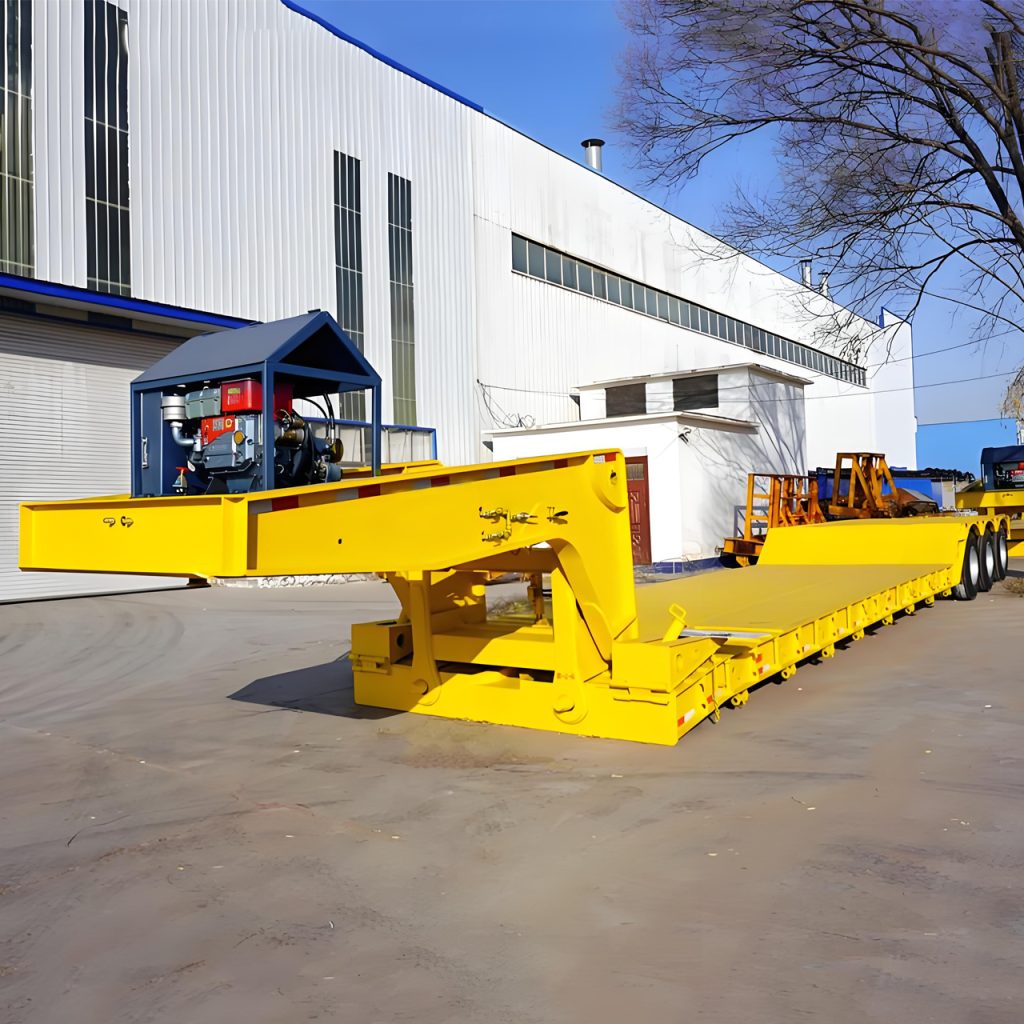
Type of heavy haul lowboy trailer for sale
Classified by structure and function:
1.Standard lowboy trailer for sale:
Structural feature: The gooseneck and the cargo platform are welding together can not disassemble. The height of the cargo platform is fixed
Core advantages: Simple structure, low manufacturing cost, high reliability during long-term use, and convenient maintenance.
Limitation: The length and width of the platform are set at the factory and cannot adjust .
2.Detachable lowboy trailer for sale
Structural features: Quick removable connection mechanism between the gooseneck and the cargo platform. The cargo platform can be independently lowered and lifted to load and unload goods. hydraulic lifting for optional.
Core Strengths: RGN lowboy trailer no need to ramps or cranes: Once the platform is lowered to the ground, the goods can push horizontally or driven up by themselves.
3.Extendable lowboy trailer
Feature: The platform adopts a telescopic or rail-type extension design (usually driven by hydraulic power), allowing the length of the platform to be adjusted continuously or in discrete steps according to the length of the goods. The typical extension range is from 6 to 12 meters (retracted) to 12 to 20 meters (extended).
Core Strengths:
Multi purpose vehicle: The short cargo platform configuration is suitable for urban conditions, while the long cargo platform configuration enables the transportation of extremely long goods.
Width adjustment suitable for wind turbine blades transportation.
Classified by suspension method
Mechanical steel spring suspension:
Low cost, easy maintenance, suitable for standard loads and paved roads.
Air suspension:
Excellent shock absorption, can slightly raise or lower the cargo platform (±100mm), suitable for precision equipment.
Hydraulic independent suspension:
Each wheel can independently rise and fall, can level or tilt as a whole (side or longitudinal tilt), suitable for low cargo platform requirements or extreme road conditions.
Classified by the number of axles
The number of axles directly determines the legal carrying capacity and driving stability of the vehicle.
| Number of Axles | Common Tire Configuration | Legal Load Range (tons) | Typical Total Length (m) | Recommended Cargo Examples |
| 2 axles | 8.25R16×8 | 20–30 | ≤9 | Small excavators, agricultural equipment |
| 3 axles | 8.25R16×12 | 35–45 | 13–16 | Medium excavators, road rollers |
| 4 axles | 12R22.5×16 | 50–65 | 14–17.5 | Large transformers, crawler cranes |
| 5 axles | Optional wide-base tires | 60–75 | 15–20 | Heavy transformers, reactors |
| 6 axles | Multiple combinations | 80–100 | >20 (requires permit) | Tunnel boring machines, engine cabins |
| 8+ axles | Axle modules | 120–150+ | Modular/adjustable | Oversized cargo, wind turbine blades |
| Line / Axle Configuration | Typical Tire Count | Load Capacity (tons) | Notes / Typical Use |
| 2 lines / 4 axles | 8–12 tires | 30–40 | Light-medium lowbed trailers |
| 3 lines / 6 axles | 12–18 tires | 45–60 | Most common medium lowbed trailers |
| 4 lines / 8 axles+ | Multiple tires | 100+ | Modular combination trailers (simplified SPMT) |
Application of lowboy equipment trailer:
Lowboy truck trailer specifically design for transporting cargo that cannot be dismantled, exceeds standard transport dimensions, or must be transported as a single, integral unit.
Construction Machinery Transport
Excavators (20–80 tons), bulldozers, road rollers, pavers, and rotary drilling rigs.
Equipment can load onto and unloaded from the lowboy trailer for sale without the need for a crane, thereby saving on operational costs.
Power and Energy Transport
Oil-immersed transformers (110 kV / 220 kV / 500 kV) weighing between 30 and 200 tons, often featuring irregular shapes.
Wind power generation equipment: blades (50–80 meters in length), nacelles (30–50 tons), and segmented tower sections.
Steel and Heavy Industry
Steel coils (hot-rolled/cold-rolled, 15–30 tons per coil), large castings and forgings, and segmented marine engines.
Military and Specialized Equipment
Tanks, armored vehicles, pontoon bridging equipment, and other machinery sensitive to ground clearance and center of gravity requirements.
Municipal and Emergency Services
Emergency power supply vehicles, large-scale hydraulic fracturing equipment, and tunnel boring machine components.
3 axle lowboy trailer specification
Here’s a detailed specification overview for a three axle lowboy trailer for sale:
| Feature | Specification / Description |
| Axles | 3 axles, heavy-duty, typically 13T–16T per axle |
| Tire Configuration | 12 tires (e.g., 8.25R16×12 or 315/80R22.5 depending on load) |
| Legal Load Range | 35–45 tons (can vary based on local regulations) |
| Deck Length | 13–16 meters (customizable) |
| Deck Width | Standard 2.5 meters (can be wider for special loads) |
| Deck Height | 1.1–1.3 meters (low deck to allow oversized cargo clearance) |
| Frame Material | High-strength steel with reinforced cross members |
| Suspension | Mechanical leaf spring or air suspension options |
| Kingpin | Standard 2-inch or 3.5-inch depending on tractor compatibility |
| Loading Capacity | Medium to heavy construction machinery, e.g., excavators, bulldozers, road rollers |
| Features | – Detachable gooseneck (RGN type) for easy drive-on loading – Side-mounted toolboxes – Optional hydraulic ramps – Anti-slip deck surface |
| Recommended Applications | Construction equipment transport, industrial machinery, medium transformers, and other heavy but non-overlength cargo |
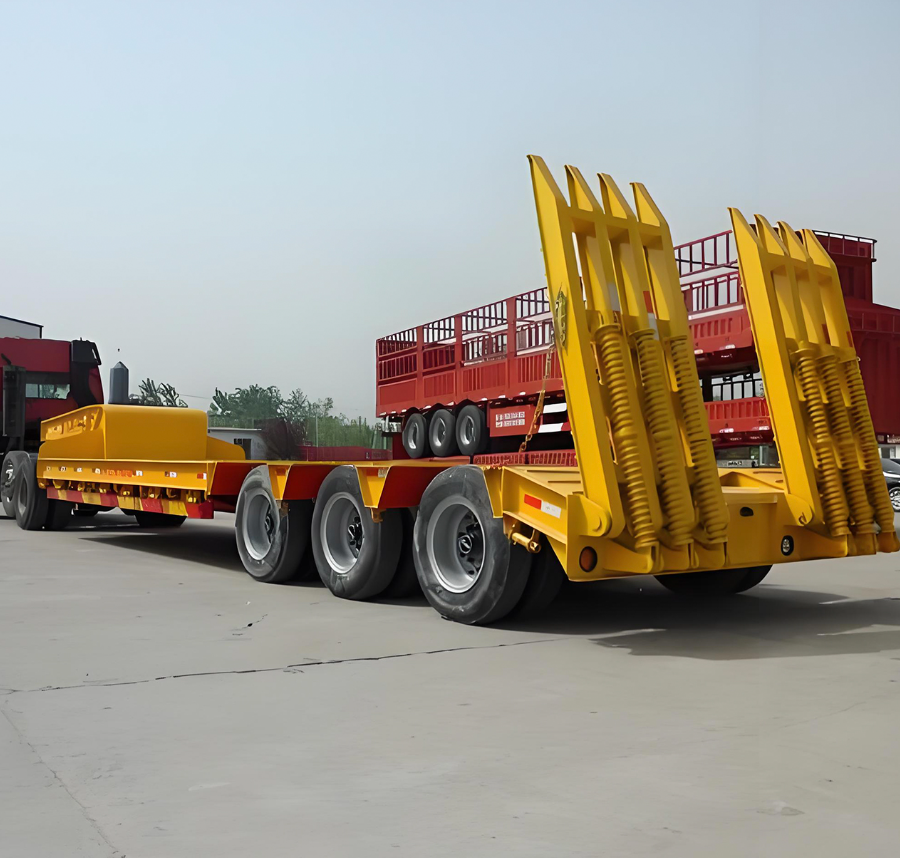
How to Choose the Right hydraulic lowboy trailer
Selecting the wrong lowboy semi trailer can lead to inefficient transport operations and pose safety risks. Please follow the steps below to ensure you make the right choice:
Step 1: Determine Cargo Characteristics
Weight: What is the maximum weight of cargo?
Dimensions: Length, width, and height (height is crucial for determining whether a lowbed trailer is required).
Loading Method: Can the cargo driven onto/off the trailer under its own power, or does it require lifting by a crane or the use of hydraulic ramps?
Step 2: Determine the Need for a Hydraulic Suspension System
Cargo Height ≤ 3.5 meters: Mechanical suspension is typically sufficient.
Height > 3.8 meters AND must pass under a bridge with a 4.2-meter clearance, Hydraulic suspension is require (deck height to lower).
Cargo Weight > 80 tons: An independent hydraulic suspension system recommend to ensure the cargo weight distribut evenly across all axles.
Step 3: Select the Number of Axles and Tires
Required Number of Axles ≈ (Total Cargo Weight + Trailer Weight) ÷ Legal Axle Load Limit (typically 10–13 tons).
Example: Cargo 60 tons + Trailer 10 tons = 70 tons → 70 ÷ 13 ≈ 5.4 → 6 axles require (e.g., a 3 line, 6 axle or 4 line, 8 axle configuration).
Step 4: Match with the Tractor Unit (Prime Mover)
Fifth Wheel Height: Must be ≤ 1.2 meters to prevent lifting the front of the trailer and compromising the low-deck clearance.
Fifth-Wheel Load Capacity: Check the weight at the kingpin (typically 25–35% of the cargo weight) to ensure the tractor’s rear axle can support the load.
Air and Electrical Connections: Multi-axle trailers typically require a dual-circuit air brake system, whereas a standard tractor unit may only be equipped with a single-circuit system.
Step 5: Select Optional Equipment
Hydraulic Detachable Ramps (replacing fixed ramps)
Side Guardrails
Multiple Tie-Down Points and Anchors (at least 12)
Aluminum Wheels (reduces weight but incurs higher costs)
FAQ
What is the difference between a standard lowboy and a hydraulic lowboy trailer?
Hydraulic lowboy semi trailer allow the deck to be lower or adjust during loading/unloading
Can a lowboy trailer transport cargo over long distances?
Yes, lowboy trailers design for long-haul transport of heavy and oversize equipment,
Why use a lowboy instead of a flatbed semi trailer?
Allows transport of taller cargo without violating height restrictions