
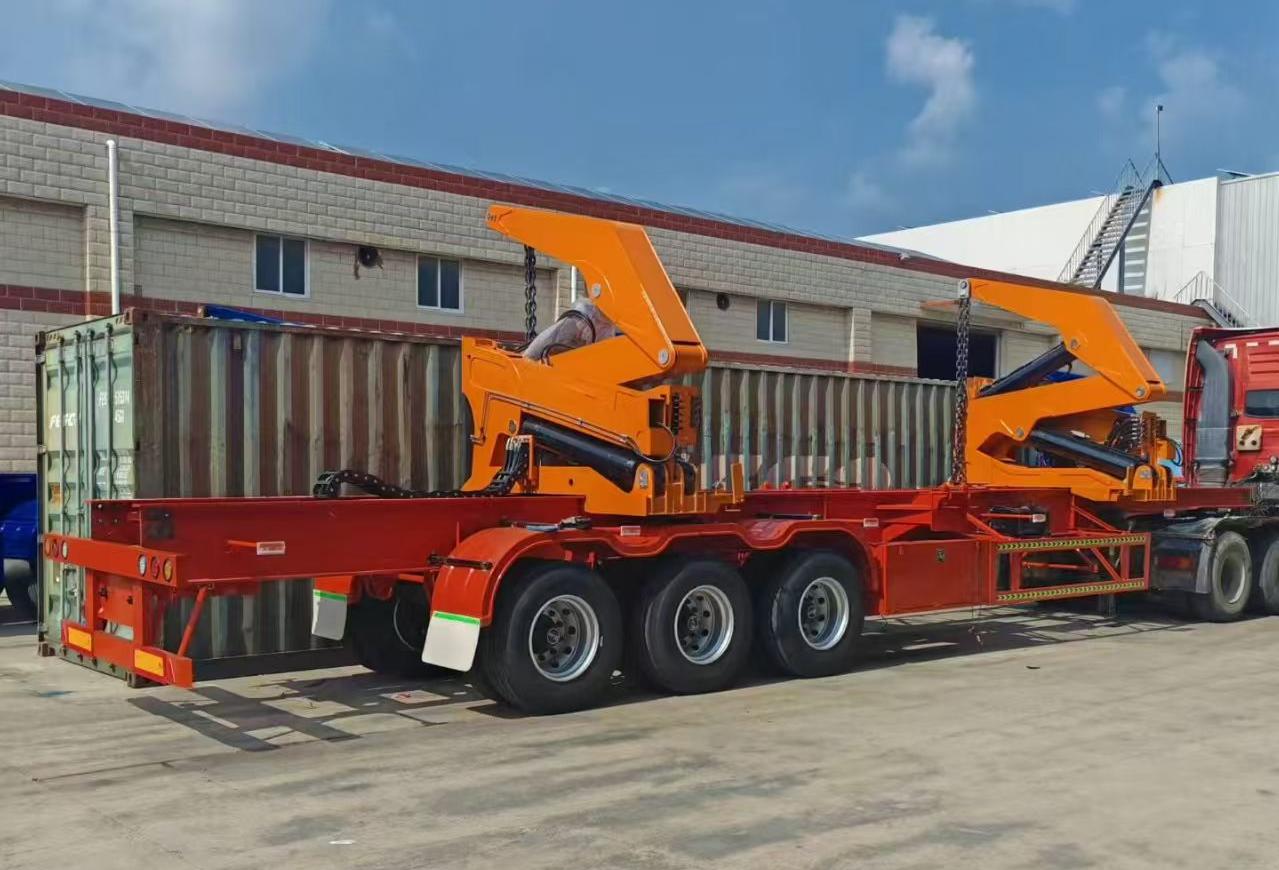
Container Side Loader Trailer Buying Guide: Lift, Transport & Unload 20ft/40ft Containers

Which container side loader do you need?
Quick Selection Guide
| No. | Application / Requirement | Recommended Equipment | Main Advantage |
| 1 | No crane on site / Remote delivery | Side Loader Trailer | Self-loading and unloading without an external crane |
| 2 | Port-only operations with cranes available | Container Chassis | Lower purchase and operating cost |
| 3 | 20 ft urban distribution | 20 ft Side Loader | Compact size and fast loading cycles |
| 4 | 40 ft international freight | 40 ft Side Lifter | Most common and versatile configuration |
| 5 | Mixed 20 ft + 40 ft containers | 20/40 Combination Side Loader | Maximum flexibility for different container sizes |
| 6 | Heavy / demanding loads | 40-ton-capacity Upgraded Model | Higher load capacity and stronger structure |
| 7 | 45 ft container routes in North America / Europe | 45 ft Side Loader | Designed for longer 45 ft containers |
Need a quote? Send your container sizes and routes — Get a quote.
Overview:
Container shipping has become a mainstay of international logistics. Millions of containers move between ports, warehouses, construction sites, railway terminals, and industrial facilities every day. While traditional container handling relies primarily on cranes, forklifts, or aerial work platforms, these devices are not always available, especially in remote sites or developing countries.This is where container side loader trailer become invaluable assets.
A side loader, also known as side loading trailer, is a specialized semi-trailers equipped with front and rear hydraulic lifting cranes. They can handle the loading, unloading, transport, and transportation of ISO containers without the need for external lifting equipment.
Unlike traditional container chassis, which can only be transported after a crane has loaded the container, sidelifter can perform three functions in one machine:
Lifting containers directly from the ground.
Safely transporting containers over long distances.
Precisely placing containers at their destination.
Due to this versatility, side loading trailer have become an essential solution for logistics companies, widely used by construction contractors, mining operations, military projects, ports, railway terminals, and remote infrastructure construction.
In this comprehensive guide, you will learn everything about container side loader trailer, including how they work, key components, lifting capacity, technical specifications, advantages, applications, and how to choose the most suitable side loader container for your business.
What Is a Container Side Loader?
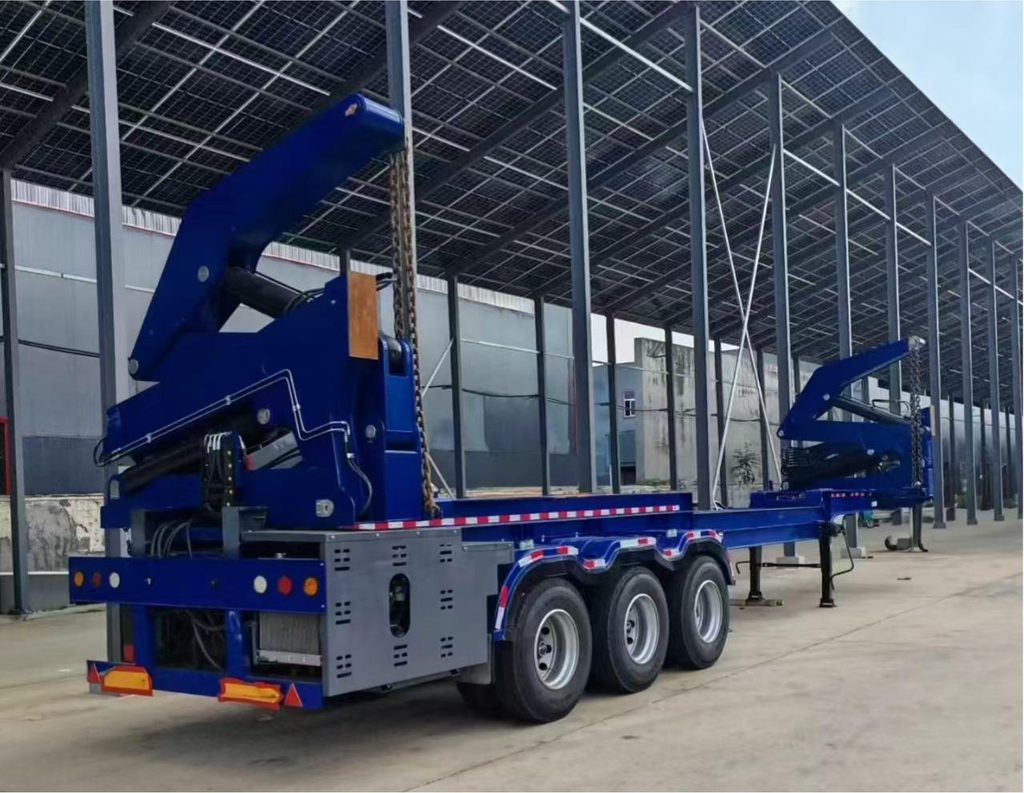
Side loader trailer transport is a hydraulic lifting trailer specifically designed for the independent loading, transport, and unloading of ISO standard containers.
Unlike standard container semi trailers, container side loaders integrate hydraulic cranes, allowing operators to lift containers directly from the ground or other trailers.
This eliminates the need for expensive handling equipment such as stackers, mobile cranes, gantry cranes, forklifts (for containers), and port lifting equipment. The lifting system typically consists of two synchronized hydraulic cranes located at the front and rear ends of the trailer.
These cranes work together to safely lift containers while maintaining excellent balance and stability.
Most side loader lift truck are designed to carry:
20 foot ISO container
40 foot ISO container
Empty container
Loaded container
High cube container
Refrigerated container
Open-top container
Flat pallet containers (depending on configuration)
Why Are Side Loading Trailers Becoming More Popular?
Global logistics companies face increasing pressure to reduce operating costs while improving efficiency.
Side loader trailer address several key issues:
Limited crane availability
Remote delivery locations
High labor costs
Confined unloading space
Shorter delivery cycles
Operators can independently complete the entire loading and unloading process without waiting for external lifting equipment.
This leads to:
Reduced operation time
Lower equipment rental costs
Increased vehicle utilization
Enhanced delivery flexibility
Faster project completion
For companies operating in Africa, Southeast Asia, the Middle East, South America, and remote mining areas, side loader trailer are often the most practical and cost-effective container handling solution.
How Does a Side Loading Trailer Work?
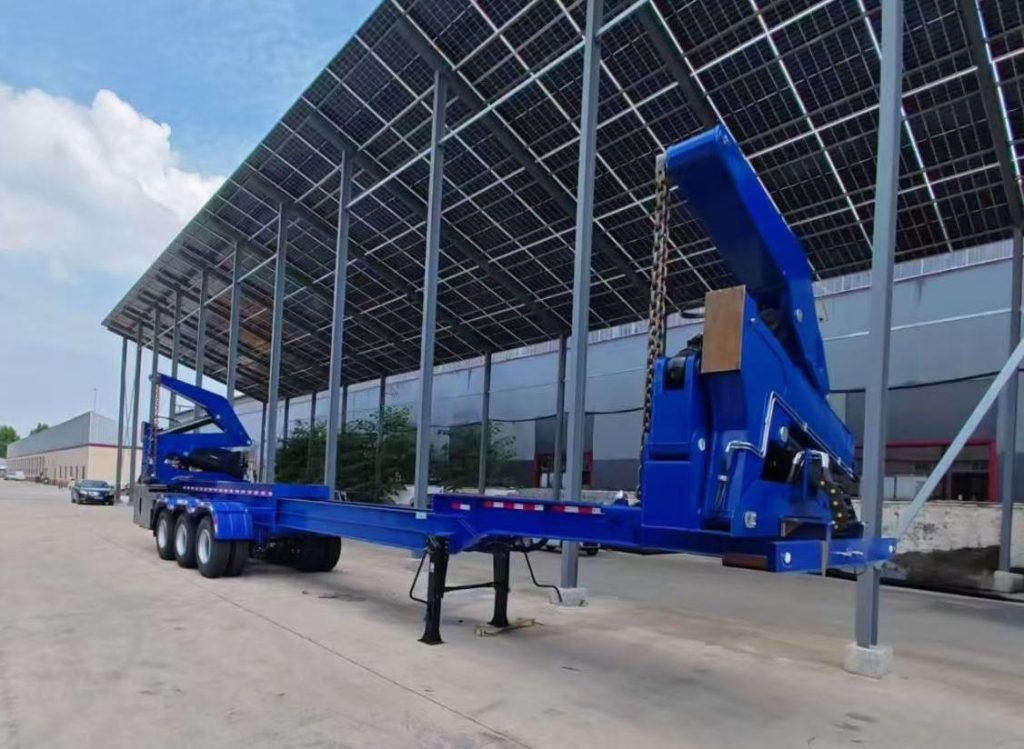
The working principle of a side loader trailer crane combines hydraulic engineering with synchronized lifting technology.
This trailer does not rely on an external crane, but instead uses two integrated hydraulic lifting units mounted at both ends of the chassis.
These lifting units work simultaneously and collaboratively to safely lift, move, and lower containers.
Step 1: Installing the Trailer
The driver parks the container side lifter semi trailer parallel to the container.
Hydraulic outriggers are deployed to stabilize the trailer before lifting begins.
Proper securing is crucial for ensuring safety and preventing excessive chassis movement.
Step 2: Extending the Hydraulic Cranes
The front and rear hydraulic cranes extend outwards towards the container.
High-strength lifting chains are connected to the container’s ISO corner castings.
Electronic synchronization ensures that both cranes operate at exactly the same speed.
This prevents uneven lifting forces, avoiding damage to the container or causing load instability.
Step 3: Lifting the Container
Once securely connected, the hydraulic system lifts the container vertically.
During lifting:
The two cranes remain synchronized.
The container remains level.
Hydraulic pressure is continuously monitored.
The operator controls the entire process via a wired or wireless remote control.
Modern side loader trailer can safely lift fully loaded containers weighing up to 36 to 40 tons, depending on the model.
Step 4: Loading the Container onto the Trailer
Once the desired height is reached, the container is moved laterally and placed on the trailer chassis.
The operator then carefully places the container onto the trailer’s twist locks.
The locks can be automatically or manually locked to secure the container during transport.
Step 5: Transporting the Container
Once the container is secured, the side loader trailer operates like a regular semi-trailer.
It can transport containers along highways, industrial roads, ports, or construction sites.
Most modern side loading trailers are compatible with standard tractor-trailers and meet ISO container transport requirements.
Step 6: Unloading at the Destination
At the delivery location, the process is reversed.
Hydraulic cranes lift containers from trailers and place them directly into position:
On the ground,On a concrete foundation,On a railcar,On another trailer
Next to a warehouse
On a construction site
This eliminates the need to schedule cranes or additional lifting equipment, saving time and operating costs.
Main Components of a Container Side Loader
A high-quality container lift side loader trailer consists of several key systems that work together to enable safe, reliable, and efficient container handling.
Understanding these components helps buyers assess product quality and long-term performance.
Main Chassis
The chassis is the structural foundation of the trailer.
It supports:
Hydraulic Lifting Crane
Container Weight Pausing
Axles
Gears
Leading manufacturers use high-strength structural steels such as:
Q355B
Q550
T700 High-Strength Steel
These materials provide excellent strength while reducing the overall weight of the trailer.
Hydraulic Lifting Crane
The hydraulic lifting crane is the most prominent feature of a container side loading trailer.
Each trailer is typically equipped with:
Front Lifting Crane
Rear Lifting Crane
These cranes work together to lift containers smoothly and safely.
High-quality hydraulic cylinders ensure:
Stable Lifting
Smooth Operation
Long Service Life
Low Maintenance Requirements
Hydraulic Power Unit
The hydraulic power unit provides energy to the lifting system.
Typically includes:
Hydraulic pump
Oil tank
Control valve
Hydraulic hose
Pressure sensor
Electrical control system. Reliable hydraulic performance is crucial for lifting heavy containers under harsh working conditions.
Twist Lock System
Twist locks secure the container during transport.
A typical container sideloader is equipped with four ISO-compliant twist locks that connect to the corner castings of the container.
This locking device prevents movement during braking, acceleration, and cornering, ensuring maximum safety during transport.
Container Side Loader Specifications
Choosing the right container side loader trailer begins with understanding its technical specifications. Dimensions, load capacity, axle configuration, and hydraulic performance directly impact transport efficiency, operational safety, and compliance with local road regulations.
While manufacturers can customize the side loader for specific applications, most models adhere to standard ISO container transport requirements.
| Item | Specification |
| Overall Length | 12,500–14,500 mm |
| Overall Width | 2,500 mm |
| Overall Height | 4,000 mm (transport position) |
| Trailer Weight | 9–13 Tons |
| Maximum Payload | 36–40 Tons |
| Suitable Container Sizes | 20ft / 40ft / 45ft (optional) |
| Lifting Capacity | Up to 40 Tons |
| Hydraulic Operating Pressure | 28–32 MPa |
| King Pin | 2″ or 3.5″ |
| Landing Gear | Heavy-duty two-speed |
| Brake System | Dual-line air brake with ABS |
| Suspension | Mechanical / Air Suspension |
| Axles | 2 or 3 Axles |
For customers transporting oversized or specialized containers, manufacturers can provide custom solutions with extended chassis lengths, reinforced frames, and higher lifting capacities.
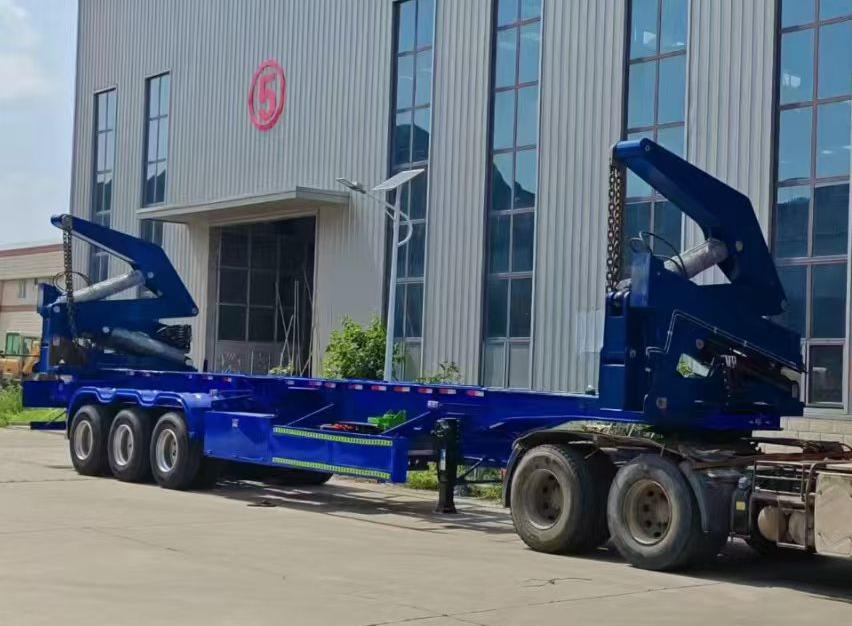
Side Lifter Lifting Capacity
One of the most important considerations when purchasing a container side lift trailer is its lifting capacity.
Most standard models are designed to safely lift and transport fully loaded ISO shipping containers.
| Container Type | Maximum Weight |
| 20ft Empty Container | Approx. 2.3 Tons |
| 20ft Loaded Container | Up to 36 Tons |
| 40ft Empty Container | Approx. 3.8 Tons |
| 40ft Loaded Container | Up to 36 Tons |
| 40ft High Cube | Up to 36 Tons |
| 45ft Container | 32–36 Tons (depending on model) |
Premium self loading container trailer equipped with upgraded hydraulic systems and reinforced chassis can lift containers weighing up to 40 tons, making them suitable for demanding industrial applications.
Factors Affecting Lifting Capacity
The rated capacity of a side loading container depends on several engineering factors.
Hydraulic Cylinder Performance
Hydraulic cylinders generate the lifting force required to lift the container.
High-quality cylinders offer:
Higher lifting force
Smooth operation
Less maintenance
Longer service life
Rugged chassis
The trailer frame must withstand both vertical lifting force and transport load.
Manufacturers typically use:
Q355B structural steel
Q550 high-strength steel
T700 high-strength steel
These materials ensure superior strength while minimizing trailer weight.
Axle Configuration
Additional axles improve load distribution.
Typical configurations include:
| Axles | Recommended Application |
| 2 Axles | Light container transport |
| 3 Axles | Standard logistics |
| 4 Axles | Heavy-duty container operations |
Three axle side loader trailers are the most popular choice because they provide an excellent balance between payload capacity, road compliance, and operating costs.
Types of side loader trailer
Different industries have varying lifting capacity requirements, therefore manufacturers offer a variety of types of side loading semi trailer.
20ft Container Side Loader
Designed specifically for 20ft container.
Advantages:
Compact size
More flexible operation
Lower procurement costs
Faster loading cycles
Ideal for typical urban distribution applications
Local logistics
Construction sites
Small warehouses
Municipal projects
Best for:urban distribution, local logistics, small warehouses, municipal projects.
Not ideal for:40 ft international freight — choose the 40 ft or combo model.
→ Get a 20 ft side loader quote
40ft container side loader trailer
The most widely used side lift globally.
Designed for both:
20ft container
40ft container
Advantages include:
Greater flexibility
Higher transport efficiency
Lower operating costs per container
Suitable for international shipping
Best for:international shipping, most container operations.
Not ideal for:small urban runs where a 20 ft model is cheaper.
→ Get a 40 ft side loader quote
20ft/40ft Combination Side Loader
Many logistics companies prefer the combination model because it offers maximum flexibility.
Benefits include:
Lifting both 20-foot and 40-foot containers
Reduced fleet size
Lower equipment investment
Increased utilization
This is currently the most popular configuration in global logistics.
45ft Container Side Loader
45 foot containers are frequently used in certain industries, particularly in North America and Europe.
Optional dedicated side-loading trailers are available, equipped with:
Extended chassis
Longer lifting boom
Reinforced frame
Improved stability
Best for:mixed-size fleets and leasing — one trailer, max flexibility.
Not ideal for:single-size operations — a dedicated model is cheaper.
→ Get a combo side loader quote
Double Crane side loader trailer
The double boom side lifter lift uses two independently controlled hydraulic lifting units.
Advantages include:
Excellent lifting stability
Higher positioning accuracy
Greater safety
Reduced container deformation
Faster operation
This configuration is standard on most high-end side loading trailers.
Best for:heavy loads, precise placement, demanding stability.
Not ideal for:budget-limited fleets — higher-end configuration.
→ Get a twin-boom side loader quote
Side Loader vs Container Chassis
Many buyers wonder whether they need a container chassis or a container side loader.
Although both transport shipping containers, their capabilities are very different.
| Feature | Side Loader Trailer | Container Chassis |
| Transport Container | Yes | Yes |
| Lift Container | Yes | No |
| Load Without Crane | Yes | No |
| Unload Independently | Yes | No |
| External Equipment Needed | No | Yes |
| Purchase Cost | Higher | Lower |
| Operating Flexibility | Excellent | Moderate |
| Suitable for Remote Sites | Excellent | Limited |
Choose a side loader if: no cranes on site, delivery locations change, containers must be placed on the ground, remote projects are common.
Choose a chassis if: containers are always loaded at ports, cranes are available, budget is the priority.
How to Choose the Right Container Side Loader
Use this 5-step process — it is how we size a side loader for a customer.
Step 1 — Container sizes.
20 ft, 40 ft, or 45 ft? Single-purpose or combo?
Step 2 — Lifting capacity.
What is the max loaded weight you will handle (up to 36 t standard, 40 t upgraded)?
Step 3 — Operating environment.
Ports, construction sites, mining, or remote regions?
Step 4 — Transport distance & regulations.
Long-haul → reinforced chassis + air suspension; confirm axle config and GVW compliance.
Step 5 — Future needs.
A combo 20/40 model usually offers better long-term flexibility.
FAQ 1: What is a container side loader?
A container side loader is a trailer with hydraulic cranes that can lift, transport, and unload 20ft or 40ft shipping containers without external lifting equipment.
FAQ 2: What is the difference between a side loader and a side lifter?
There is no significant difference. Side loader and side lifter are commonly used to describe the same type of container handling trailer.
FAQ 3: How much can a side lifter lift?
Most side lifters can safely lift and transport loaded containers weighing up to 36–40 tons, depending on the model.
FAQ 4: Can a side loading trailer lift both 20ft and 40ft containers?
Yes. Most side loading trailers are designed to handle both 20ft and 40ft ISO containers, and some models also support 45ft containers.
FAQ 5: Why choose a side loader trailer?
A side loader trailer reduces loading time, eliminates the need for cranes, lowers operating costs, and improves efficiency for container transportation.