
lowbed trailer | Buy Guide | Choose the Perfect Low-Deck Trailer in Minutes

Introduction
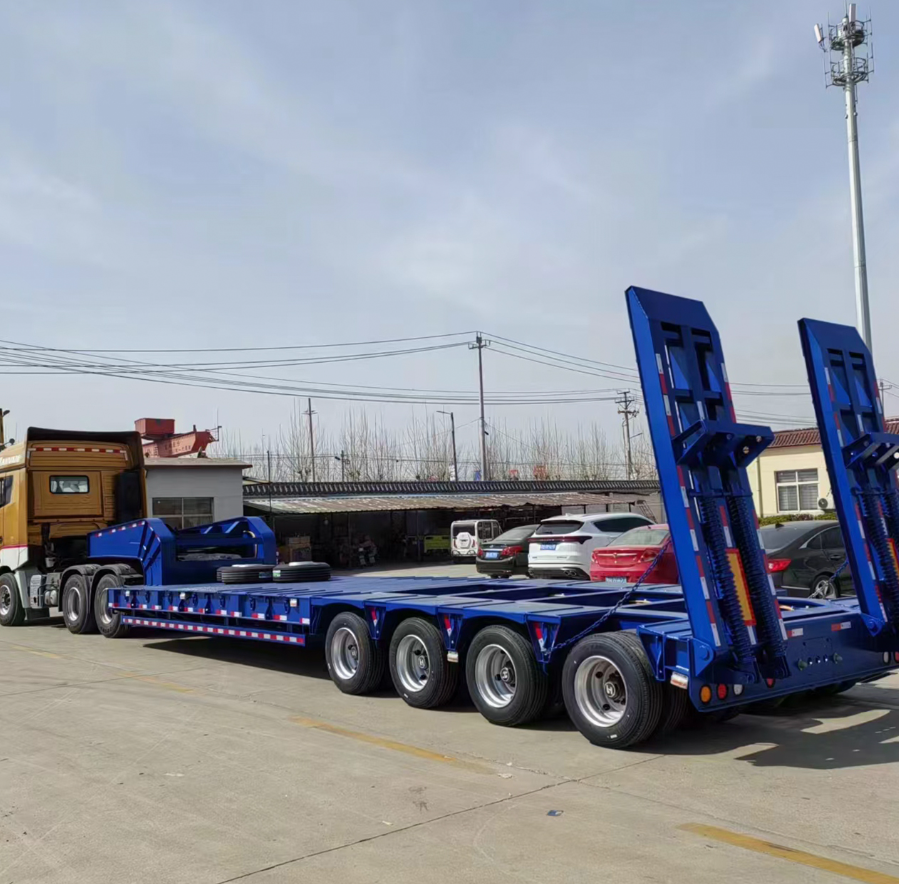
lowbed trailer exists for one core reason: tall, heavy equipment becomes far easier to move when the deck sits closer to the road. A lower platform reduces the combined center of gravity of the tractor–trailer–payload system, which improves stability through corners, ramps, and uneven surfaces. It also helps manage clearance under bridges and overhead lines, and it often simplifies loading because approach angles can be gentler.
This guide is written as a practical selection manual. It focuses on benefits, use cases, real-world configuration logic, pairing methods, and common questions. The goal is a clean spec process: define the payload set, pick the loading method, set axle strategy for compliance, and then finalize deck geometry, suspension, and accessories.
Where low-deck transport delivers the biggest advantage
Low-deck heavy-haul work is not limited to one industry. It shows up wherever payload height, weight concentration, and loading constraints overlap.
Construction and infrastructure rotation
Job sites change quickly. Equipment is redeployed constantly. Typical payloads include excavators, bulldozers, loaders, rollers, pavers, and crane components.
Why low-deck transport helps in construction:
- Better stability on mixed road quality.
- Improved clearance for tall equipment with attachments left installed.
- Faster site turnaround when loading workflow is smooth.
Loading workflow tends to be the deciding factor. Tracked machines often benefit from front-loading configurations. Wheeled machines often load easily from rear ramps when approach angles are reasonable.
Mining, quarry, and heavy earthmoving
Mining and quarry operations emphasize durability. Loads may be abrasive, weight is concentrated, and route surfaces vary widely.
Low-deck transport advantage in mining:
- The lower platform improves stability on rough corridors.
- Multi-axle layouts distribute weight, reducing stress per wheel position.
- Reinforced deck and beam structures handle repeated heavy cycles.
Maintenance access matters more here than “headline features.” A configuration that is easy to inspect and service tends to deliver higher uptime.
Energy, industrial relocation, and heavy modules
Industrial modules often bring unique shapes and high value. Vibration, harsh braking, and poor securement can damage payloads.
Low-deck transport advantage in industrial moves:
- Height control supports easier route planning.
- A stable platform reduces load motion over long distances.
- Securement geometry can be cleaner when the deck is lower.
Many heavy modules require a deck layout that supports multiple tie-down patterns and keeps anchor points accessible even when the load is wide.
Agriculture and oversized seasonal equipment
Agricultural machinery can be tall, wide, and awkward. Some units have low ground clearance or fragile undercarriage components.
Low-deck transport advantage in agriculture:
- Gentler loading angles reduce underbody contact risk.
- Better control of total transport height with attachments.
- Flexible deck width strategies for seasonal mixed loads.
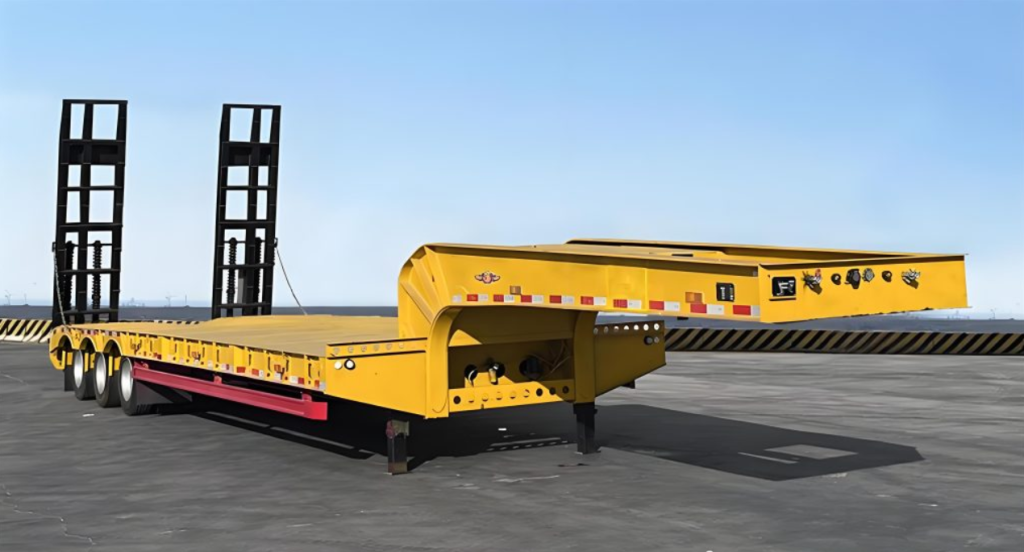
Anatomy of a low-deck heavy-haul semi-trailer
Understanding the main assemblies makes spec decisions easier. Most low-deck systems can be broken into five functional zones.
1) Gooseneck (front connection)
This area ties the trailer to the tractor via the kingpin/fifth-wheel interface. Gooseneck design strongly influences:
- Loading method (front-loading vs rear-loading).
- Turning clearance with the tractor.
- Structural stress at the transition into the main deck.
2) Main deck (working platform)
This is where the payload sits. Deck design influences:
- Usable length and width for real equipment footprints.
- Crossmember density for track loads.
- Tie-down geometry and anchor placement.
- Surface friction behavior under vibration.
3) Rear frame and loading interface
Rear structure typically holds ramps, a beavertail approach, or other loading components. Rear geometry influences:
- Approach angle.
- Breakover angle for low-clearance machines.
- Ramp deflection under load.
- Space required at the loading site.
4) Axle group and running gear
Axles, suspension, brakes, hubs, and wheels determine:
- Load distribution and legal compliance.
- Ride behavior.
- Tire heat and wear.
- Braking stability under heavy inertia.
Multi-axle strategies are common in heavy-haul solutions, and axle count often scales with payload requirements.
5) Securement system and accessory interfaces
Tie-down points, chain trays, recessed lashing pockets, and storage options determine:
- Securement efficiency.
- Repeatability for common payloads.
- Daily workflow speed.
The core benefit: lower deck height changes physics, not just clearance
Many people first think of “bridge clearance.” That is real, but not the full story. Lower deck height also improves stability because it reduces the center of gravity and the roll moment arm. Pages on Boca Vehicle’s site describe low platform height ranges for low-deck transport designs and their role in staying within height limits.
Stability improvements that matter on the road
Lower deck height tends to reduce:
- Lateral sway during lane changes.
- Risk of rollover in curved ramps.
- Load shift under hard braking.
- Bounce effects on uneven pavement.
The effect is most noticeable with tall machines and modules.
Clearance planning becomes less fragile
A route that barely works on paper is expensive in practice. A lower deck provides more clearance margin, which reduces:
- last-minute route changes,
- forced detours,
- and high-risk site entrance improvisation.
Loading becomes more practical for mixed job sites
A lower platform can:
- reduce ramp angle for rear-loading,
- improve front-loading geometry in removable-neck designs,
- and limit undercarriage strikes for low-clearance machines.
Configuration types and how to choose the right one
Configuration is the first major decision because it locks in the loading method.
Fixed-neck low-deck design (rear loading)
A fixed-neck design uses rear ramps for loading. It tends to fit operations with:
- Frequent wheeled equipment.
- Predictable loading space behind the trailer.
- A preference for simpler structure and fewer interfaces.
Strengths:
- Simple connection structure.
- Consistent daily workflow.
- Often fewer moving parts around the neck.
Constraints:
- Ramp angle can become limiting for tracked machines.
- Some low-clearance equipment may scrape at ramp transitions.
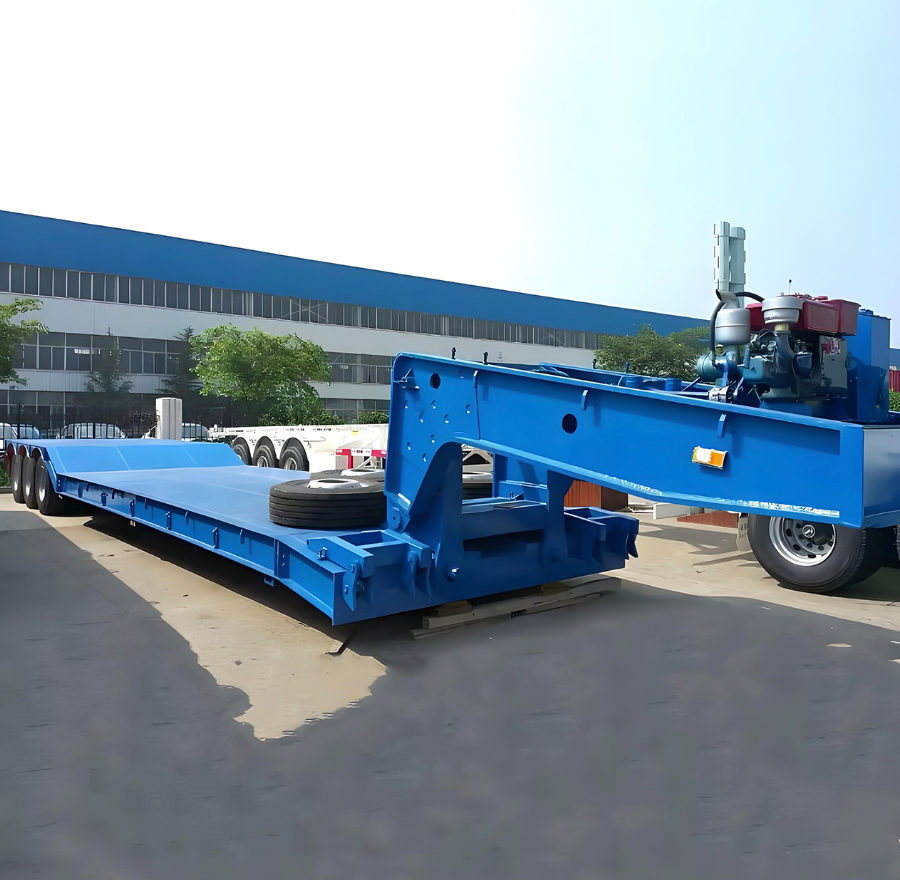
Detachable gooseneck (front loading)
A detachable gooseneck allows front-loading by separating the front section. Boca Vehicle’s content describes front-loading concepts and the efficiency benefits of detachable lowboy-style configurations for heavy machinery.
Best fit:
- Tracked machines that dislike steep ramps.
- High-frequency loading and unloading.
- Job sites with limited rear space.
Strengths:
- Front-loading often reduces reliance on ramps or cranes.
- More natural approach angle for tracked machines.
Constraints:
- Locking and interface inspection becomes critical.
- More components require consistent maintenance discipline.
RGN (removable gooseneck) style
RGN concepts are widely associated with removable gooseneck connection and front-loading capability. Boca Vehicle’s RGN guide describes removable gooseneck connection options and typical multi-axle scaling.
Best fit:
- Tracked construction equipment.
- Heavy equipment redeployment with high tempo.
- Mixed payload sets that include machines with low clearance.
Strengths:
- Front-loading supports safer approach geometry for tracked equipment.
- Multi-axle options scale across payload needs.
Constraints:
- Higher operational discipline required around reconnection and lock checks.
Extendable deck options (when length varies)
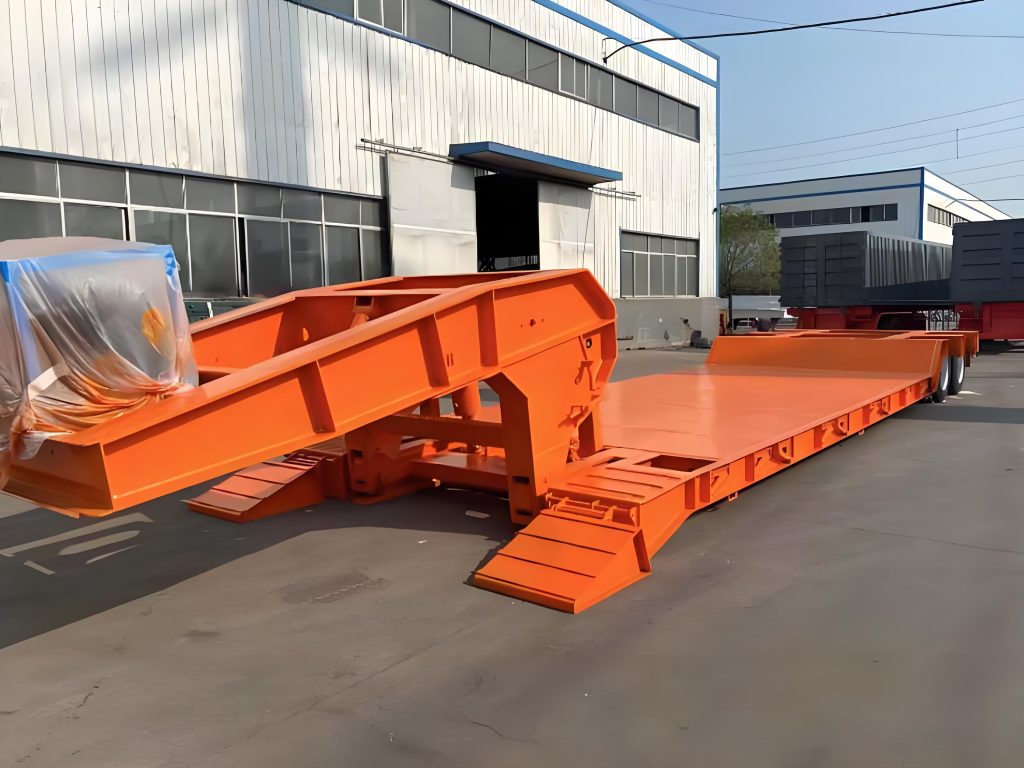
Extendable decks solve a different problem: length variability. They are useful when:
- components are long,
- payload length changes frequently,
- and a single trailer needs to cover multiple job types.
Strengths:
- One platform covers more load lengths.
- Better distribution for long modules.
Constraints:
- More interfaces require inspection.
- Maneuverability and route constraints become more demanding.
Axle count: the foundation for compliance, stability, and tire life
Axle strategy should be set early. It affects legal compliance, road impact, braking distribution, and tire wear.
Why axle count is not only about “more tons”
More axles generally help distribute weight, but they also influence:
- turning scrub and tire wear,
- maintenance workload (more hubs, brakes, sensors),
- and route feasibility (bridge and lane constraints).
Boca Vehicle’s RGN guide describes typical axle scaling and payload ranges across configurations.
Practical axle selection logic
A stable process:
- Define the heaviest and most restrictive payload
Include attachments, fuel, and configuration. - Model weight distribution
Consider the split between tractor fifth wheel and trailer axles. - Match axle count to regulatory reality
Rules differ by region. The goal is predictable compliance, not theoretical maximum rating. - Add margin for future equipment changes
Fleet payload sets evolve. A small margin can prevent early replacement.
Axle spacing and maneuverability
Longer axle groups increase stability and distribution but can:
- increase turning radius,
- increase scrub in tight corners,
- and demand more careful yard planning.
Suspension: durability, ride control, and load protection
Suspension choice depends on environment and payload sensitivity. Boca Vehicle content references mechanical and air suspension options in heavy-haul product specifications and buying guides.
Mechanical suspension
Common strengths:
- Rugged and durable for harsh environments.
- Simpler inspection and service routines.
- Often preferred where debris and site abuse are common.
Common constraints:
- Rougher ride than air systems for sensitive modules.
- More vibration transferred into the deck.
Air suspension
Common strengths:
- Improved ride behavior for sensitive cargo.
- Better leveling capability in some applications.
- Often smoother highway performance.
Common constraints:
- Air system integrity becomes mission-critical.
- Damage to lines or valves can create downtime quickly.
Hydraulic systems (where used)
Hydraulic systems are sometimes used for specific control needs. Boca Vehicle’s RGN guide notes mechanical or hydraulic systems for gooseneck removal and highlights smoother operation as a benefit of hydraulic options.
Deck geometry: length, width, and real footprint planning
Deck geometry decisions should follow payload footprint, not marketing labels.
Deck length: fit the footprint plus securement space
Deck length must cover:
- the machine footprint,
- space for safe tie-down angles,
- and clearance for attachments or protrusions.
Too short:
- forces awkward load placement,
- increases risk of poor weight distribution,
- and can create tie-down interference.
Too long:
- reduces maneuverability,
- increases turning sweep,
- and can increase route constraints.
Deck width: avoid “over-width by default”
Width strategy usually works best when:
- standard width covers most loads,
- wideners are used only when required,
- tie-down points support both narrow and wide load patterns.
Crossmember density and track loads
Tracked machines concentrate weight along track lines. Deck structure should support:
- repeated track contact,
- resistance to local deformation,
- and long fatigue life.
Loading systems: ramps, approach angle, and cycle efficiency
Loading is where time is gained or lost. It is also where most avoidable damage occurs.
Rear ramp loading: strong, common, and space-dependent
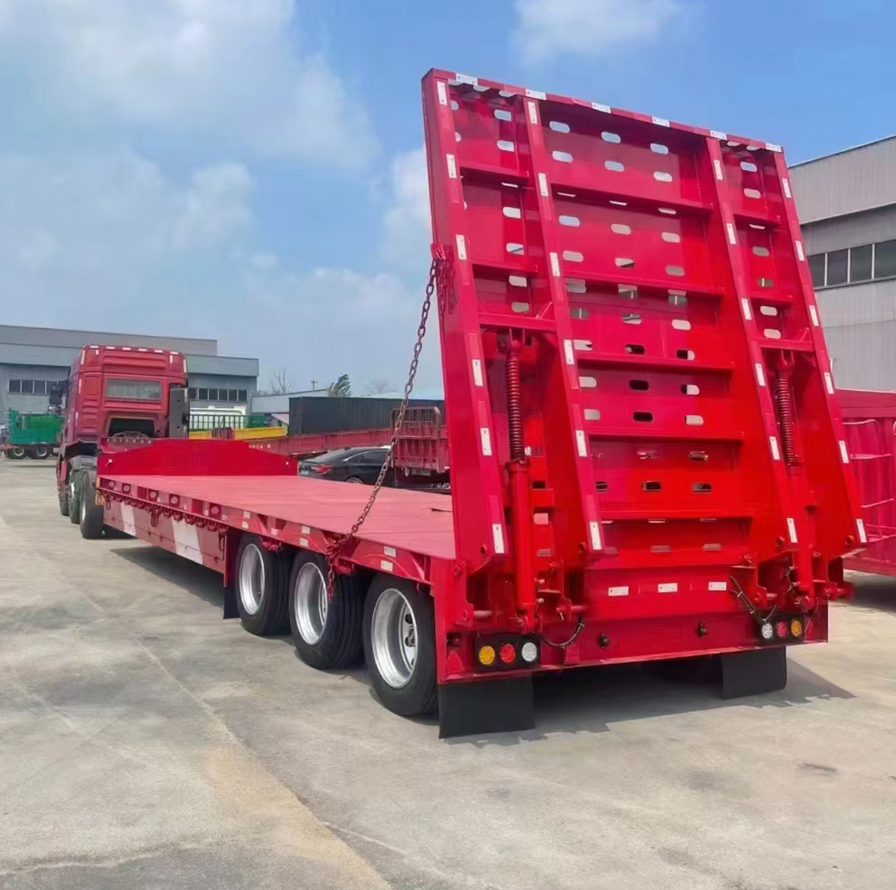
Rear ramps work well when:
- the job site provides enough straight space behind the trailer,
- the ramp angle matches machine clearance,
- and ramps are designed for repeated load cycles.
Key ramp quality signals:
- hinge strength and support design,
- ramp traction surfaces,
- consistent locking and stow system,
- low deflection under heavy climbs.
Front-loading: efficiency and lower approach stress
Front-loading via detachable or removable gooseneck can:
- reduce approach angle,
- reduce risk of undercarriage strikes,
- and improve loading efficiency in repeated cycles.
Boca Vehicle’s detachable lowboy guide describes front-loading efficiency as a key reason these designs are popular.
Breakover angle: the quiet limiter
Even if a machine can climb a ramp, it may scrape at the transition between ramp and deck. Breakover risk increases with:
- short ramp length,
- steep ramp angle,
- low machine ground clearance,
- and sharp deck transition geometry.
Securement: stability comes from geometry and repeatability
Securement is not just compliance. It protects the payload, the trailer, and the schedule.
Tie-down points: placement matters more than quantity
Useful tie-down systems:
- provide anchor points along the deck edges,
- include reinforced lashing areas near high-stress zones,
- support clean chain angles without crossing fragile machine parts.
Chain angles: avoid shallow geometry
Shallow angles reduce vertical restraint. Better geometry:
- pulls down as well as back,
- prevents bounce and creep under vibration,
- reduces mid-route re-tension cycles.
Friction management: the deck surface matters
Even strong securement can loosen over time if the contact interface creeps under vibration. Friction aids include:
- anti-slip surface zones,
- appropriate mats where permitted,
- deck surfaces designed to resist polishing and wear.
A practical securement workflow
A repeatable workflow helps reduce errors:
- Plan anchor points before loading
- Load centered and balanced
- Apply primary restraints
- Add secondary restraints where needed
- Short-move check (first checkpoint re-tension)
- Route checkpoint checks on rough segments
Pairing strategy: tractor, fifth wheel, and system compatibility
A heavy-haul trailer cannot be specified alone. Pairing determines real-world performance.
Fifth wheel height and deck attitude
The coupling height affects:
- deck pitch,
- ramp geometry,
- axle load split,
- and clearance at the gooseneck transition.
A stable deck attitude reduces:
- uneven axle loading,
- excessive tire heat,
- and ramp approach problems.
Tractor power and driveline match
Power is not just about speed. It affects:
- controlled starts on grade,
- low-speed maneuvering on site,
- and stable performance under heavy inertia.
Air lines, electrical, and hydraulic interfaces
Downtime often comes from interface wear:
- air line routing damage,
- electrical connector corrosion,
- hydraulic hose abrasion (where used).
Routing and protection matter as much as component rating.
Accessories and options that improve daily efficiency
Options should solve recurring operational pain points.
Storage: chain trays and toolboxes
Benefits:
- faster securement setup,
- fewer missing components,
- cleaner inspection workflow.
Outriggers and support legs
Stability during loading and detachment benefits from strong support. Boca Vehicle’s user case content describes stability benefits from heavy-duty support systems and discusses pre-shipment protection practices.
Deck surface upgrades
Useful upgrades include:
- checkered plate patterns,
- wear plates in high-contact zones,
- reinforced lashing pockets.
Corrosion protection for sea routes
For export and sea transport, Boca Vehicle’s user case describes wax treatment and waterproof covering to reduce corrosion risk during sea transport.
Typical applications and “best-fit” combinations
This section connects job types to configuration logic.
Scenario 1: Frequent tracked equipment redeployment
Common loads:
- excavators,
- dozers,
- pavers,
- large tracked attachments.
Best-fit direction:
- front-loading configuration (detachable/removable gooseneck)
- deck structure designed for repeated track contact
- securement layout built around track machine anchor points
Scenario 2: Tall industrial modules with strict clearance constraints
Common loads:
- generators,
- transformers,
- skid modules,
- large pumps and press equipment.
Best-fit direction:
- lower deck height emphasis for clearance margin
- multi-axle distribution for compliance and stability
- securement planned around fragile protrusions and tie-down access
Scenario 3: Mixed fleet with wheeled equipment and steady loading yards
Common loads:
- loaders,
- compactors,
- trucks or wheeled machines with adequate clearance.
Best-fit direction:
- rear-ramp loading configuration if yard space is consistent
- ramp system designed for repeated cycles
- strong deck friction management to limit creep
Scenario 4: Long components with changing length requirements
Common loads:
- structural beams,
- pipe modules,
- wind and energy components (by segment).
Best-fit direction:
- extendable deck option
- axle strategy set for the longest expected configuration
- route planning discipline to manage turning sweep
Selection method: a step-by-step framework that avoids spec mistakes
A structured selection method reduces rework.
Step 1: Define the payload set (not a single payload)
List:
- top 10 most common loads,
- the heaviest load,
- the tallest load,
- the widest load,
- and the most clearance-sensitive load.
Include attachment combinations because attachments often change height and length more than expected.
Step 2: Choose loading method first
Loading method drives configuration choice:
- tracked machines and high-tempo work often align with front-loading designs
- steady yard work with adequate space often works well with rear ramps
Step 3: Set axle strategy for compliance and stability
Use:
- weight distribution planning,
- region rules and corridor constraints,
- and margin for future equipment.
Boca Vehicle pages describe axle scaling and typical configuration ranges for heavy-haul lowboy/RGN solutions.
Step 4: Lock deck geometry
Deck geometry must match:
- real footprint,
- securement space,
- and turning reality.
If occasional long loads exist, consider whether extendable deck is better than a permanently long deck.
Step 5: Choose suspension for environment
- rough sites: durability-first systems
- sensitive modules: smoother ride systems
Boca Vehicle’s RGN guide discusses suspension considerations such as air vs mechanical based on transport conditions.
Step 6: Define securement infrastructure
Securement should be repeatable:
- anchor point density,
- tie-down point placement,
- storage and workflow.
Step 7: Confirm tractor pairing and interfaces
Confirm:
- fifth wheel height,
- braking capacity,
- air and electrical compatibility,
- hydraulic supply if detachable systems require it.
Step 8: Finalize accessory package
Accessories should address recurring constraints:
- soft ground,
- tight yards,
- export environments,
- frequent securement cycles.
Operating practices that protect the trailer and the payload
Even the right specification can underperform without consistent operating routines.
Loading discipline
A clean loading discipline reduces deck damage and securement rework:
- centered climb-on alignment,
- controlled speed,
- consistent ramp inspection,
- and defined stop points for re-check.
First checkpoint re-tension
A short-move re-check captures early settling. It reduces:
- mid-route corrections,
- chain slack accumulation,
- and tie-down creep.
Planned inspection intervals
Inspection priorities:
- neck locks and pins,
- hydraulic connections (if used),
- brake lines and chamber integrity,
- suspension fasteners and bushings,
- tire pressure and heat behavior.
Boca Vehicle’s content includes maintenance-oriented points such as checking locking systems, lubricating hydraulic components, and inspecting air lines and brakes.
Common mistakes and how to avoid them
Mistake 1: Selecting by “tons” without distribution planning
Tonnage is not the same as compliance. Axle load distribution is what interacts with regulation and road limits.
Avoid by:
- modeling axle loads,
- confirming tractor-trailer load split,
- and adding compliance margin.
Mistake 2: Ignoring loading space at job sites
Rear ramps require straight-line space. Front-loading needs stable staging and clean reconnection workflow.
Avoid by:
- mapping typical job site staging,
- and selecting loading method based on reality, not preference.
Mistake 3: Treating securement as an afterthought
Securement geometry is part of the trailer design.
Avoid by:
- requiring adequate lashing points,
- planning chain angles,
- and defining storage/access.
Mistake 4: Overlooking route transitions and ground contact
Low decks can be sensitive at sharp transitions.
Avoid by:
- checking frequent route entrance ramps,
- planning for plates/mats,
- and ensuring deck geometry supports transition angles.
FAQ
1) What loads most often require a low-deck heavy-haul solution?
Tracked construction machines, tall equipment with attachments installed, heavy mining equipment, and industrial modules frequently benefit from low deck height for stability and clearance.
2) When is front-loading the better choice?
Front-loading is often preferred for tracked machines and frequent redeployment because it can reduce ramp dependence and improve loading efficiency.
3) What determines the right axle count?
Axle count depends on payload weight, compliance requirements, and route limits. Boca Vehicle’s RGN guide describes typical axle ranges and capacity scaling by axle configuration.
4) Mechanical vs air suspension: what changes in practice?
Mechanical systems emphasize durability and simplicity. Air systems emphasize ride control and load protection. Selection depends on route roughness and cargo sensitivity.
5) What deck features matter most for tracked machines?
Crossmember strength, deck wear protection, friction management, and tie-down point placement matter most because tracks concentrate weight and can cause abrasion over repeated cycles.
6) Why do ramp specifications matter so much?
Ramps control approach angle, breakover risk, and loading safety. Strong hinges, low deflection, and good traction surfaces reduce damage risk in repeated loading cycles.
7) How often should securement be re-checked on rough routes?
A practical method is a short initial checkpoint after loading and additional checks after rough segments or significant braking events. Frequency depends on route severity and internal procedures.
8) What creates the most avoidable deck damage?
Misalignment during climb-on, steep approach angles, and track slip are common causes. These issues often come from geometry and site setup more than from payload weight alone.
9) What is the role of corrosion protection in export shipments?
Sea transport introduces salt spray and moisture risk. Boca Vehicle’s case content describes wax treatment and waterproof covering as protective practices for sea shipment.
10) Where can configuration options be compared internally?
The internal category page provides a consolidated view of relevant products and configurations: Low-bed semi-trailer range.
11) How can deck length be chosen without overspending?
Deck length should match the longest routine footprint plus tie-down space. If long loads are occasional, an extendable deck can reduce the need for multiple dedicated platforms.
12) What matters most when pairing a tractor to the trailer?
Fifth wheel height, axle ratings, braking capacity, and interface compatibility (air, electrical, and hydraulic where needed) are critical.
13) Why does a lower deck reduce rollover risk?
Lower deck height lowers the center of gravity and reduces lateral load transfer in corners, improving stability margin.
14) Is rear ramp loading always slower than front-loading?
Not always. In a yard with strong processes and correct ramp geometry, rear loading can be fast. Front-loading tends to show bigger gains when tracked machines are frequent and site space is limited.
15) What is the simplest way to improve daily efficiency?
Repeatable workflows: consistent loading staging, pre-planned securement points, organized storage, and defined re-check intervals.
Conclusion
A low-deck heavy-haul semi-trailer is most effective when selection begins with real constraints: payload height, loading method, axle compliance, and job site access. Once those fundamentals are set, deck geometry, suspension, ramp strategy, and securement layout can be finalized with far fewer compromises. The result is a platform that supports stable handling, predictable routing, and faster loading cycles across mixed projects.
For a central reference point to explore heavy-haul equipment transport solutions and related configurations, lowbed trailer can serve as the anchor page for internal navigation and product discovery.