

Container Chassis Trailer Types & Buying Guide: 20ft / 40ft / 45ft, Axles & Specs

Which container chassis trailer do you need?
| Your situation | Recommended type | Why |
| Standard 20 ft, urban / port / terminal | 20 ft chassis (2 axle) | Lightweight, easy to maneuver |
| One 40 ft or two 20 ft, long-haul | 40 ft chassis (3 axle) | Most common worldwide, best all-round |
| High-cube / 45ft or 48 ft container | 45 ft or Gooseneck | Lower deck, stable for tall boxes |
| Heavy / bulk cargo, rugged terrain | Tri-axle (45–60 t) | Best weight distribution |
| Mixed container sizes, leasing fleets | Extendable chassis | One trailer handles 20 / 40 / 45 ft |
| Port terminal | Terminal chassis trailerBomb Cart Trailer | Ultra heavy-duty, low speed |
| Africa / Middle East heavy haul | 4-axle (50–65 t) | Meets stricter axle-load rules |
| Special cargo needing angled loading | Tilt chassis | Hydraulic tilting deck |
> Need a quote? Tell us your container sizes, load weight, and routes — [Get a quote].
Overview
Container chassis trailer are indispensable equipment in modern multimodal logistics. They provide the necessary structural support for transporting standard international containers, enabling efficient transport between ports, rail hubs, warehouses, and long-haul road networks.
Although a container chassis semi trailer may appear to be just a simple steel frame, there are actually many types of container chassis trailers, each designed for different container sizes, operating conditions, and load requirements. Understanding the differences between these chassis types helps businesses improve transport efficiency, reduce costs, and select the right equipment for their fleets.
This guide provides a comprehensive overview of all types of container chassis trailers, including their working principles, applications, and corresponding specifications.
What is a Container Chassis Trailer?
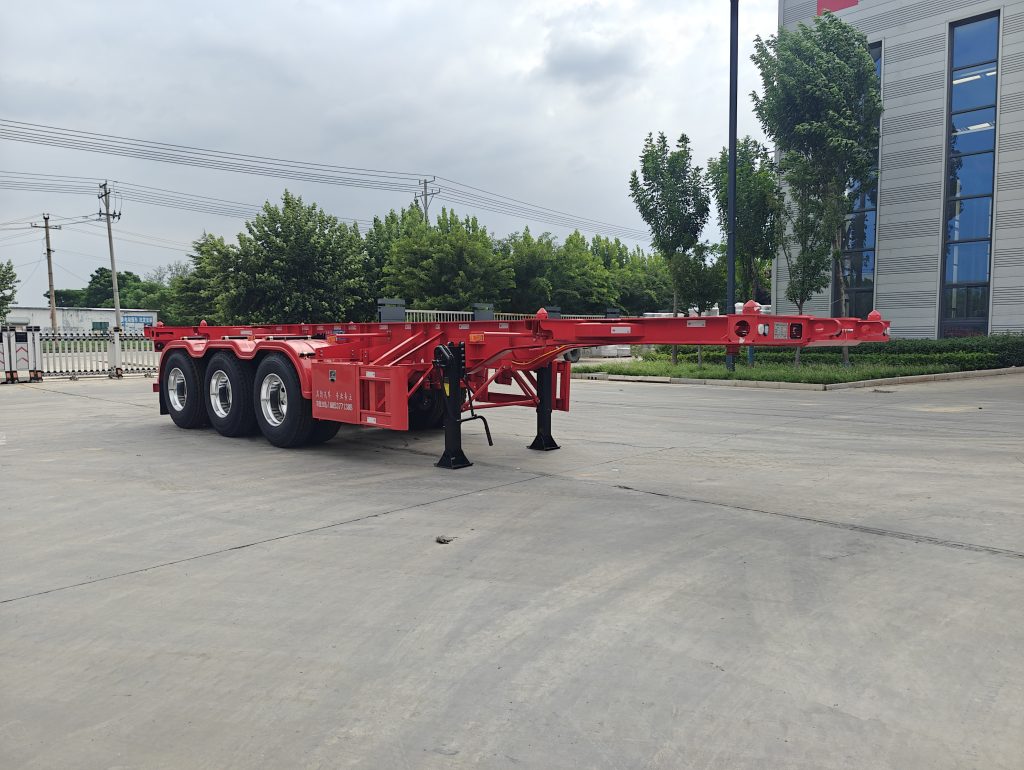
Container chassis trailer is a specially designed container shipping semi trailer for transporting 20 foot, 40 foot, 45 foot, and even 53 foot standard international containers. Unlike flatbed container semi trailers, which have a complete cargo box, chassis trailers utilize a steel frame structure and are equipped with torsion locks that connect directly to the corner castings of the container.
Their lightweight yet robust construction makes them highly efficient at transporting fully loaded or empty containers from different locations or within terminal areas.
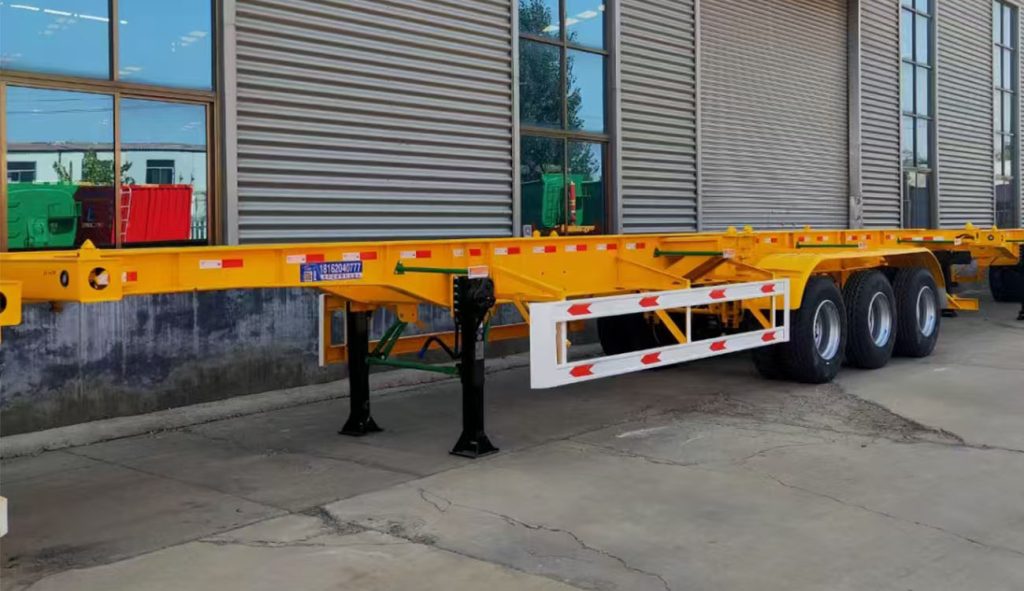
This container chassis can be used with standard containers, enabling quick and convenient loading and unloading. This facilitates more efficient transport of goods between ports, rail, and road.
Different chassis are suitable for different operating scenarios. Extendable chassis trailer can accommodate containers of varying lengths, while tilting chassis are helpful for loading certain types of cargo. These features make container chassis an essential component of modern transportation, contributing to the safe and timely delivery of goods to their destinations.
Why are there different types of Container Chassis?
Various types of container chassis trailer are designed to meet the diverse demands of global logistics and container transport. Given the significant variations in cargo types, transport routes, and local regulations, no single trailer design can adequately satisfy every operational requirement.
Varying Container Sizes
Shipping containers are available in a range of standard lengths—such as 20 ft, 40 ft, 45 ft, 48 ft, and 53 ft. To ensure proper seating and secure locking, transport vehicles must be designed or adapted to accommodate these specific dimensions. Some models feature a fixed length, while others are extendable to offer greater operational flexibility.
Diverse Load Capacity Requirements
The weight of transported cargo varies significantly depending on the nature of the goods. Heavy industrial materials, machinery, or fully loaded containers necessitate a more robust chassis structure and higher axle load capacity, whereas lighter cargo may require only a standard configuration.
Country-Specific Weight and Axle Spacing Regulations
Highway regulations differ from one country to another. Legal limits regarding gross vehicle weight, axle loads, and trailer dimensions often require manufacturers to provide customized axle configurations and structural designs that comply with local laws.
Transport Route and Road Condition Requirements
Certain transport routes involve navigating narrow urban streets, port terminals, or rugged rural roads. These conditions demand specific trailer characteristics, such as enhanced maneuverability, reinforced suspension systems, or optimized ground clearance.
High-Cube and Specialized Containers
High-cube containers require specially engineered frame structures to ensure stability during transit and to guarantee compliance with mandated height restrictions when passing through bridges or tunnels.
Versatile Fleet Requirements
Many logistics companies prefer versatile trailer designs capable of accommodating containers of various sizes as well as diverse types of cargo. Multi-purpose skeletal trailers help reduce capital investment in equipment and enhance overall fleet utilization efficiency.
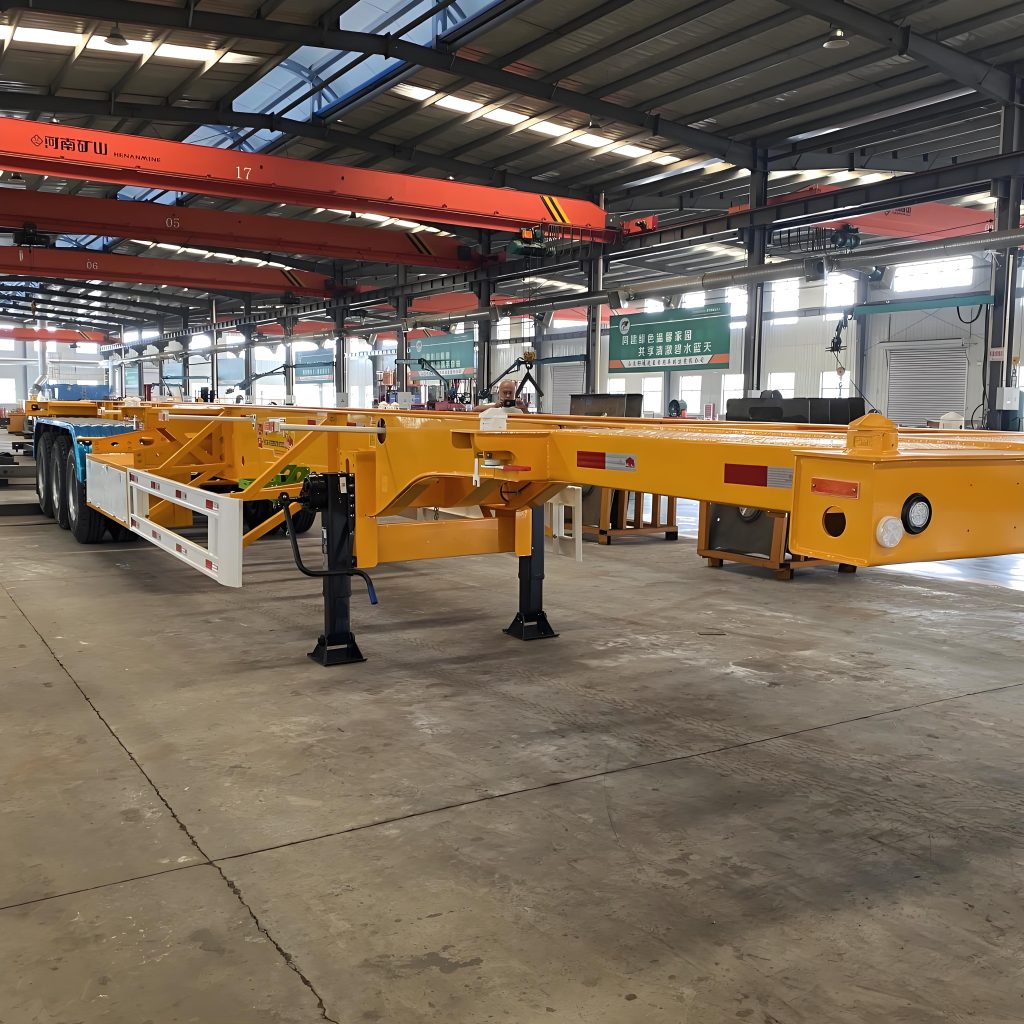
Main Types of Container Chassis
The following is a comprehensive overview of the most widely use container chassis semi trailer types in the global market.
20ft container chassis
The 20 foot container chassis semi trailer is a compact trailer specifically designed for 20 foot standard international shipping containers.
Key Features
Short wheelbase provides excellent handling performance
Lightweight design suitable for urban or port use
Suitable for heavy container transport (specific tonnage varies by region, up to 36-40 tons)
Sample Specifications – 20 foot shipping container trailer
| Item | Specification |
| Overall Length | 7,200–8,200 mm |
| Width | 2,480 mm |
| Height | 1,450–1,550 mm |
| Tare Weight | 3,500–4,500 kg |
| Axles | 2 or 3 axles |
| Twist Locks | 4 |
| Suspension | Mechanical leaf or air suspension |
| Payload | Up to 36,000 kg |
Applications
Port Operations
City Distribution Services
Short-haul Multimodal Transport
Best for:urban distribution, port shuttle, short-haul multimodal moves.
Not ideal for:long-haul heavy loads — choose a 40 ft chassis instead.

40ft container chassis semi trailer
The 40 foot container chassis semi trailer is the most widely used type globally.
Features/Characteristics
Can be used with one 40-foot container or two 20-foot containers.
Ideal for long-haul freight transport.
Available in dual-axle or tri-axle configurations.
Sample Specifications – 40ft container semi trailer
| Item | Specification |
| Length | 12,480–12,600 mm |
| Tare Weight | 5,800–7,500 kg |
| Axles | 2–3 axles |
| Payload | 36–40 tons |
| Twist Locks | 4–8 |
| Material | Q345, T700 steel |
Applications
Inland Transportation
Container Yard
Cross-border Freight
Best for:inland transport, container yards, cross-border and long-haul freight.
Not ideal for:45 ft / high-cube containers — choose the gooseneck or 45 ft chassis.
45 foot Container Chassis trailer
Primarily used for large containers and international shipping containers.
Why Choose a 45 ft container trailer?
Extended wheelbase for enhanced stability
Designed for ultra-large capacity containers
Suitable for areas using 45-foot and 48-foot high cubic equipment
Specifications Example
| Item | Data |
| Length | 13,700–14,200 mm |
| Height | 1,550 mm |
| Tare Weight | 6,500–8,000 kg |
| Payload | 40,000 kg |
Best for:high-cube and long international lanes (45 / 48 ft containers).
Not ideal for:tight urban yards — it needs more turning space.
Gooseneck container chassis trailer
The gooseneck container trailer features a lower central section to accommodate high-volume containers.
Advantages
Increased container loading and unloading space
Lower center of gravity → Enhanced stability
Widely used for large 40-foot/45-foot containers
Applications
International shipping routes
Heavy machinery transport within containers
Best for:40 / 45 ft high-cube containers, heavy machinery inside containers, international routes.
Not ideal for:budget-sensitive fleets — slightly higher cost.
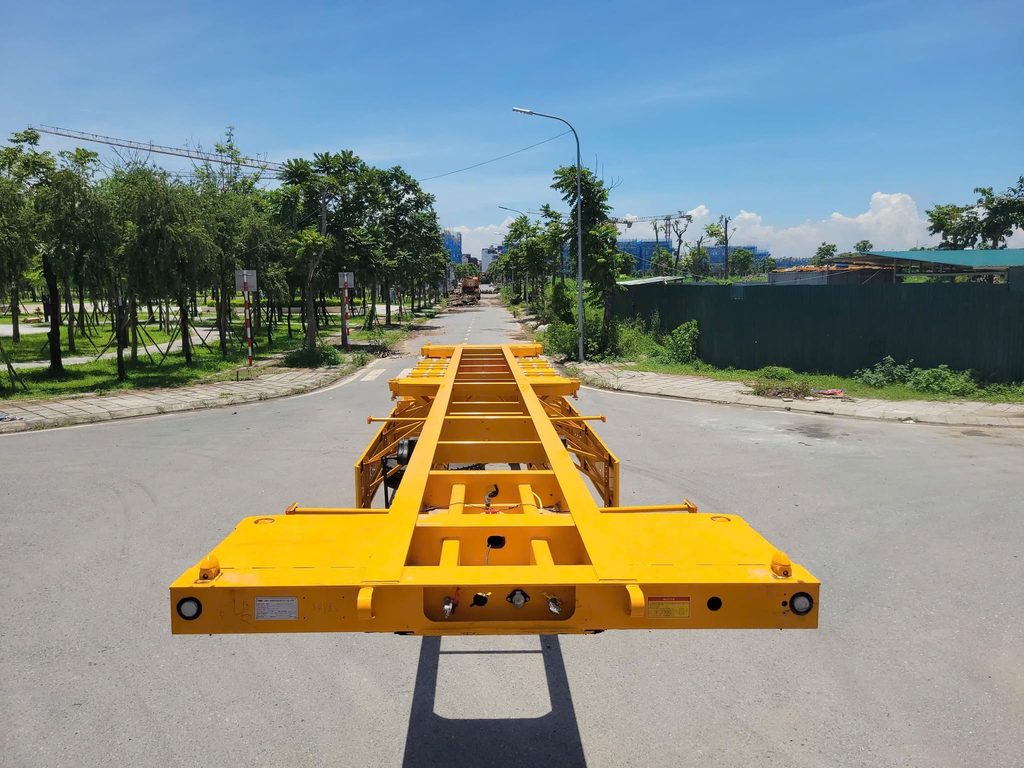
Tri-axle container trailer
Tri-axle container chassis are used when weight restrictions are stricter or cargo weight is heavier.
Features/Characteristics
Three axles distribute weight evenly
Suitable for rugged terrain and long-haul transport
Payload capacity from 45 to 60 tons, depending on structural design.
Specifications – tri-axle container trailer
| Parameter | Details |
| Axles | 3×13T or 3×16T |
| Tire Size | 12R22.5 / 315/80R22.5 |
| Suspension | Mechanical or air |
| Payload | 45–60 tons |
| Suitable Containers | 20ft, 40ft, 45ft |
Best for:heavy / bulk loads, rugged terrain, long-haul (45–60 t).
Not ideal for:light urban runs where a 2-axle is cheaper and easier to maneuver.
Extendable Container Chassis trailer
Telescopic Container Chassis trailer can be adjusted to various lengths as needed, typically 20 feet, 40 feet, and 45 feet.
Benefits
One trailer = multiple container sizes
Ideal for fleets seeking maximum flexibility.
Reduced asset investment
Uses
Container leasing companies
Mixed-size container shipping
International freight services
Best for:container leasing companies, mixed-size shipping, multi-purpose fleets.
Not ideal for:fleets running only one size — a fixed chassis is cheaper and lower-maintenance.
2-Axle, 3-Axle, and 4-Axle Container Chassis
Different axle configurations comply with different transport regulations.
| Axle Type | Use Case | Notes |
| 2 Axles container chassis | Light-to-medium load, short distance | Lower cost, great for urban areas |
| 3 Axles container chassis | Standard long-distance operations | Most common globally |
| 4 Axles container chassis | Heavy-duty or special regions (Africa, Middle East) | Higher payloads 50–65 tons |
Decision rule:if your region caps axle load (e.g. 13 t or 16 t per axle), choose the axle count that reaches your target payload without overloading any single axle.
Terminal container Chassis trailer
Specialized equipment specifically designed for loading and unloading areas in ports or docks.
Features; Characteristics
Extremely robust frame
Simple construction (reduced number of road-driving standard components)
Designed for short-haul transport
Typical Specifications
| Parameter | Data |
| Speed | Limited to 25–40 km/h |
| Axles | 2–3 |
| Tare Weight | 4,500–6,000 kg |
| Container Size | 20ft / 40ft dominate |
Best for:port terminals and container yards — ultra heavy-duty, built for short-haul shuttle.
Not ideal for:road use — it is not road-legal.
→ Get a terminal chassis quote
Tilt Container Chassis
A tilting chassis is designed with a hydraulic or mechanical tilting function that allows the trailer deck to be angled during loading and unloading. This feature is especially useful for handling cargo that cannot be easily lifted or requires controlled movement onto the trailer.
Enables the deck to tilt for smoother loading of specific cargo types
Ideal for bulk materials, wheeled equipment, or goods requiring angled placement
Reduces reliance on cranes or additional loading equipment
Improves efficiency and safety during loading and unloading operations
Thanks to its flexibility, the tilt chassis is a practical solution for specialized transport scenarios where conventional flat loading is not suitable.
Best for:bulk materials, wheeled equipment, cargo needing angled loading.
Not ideal for:standard container-only operations — the tilt feature adds cost and complexity.
Applications of container chassis trailer
Container chassis trailer play a pivotal role within the entire logistics chain, ensuring the efficient movement of cargo between various modes of transport and storage points. Their versatility leads to their widespread application across the following sectors:
Ports and Shipping Companies
Container shipping trailers are extensively utilized in port operations to transfer containers between vessels, container yards, and inland transport vehicles. Designed to facilitate rapid turnaround and efficient handling, they perform exceptionally well in high-traffic environments.
Railway Stations
At railway hubs, these trailers facilitate the smooth transfer of containers between trains and trucks, ensuring seamless intermodal transport and reducing cargo handling times.
Container Depots
Within warehousing facilities, container trailers assist in moving containers within the yard or between different warehouses, thereby enhancing operational efficiency and minimizing manual handling requirements.
Long-Haul Logistics Operators
For long-distance transport, container trailers provide a stable and reliable solution for moving cargo between different regions or countries, ensuring the safe transit and timely delivery of goods.
Export Manufacturers
Manufacturers rely on container trailers to transport finished goods from factories to ports or distribution centers, facilitating efficient export operations and ensuring supply chain continuity.
Container Leasing Companies
Leasing companies utilize these trailers to reposition containers between various locations, thereby maximizing container utilization rates and meeting flexible logistics demands.
Customs Warehouses and Bonded Storage Facilities
Container chassis trailers are essential for transporting cargo under customs supervision, ensuring the secure and compliant movement of goods between bonded warehouses, ports, and inspection checkpoints.
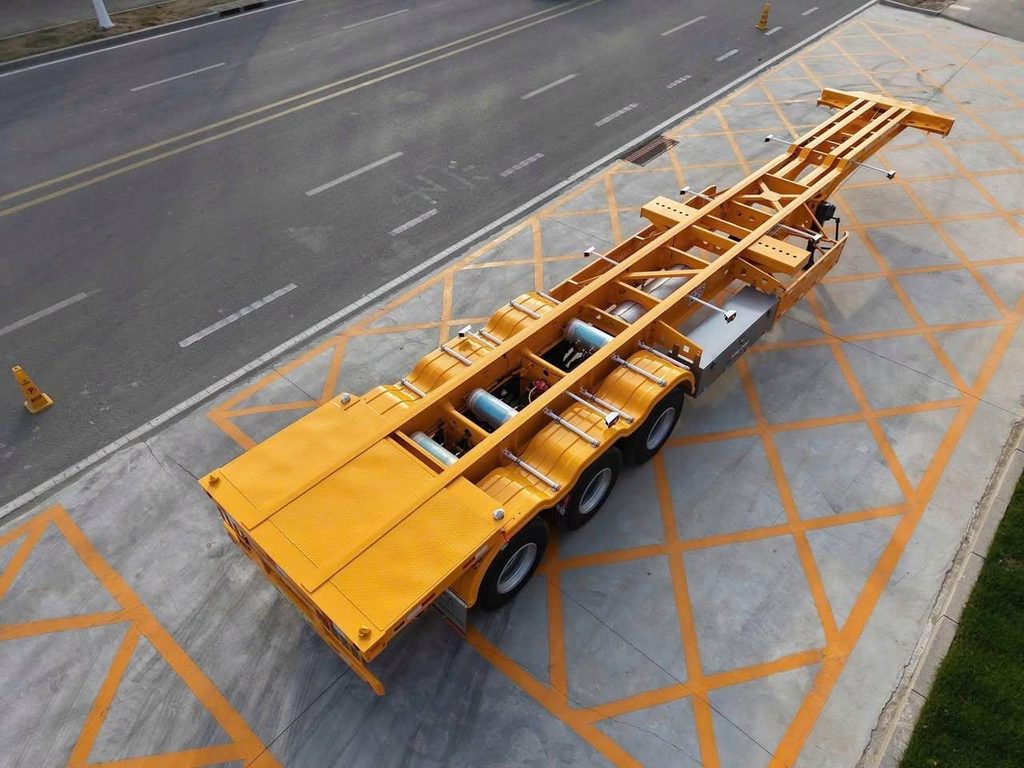
How to Choose the Right Container Chassis Trailer
Choosing the right chassis is what makes the difference between a profitable fleet and one that eats margin on every load. Use this 5-step process — it is exactly how we size a chassis for a customer.
Step 1 — Container types you handle.
20 ft, 40 ft, 45 ft, high-cube? Fixed length, or extendable to cover multiple sizes?
Step 2 — Max load per trip.
Heavier cargo needs a stronger frame and more axles. Pick an axle count that reaches your target payload without overloading any single axle.
Step 3 — Routes and road conditions.
Urban → prioritize maneuverability.
Port → prioritize loading/unloading speed.
Rough rural roads → reinforced suspension and frame.
Step 4 — Local regulations.
Check axle-load limits, trailer dimensions, and gross weight rules in your country. Compliance avoids fines, delays, and operational downtime.
Step 5 — Frequency and distance.
Frequent long-haul → durable, fuel-efficient design.
High-frequency short moves → wear-resistant components and a robust frame.
Rule of thumb: when in doubt, size one axle step up — the small extra cost prevents overloading and structural damage.
Side-by-side comparison
| Type | Container Sizes | Payload | Strengths | Limitations |
| 20 ft Chassis | 20 ft | Up to 36 t | Lightweight, maneuverable | No larger containers |
| 40 ft Chassis | 40 ft / 2 × 20 ft | 36–40 t | Most versatile | Not suitable for 45 ft containers |
| 45 ft Chassis | 45 ft | Up to 40 t | Best for long containers | Requires more space |
| Gooseneck | 40 / 45 ft | High | Stable for high-cube containers | Higher cost |
| Tri-Axle | 20–45 ft | 45–60 t | Better weight distribution | Heavier tare weight |
| 4-Axle | 20–45 ft | 50–65 t | Suitable for heavy haulage | Higher cost and complexity |
| Extendable | 20–45 ft | Varies | Handles multiple container sizes with one trailer | Higher maintenance |
| Terminal | 20 / 40 ft | Ultra-heavy | Ultra heavy-duty design | Not road-legal |
| Tilt | 20 / 40 / 45 ft | Varies | Enables angled loading | Specialized applications only |
Recommended by scenario
– Port operations → 40 ft tri-axle or terminal chassis semi trailer
– Cross-border / long haul → 40 ft tri-axle, air suspension
– Domestic distribution → 20 ft or 40 ft 2-axle
– Africa / Middle East heavy haul → 4-axle, 50–65 t
– High-cube / long containers → 45 ft or gooseneck
– Leasing / multi-size fleet → extendable
Send us your container sizes…we reply with a tailored configuration and FOB quote
Container chassis trailers Market Trends
The global market for container chassis trailers is experiencing steady growth, driven by the continuous expansion of international trade and the increasing demand for efficient multimodal transport solutions. Recent industry data highlights several key developments within this sector:
1. Steady Global Market Growth
Global demand for container chassis trailers continues to rise, with a projected Compound Annual Growth Rate (CAGR) of approximately 5.5%. This growth is primarily fueled by the expansion of port infrastructure, cross-border logistics, and cargo transportation driven by e-commerce.
2. Growing Demand for Lightweight Designs
Manufacturers are increasingly focusing on achieving weight reduction without compromising structural integrity.
The production volume of lightweight chassis has increased by approximately 22% year-on-year.
Lighter container shipping trailers contribute to improved fuel efficiency and increased cargo payload capacity.
This trend also helps logistics companies reduce their operational costs.
3. High Concentration of Manufacturing in China
China continues to maintain a dominant position in the global chassis manufacturing market.
Over 80% of exported container trailers are manufactured in China.
Competitive pricing, mature supply chains, and advanced manufacturing capabilities have contributed to this market dominance.
Chinese manufacturers are continuing to expand their influence across Africa, Southeast Asia, and the Middle East.
4. Increasing Preference for Extendable Chassis
Extendable and adjustable chassis models are gaining significant traction in the market.
They offer the flexibility to accommodate various container sizes (20ft, 40ft, 45ft, etc.).enable logistics companies to reduce fleet size while simultaneously enhancing operational agility.
They are becoming increasingly popular in multi-purpose transport operations and rental fleets.
Maintenance Tip For Container Chassis
Proper maintenance can extend equipment life and reduce downtime.
Recommended Maintenance Table
| Component | Frequency | Inspection Tasks |
| Tires | Weekly | Pressure, tread wear |
| Twist Locks | Every trip | Secure locking, lubrication |
| Suspension | Monthly | Springs, airbags, bolts |
| Braking System | Monthly | Air leaks, pads |
| Axles | Quarterly | Alignment, bearings |
| Frame | Twice yearly | Corrosion, cracks |
| Electrical System | Monthly | Lights, connectors |
Conclusion
Understanding the different types of container chassis trailer is crucial for any logistics business. From compact 20 foot container chassis to multi-purpose telescopic container chassis trailers and heavy-duty three axle container chassis, each type has its unique application in the supply chain.
Choosing the right container chassis trailer can improve cargo transport safety, road efficiency, and the overall profitability of your fleet. Whether you are focused on port operations, cross-border logistics, or domestic distribution, there is a chassis configuration that can fully meet your needs.
FAQ – Container Chassis Trailer
What is a container chassis trailer used for?
It is used to transport ISO containers such as 20ft and 40ft containers between ports, warehouses, and logistics hubs.
What container sizes can it carry?
It can carry 20ft, 40ft, and in some cases 45ft containers depending on the chassis design.
What is the difference between a chassis trailer and a flatbed trailer?
A chassis trailer is designed only for containers with twist locks, while a flatbed trailer can carry different types of cargo.
What is the loading capacity?
Most container chassis trailers can carry 30–60 tons depending on axle configuration.
What are the main types?
20ft chassis, 40ft chassis, 45ft chassis, and extendable chassis trailers.
How are containers fixed on the trailer?
Containers are secured using twist locks that connect to the container corner castings.