
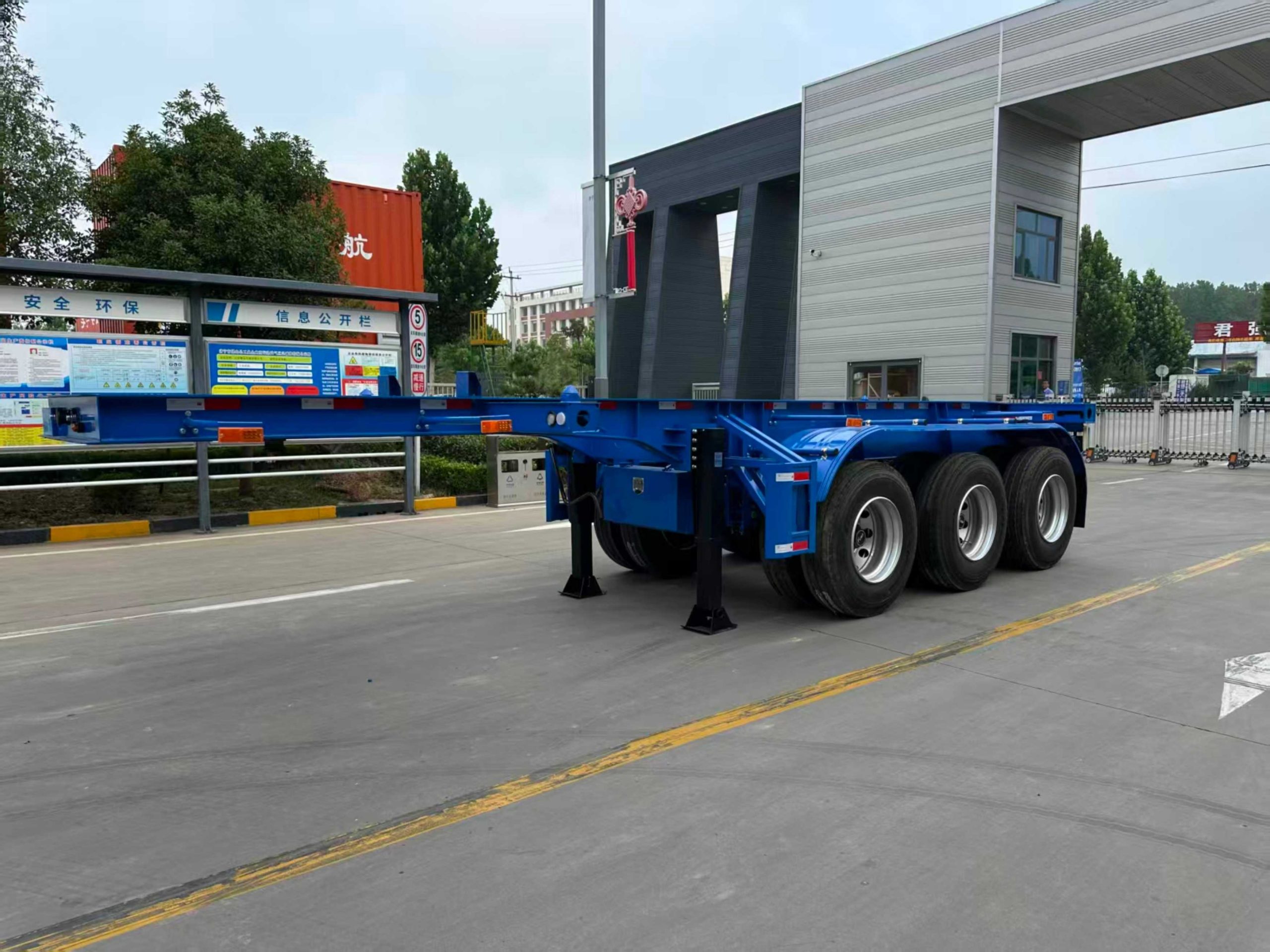
Container Skeleton Trailer Design and Safety Standards

Overview
Container skeleton trailer—also known as container chassis trailer—are essential equipment in international logistics and port transportation. Their primary purpose is to safely and efficiently transport standard international shipping containers on roads. With the continuous expansion of global shipping activities, innovative design and stringent safety standards have become key factors determining a vehicle’s reliable operation, reduced operational risks, and minimized long-term financial costs.
This article describes the engineering design, key components, international safety standards, and considerations buyers should evaluate before selecting a container skeleton trailer.
What is a Container Skeleton Trailer?
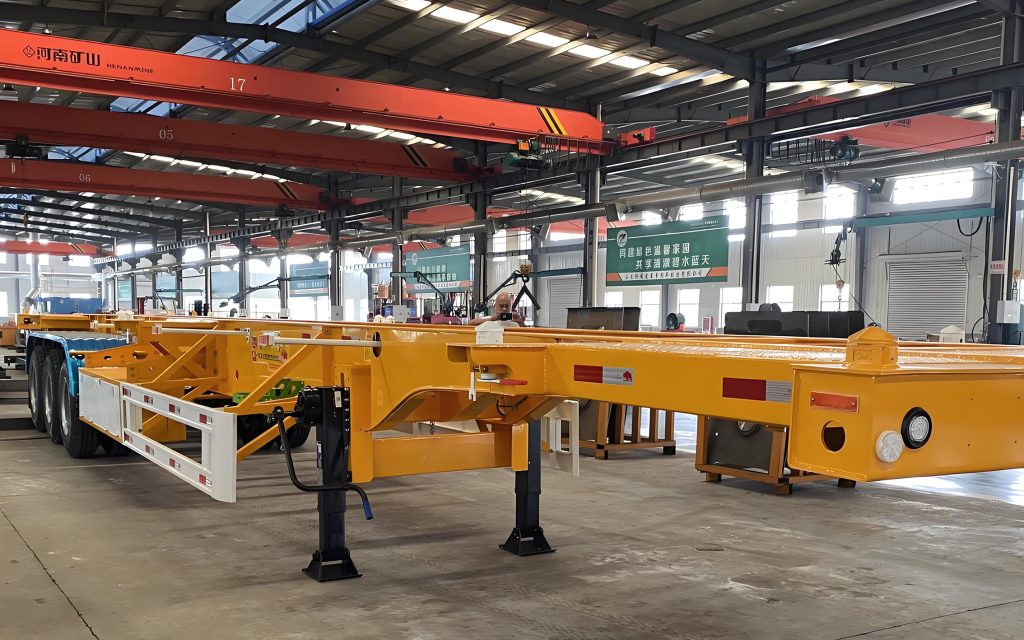
A container skeleton semi trailer with a lightweight yet robust steel frame specifically designed for transporting 20 foot, 40 foot, or 45 foot ocean shipping containers. Unlike flatbed semi trailers, skeleton semi trailers do not have a platform; the container itself becomes the load-bearing structure when locked with a twist lock.
General Application Form
Inland Container Transport
Port and Terminal Cargo Transport
Long-Distance Freight Transport
Rail-Road Intermodal Logistics
Bulk Cargo Shipping Companies and Freight Forwarders
Key Design Elements of Skeleton Container Trailers
High-quality skeleton semi trailer adhere to certain engineering principles to ensure their strength, stability, and long service life.
2.1 Frame Structure
The frame is the most critical part, typically made of high-strength steel such as Q345B, Q355, or T700.
Frame Characteristics
High strength, high yield strength
Excellent fatigue resistance
Suitable for heavy and long-distance transport
Most container skeleton trailer employ an I-beam or rectangular tube welded structure, supported by crossbeams to evenly distribute the load.
2.2 Skeleton semi trailer Twist Locks (Container Locking System)
Twist locks secure containers to the frame.
Types of Twist Locks
Manual Twist Lock
Automatic Twist Lock
Retractable Twist Lock (Suitable for Multiple Sizes)
Advanced twist locks must comply with ISO 3874 and BS EN 13044 safety standards.

2.3 Axle and Suspension System
Skeleton semi-trailer axle system directly affects stability and braking performance.
Typical options:
BPW, Fuhua, or high-end Chinese axles
Mechanical suspension (economical)
Air suspension (better shock absorption and tire protection)
2.4 Braking System
To ensure safe operation, the container skeleton trailer uses:
Dual-circuit air brakes
Anti-lock braking system (mandatory in many countries)
Optional EBS (Electronic Braking System) for enhanced stability
2.5 Container skeleton trailer electrical System
A 24-volt lighting system with international standard connectors ensures compatibility with various truck brands.
2.6 Rust-Proof Surface Treatment
High-quality paint or hot-dip galvanizing prevents corrosion, especially in coastal and rainy areas.
Skeleton container semi trailer Technical Specifications Table
Below is a general parameter table for a standard 40ft skeleton semi trailer. You can substitute the data according to your actual vehicle model.
| Item | Specification |
| Overall Length | 12,500–13,000 mm |
| Overall Width | 2,480 mm |
| Overall Height | 1,450 mm |
| Loading Capacity | 40–60 tons |
| Suitable Container | 20ft / 40ft / 2×20ft |
| Main Beam Material | Q345B/Q355 High-tensile steel |
| Axles | 2 or 3 axles (BPW / FUWA / OEM) |
| Suspension | Mechanical / Air suspension |
| Brake System | Dual-line pneumatic with ABS |
| Kingpin | 2″ or 3.5″ (JOST optional) |
| Landing Gear | 28-ton, two-speed |
| Tires | 12R22.5, 11R22.5, or 315/80R22.5 |
| Twist Locks | 4 or 12 sets (ISO-certified) |
| Paint | Anti-rust + polyurethane top coat |
| Electrical | 24V LED lighting system |

International Design and Safety Standards
Container skeleton trailers used in global logistics must comply with stringent safety regulations. The following are the globally recognized key standards:
4.1 International Organization for Standardization (ISO) Standards
ISO 668 – Classification and Dimensioning of Containers,ISO 3874 – Rules for Container Loading, Unloading and Securement (Lock Specifications),ISO 1726 – Requirements for Drawbar and Tow Pin Connections,ISO 1496 – Testing and Structural Loading of Containers
Compliance ensures global interoperability.
4.2 European Standards (EN/ECE)
ECE R13 – Braking Requirements
EN 13044 – Marking and Identification of Container Chassis
EN ISO 12944 – Anti-corrosion Coatings
These standards ensure safe braking, proper marking, and long-term rust prevention.
4.3 U.S. Department of Transportation and Federal Motor Vehicle Safety Standards (USA)
Trailers entering the U.S. market must meet:
Federal Motor Vehicle Safety Standard 121 – Air Braking Performance
U.S. Department of Transportation Lighting and Reflector Standards
Rear Collision Protection Requirements
4.4 Chinese National Standards GB/T Standards
As Chinese-made trailers dominate global exports:
GB/T 14455 – General Technical Requirements for Semi-Trailers
GB 11567 – Side and Rear Underrun Protection Devices
GB 7258 – Road Vehicle Safety Technical Requirements
Braking Safety of 20ft skeleton semi trailer
Ensuring container skeleton trailer stability when fully loaded:
Anti-lock Braking System (ABS) prevents wheel lock-up
Electronic Braking System improves directional stability
Optional Disc Brakes offer better heat dissipation
5.2 Load Distribution
Uneven weight distribution can lead to:
Tire blowout
Axle overload
Container skeleton trailer rollover
A superior chassis design includes optimized wheelbase and beam geometry to maintain a stable center of gravity.
5.3 Structural Reinforcement
Key areas for steel reinforcement:
Gooseneck section
Rear frame
Crossbeams
Main shaft area
These reinforcements reduce metal fatigue during long-term operation.
5.4 Corrosion Prevention Solutions
Corrosion is the leading cause of structural failure in port environments.
Common methods:
Sandblasting + epoxy primer
Polyurethane topcoat
Hot-dip galvanizing (premium option)
5.5 Road Safety Elements
Side reflectors
Rear bumper protection device (RUPD)
Side sag protection device (SUPD)
High-brightness LED lights
These significantly reduce the risk of accidents.
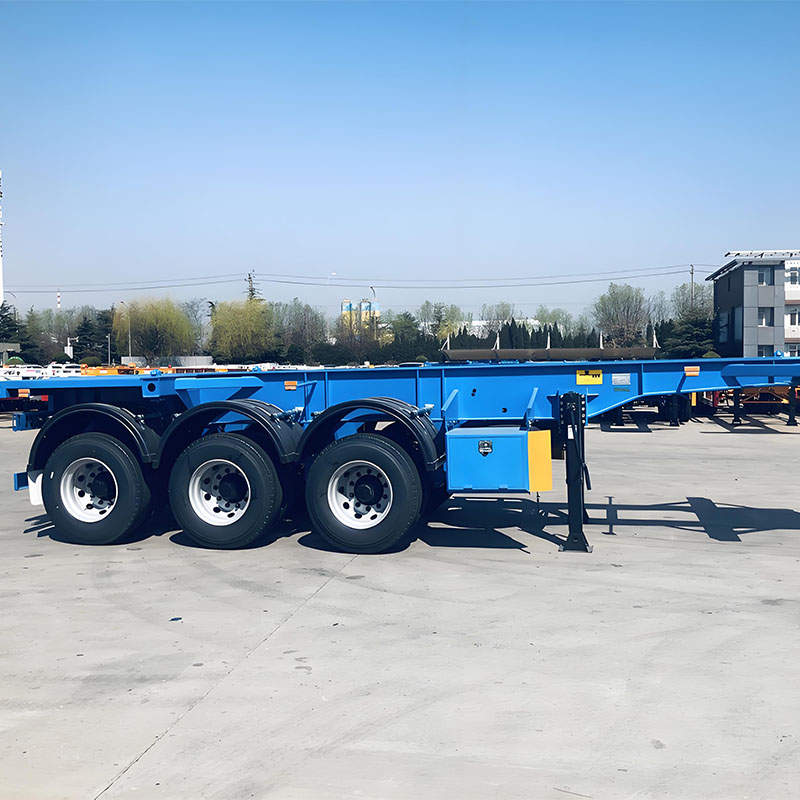
Advantages of Modern container skeleton semi trailer Design
1. Lighter than flatbed container semi trailers
Container skeleton trailer eliminate the frame structure, reducing weight by 800 to 1200 kg and improving fuel efficiency.
2. Lower maintenance costs
The simple frame structure means fewer welding points and minimal maintenance.
3. Flexible Container Compatibility
The multi-locking system enables:
One 20-foot container
Two 20-foot containers
40-foot
45-foot (optional)
4. High-Strength Structure
T700 or Q355 steel beams support long-distance heavy-load operations with minimal deformation.
5. Enhanced Safety for High-Speed Transportation
Air suspension and anti-lock braking/electronic braking systems significantly reduce the risk of rollover.