
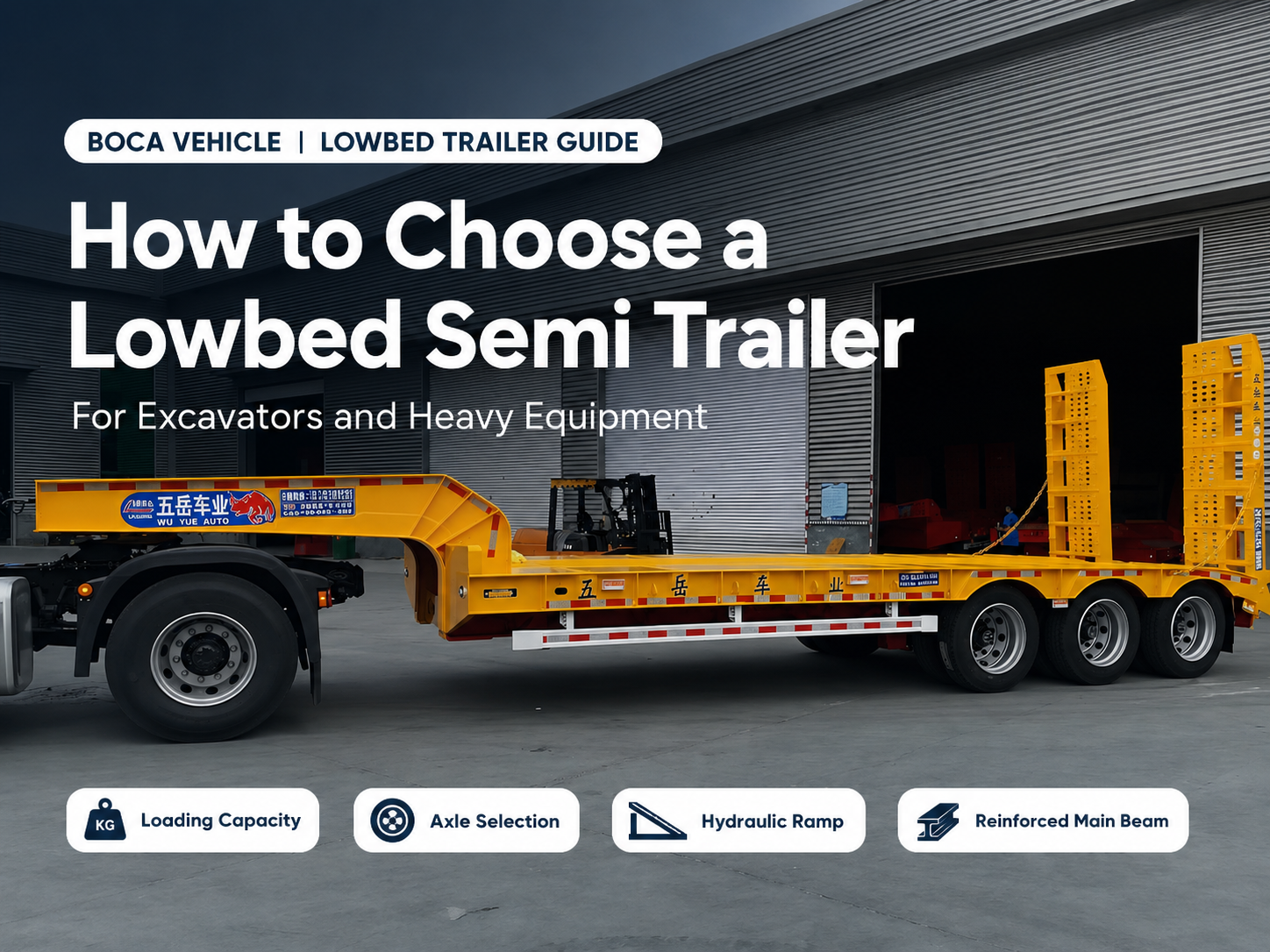
How to Choose a Lowbed Semi Trailer for Excavators and Heavy Equipment
Choosing a lowbed semi trailer for excavators depends on equipment weight, axle quantity, ramp type, suspension, tires, brakes, and reinforced frame design. This guide explains how to match the right configuration for heavy equipment transport and export projects.

For excavators, bulldozers, wheel loaders, cranes, pavers, and drilling rigs, trailer selection should start with the machine, not only with the rated payload. A lowbed semi trailer helps heavy equipment move with a lower deck height, better loading access, and stronger support under concentrated loads. Therefore, the right configuration should match equipment weight, machine size, axle load rules, ramp type, suspension, tire rating, brake system, and main beam reinforcement.
Meanwhile, export projects need more than a simple model name. Road conditions, destination port, tractor matching, shipping method, and local transport limits can change the final design. In other words, a good low-bed trailer should not only carry the load once. It should load safely, travel steadily, resist frame fatigue, and remain practical to maintain after delivery.
Quick Selection Logic Before Comparing Models
First, define the machine that will be transported most often. An excavator transport trailer needs strong track support and a workable loading angle. However, a trailer used for loaders, compactors, or industrial modules may need a different deck width, ramp structure, and lashing layout.
- Start with real operating weight, including bucket, blade, hammer, counterweight, fuel, and attachments.
- Check total machine length, width, height, track width, and ground clearance.
- Match axle quantity to cargo weight, route condition, and destination axle load limits.
- Select hydraulic ramp, mechanical ramp, or detachable gooseneck by loading frequency and cargo clearance.
- Review suspension, tire size, brake system, steel grade, beam thickness, and deck reinforcement.
What Is a Low-Bed Trailer Used For?
A low-bed trailer has a lowered loading platform. As a result, tall or heavy machinery can travel with a lower center of gravity and a more manageable transport height. This structure is widely used for excavator haulage, bulldozer movement, mining equipment transfer, and heavy construction fleet work.
Compared with a standard flatbed semi trailer, the low-bed structure focuses more on vertical clearance, concentrated load strength, rear loading access, and deck stability. Meanwhile, a flatbed remains more suitable for containers, steel, timber, pipes, palletized cargo, and general open-deck transport.
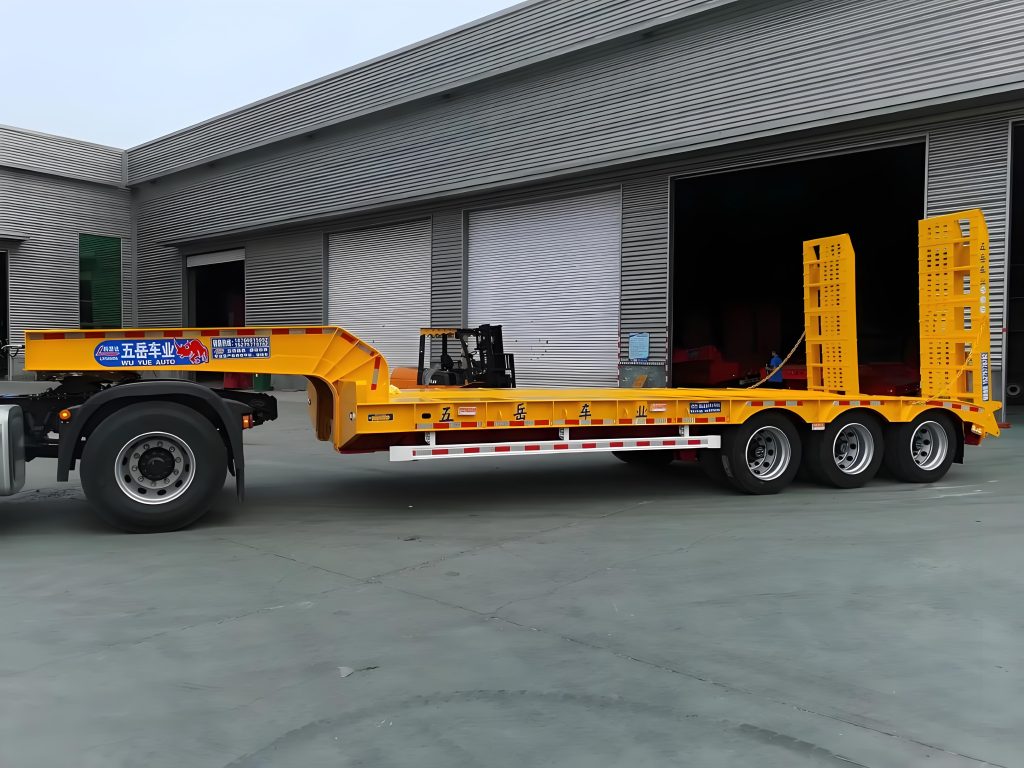
3 Axle Lowbed Semi Trailer
This configuration suits many regular excavator, loader, and mixed construction equipment transport tasks. It is a practical starting point when capacity, maintenance, and export cost need to stay balanced.
View 3 Axle Lowbed TrailerStart with Equipment Weight and Dimensions
First, the operating weight must be realistic. Catalogue weight may not include attachments, additional tools, blades, hydraulic hammers, or spare parts. Therefore, a useful configuration should include a safety margin instead of matching the rated capacity too tightly.
For example, a 36-ton excavator may not be suitable for a trailer selected only around 36 tons. With attachments and uneven road impact, a 50-ton or 60-ton lowbed trailer may make more sense. Similarly, a large bulldozer or mining loader may require a heavy duty lowbed semi trailer with stronger beams, more axles, and reinforced ramps.
In addition, machine width and height should be checked carefully. Wide crawler tracks may need a wider deck or side extension. Tall equipment may need a lower deck height to reduce transport risk under bridges, power lines, or port restrictions.
Cargo Information to Confirm First
- Equipment type, such as excavator, bulldozer, loader, crane, roller, paver, crusher, or drilling rig.
- Operating weight with bucket, blade, hammer, counterweight, and installed attachments.
- Overall length, width, and height after the machine is prepared for transport.
- Track width, tire contact area, and ground clearance.
- Loading method, loading frequency, and available site space.
- Destination country, road condition, and expected working route.
Choose Loading Capacity from 40 Tons to 150 Tons
Next, loading capacity should follow real transport work. A 40-ton trailer may suit medium machines, farm equipment, compact construction machinery, and short-distance site movement. However, frequent heavy haulage needs stronger structural design and better load distribution.
A 60 ton lowbed trailer is a common export choice because it covers many excavator, bulldozer, and loader applications. Nevertheless, larger equipment may need a 70-ton, 80-ton, 100-ton, or 150-ton lowboy trailer depending on cargo size, axle regulations, and road conditions.
| Capacity Range | Typical Use | Selection Logic |
| 40–50 tons | Medium excavators, loaders, rollers, compact site machinery | Suitable for moderate weight and regular road transport. |
| 60 tons | Excavators, bulldozers, loaders, mixed construction equipment | A practical balance between payload, cost, and export use. |
| 70–100 tons | Large excavators, mining machines, heavy bulldozers | Requires stronger beams, more axles, and reinforced ramps. |
| 100–150 tons | Oversized mining, oilfield, and infrastructure equipment | Usually needs multi-axle design and detailed route planning. |
In practice, capacity should not be judged by one number alone. Frame depth, steel material, cross member spacing, ramp design, suspension strength, tire rating, and braking performance all decide whether the trailer can handle repeated heavy equipment transport.
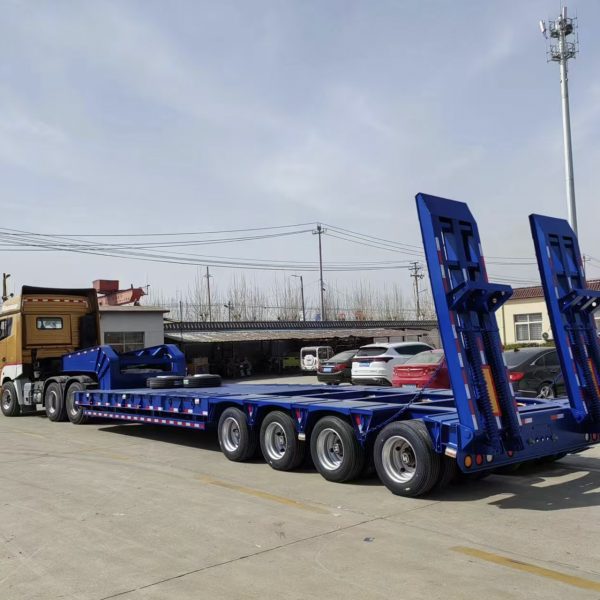
4 Axle Lowboy Trailer
A 4 axle lowboy trailer helps spread heavier machinery loads across more contact points. Therefore, it is often considered for larger excavators, mining equipment, and rougher road operation.
View 4 Axle Lowboy TrailerAxle Selection: 2 Axle, 3 Axle, 4 Axle, or Multi-Axle
Axle quantity affects payload distribution, tire wear, braking stability, turning behavior, and legal road access. Therefore, it should not be selected only by initial cost. A lighter axle layout may reduce purchase cost, but it can increase long-term stress when the cargo is heavy or the route is rough.
A 2 axle lowbed trailer can work for lighter machinery and short routes. Meanwhile, a 3 axle lowbed trailer is often used for excavators and general construction equipment because it balances payload, maintenance, and road flexibility. For heavier machines, a 4 axle lowboy trailer spreads weight more effectively and improves stability under high load.
For ultra-heavy cargo, multi-axle lowboy trailer designs may be required. In that case, route planning becomes more important. Turning space, bridge capacity, tire replacement access, and tractor power should all be checked before confirming the trailer.
Practical Axle Matching
- 2 axle: lighter machines, easier road conditions, and moderate transport demand.
- 3 axle: regular excavator transport, mixed equipment hauling, and common export use.
- 4 axle: large machinery, rougher roads, stronger load distribution, and higher payload needs.
- Multi-axle: oversized mining, energy, industrial, or infrastructure cargo with strict route limits.
Ramp Type: Hydraulic Ramp, Mechanical Ramp, or Detachable Gooseneck
Loading method has a direct effect on daily efficiency and safety. A hydraulic ramp lowbed is convenient when machinery needs to load and unload frequently. The ramp can be raised and lowered with less manual work, which helps in construction sites, equipment yards, and project-based transport.
Mechanical ramps are simpler. In addition, they may be easier to maintain in areas where hydraulic parts are harder to source. However, they require more labor and may be less suitable for frequent loading or heavy tracked machines.
A detachable gooseneck, also called an RGN design in some markets, allows front loading from a lower angle. Therefore, it works well for large machinery with low ground clearance, long tracks, or limited ramp climbing ability. Nevertheless, it requires more operating skill and a more detailed tractor-trailer matching plan.
| Loading Design | Main Advantage | Best-Fit Scenario |
| Hydraulic ramp | Faster operation and easier loading | Frequent site transfer and mixed machinery transport |
| Mechanical ramp | Simple structure and lower maintenance complexity | Occasional loading and cost-sensitive operation |
| Detachable gooseneck | Low loading angle and front access | Heavy equipment, low clearance cargo, and specialized haulage |
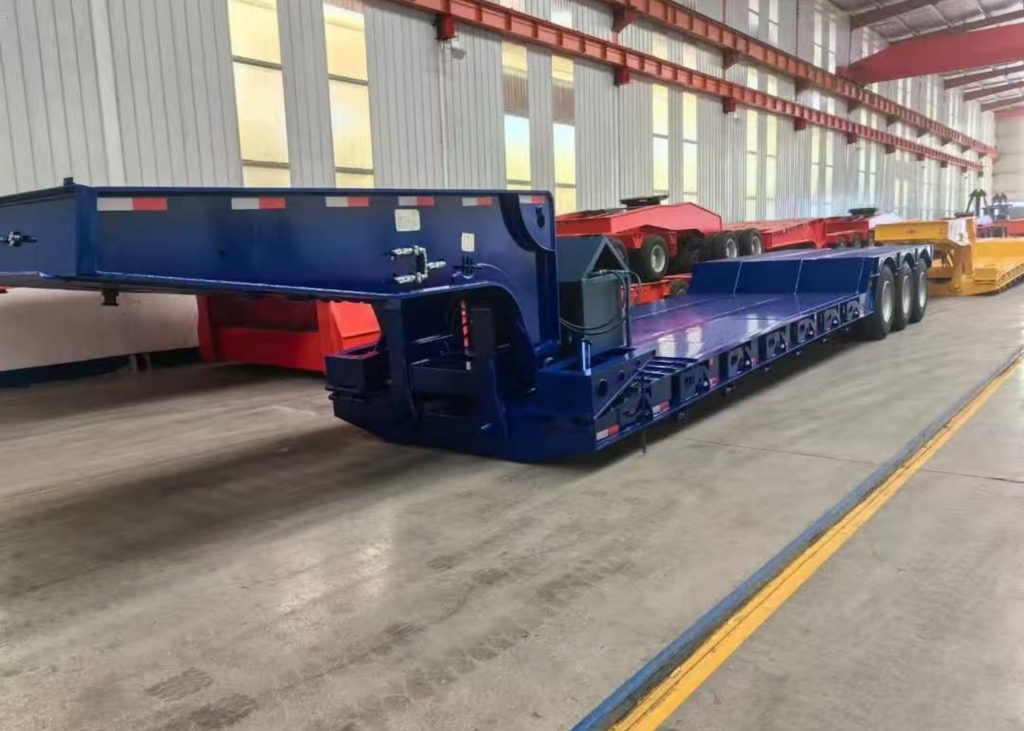
Detachable Gooseneck Lowboy Trailer
This design supports front loading and a lower loading angle. As a result, it is suitable for low-clearance machines, oversized crawler equipment, and specialized heavy haul tasks.
View Detachable Gooseneck TrailerSuspension, Tires, and Brake System
Suspension choice affects stability, maintenance, and road adaptability. Mechanical suspension is common for many export semi trailer projects because it is strong, direct, and easier to service in rough working regions. In addition, it performs well where unpaved roads and heavy loads are common.
Air suspension gives a smoother ride and may help protect certain cargo. However, it includes more components and needs better maintenance support. For quarry roads, construction access roads, and remote jobsite work, a heavy duty mechanical suspension often remains the more practical option.
Tire choice should match axle load, route distance, climate, speed, and local replacement availability. Meanwhile, the brake system should support controlled stopping under heavy load. Reliable air lines, brake chambers, brake drums, and optional ABS compatibility all deserve attention during specification review.
What to Check in Running Gear
- Suspension type and leaf spring strength for rough roads.
- Axle brand, axle rating, and replacement part access.
- Tire size, tire quantity, and load suitability.
- Brake chamber layout, air tank arrangement, and line protection.
- Landing gear strength and kingpin compatibility with the tractor.
Main Beam Reinforcement and Deck Strength
The main beam is the structural core of a heavy equipment trailer. Therefore, its height, steel material, flange thickness, web plate thickness, and welding quality are more important than surface appearance. A trailer may look strong in photos, yet the frame details decide long-term durability.
Crawler machines create concentrated pressure under the tracks. As a result, cross member spacing and deck plate thickness should match the track contact area. If the support is too weak, the deck may bend, the ramp hinge may suffer stress, or the rear frame may fatigue after repeated loading.
In addition, reinforcement should appear in the correct places. The gooseneck, rear ramp base, suspension mounting area, side beam, and lashing points all carry important stress. For heavy duty export use, reinforcement should be planned around real cargo pressure instead of added randomly.
Frame Details Worth Comparing
- Main beam height, upper flange, lower flange, and web plate thickness.
- Steel grade used in high-stress sections.
- Cross member spacing beneath the crawler track area.
- Rear ramp hinge reinforcement and hydraulic cylinder support.
- Gooseneck reinforcement, side beam layout, and deck plate thickness.
- Lashing rings, chain hooks, and working platform anti-slip design.
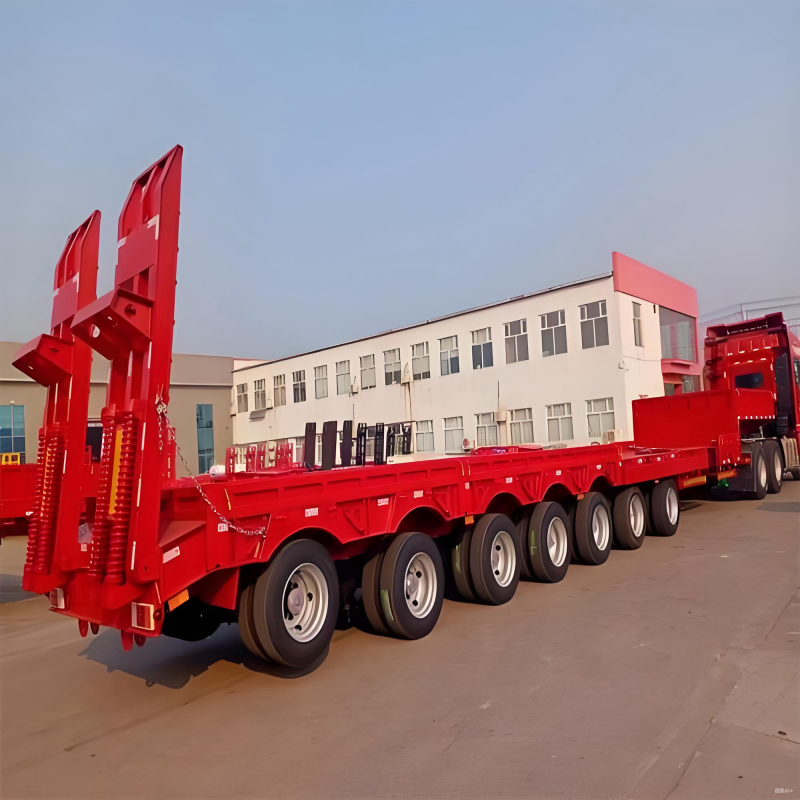
7 Axle Lowboy Trailer
For oversized industrial equipment, heavy mining machinery, and extreme payload projects, a multi-axle layout can improve weight distribution and reduce pressure on each axle group.
View 7 Axle Lowboy TrailerCargo Securement and Transport Safety
A trailer specification should also support safe cargo securement. Heavy equipment creates movement forces during braking, cornering, acceleration, and uneven road driving. Therefore, chain hooks, lashing rings, anti-slip deck surfaces, and correct tie-down positions should be considered during the design stage.
For a useful external reference, the official FMCSA cargo securement rules explain heavy vehicle, equipment, and machinery securement for equipment operating on wheels or tracks. Although local rules differ by country, this type of official guidance is helpful when planning lashing points and transport safety checks.
At the same time, securement requirements should not be treated as an afterthought. A strong frame needs the right anchor points. In addition, the loading deck should allow chains or straps to be placed at proper angles without damaging the machine or trailer structure.
How Road Conditions Change the Trailer Specification
Road condition is one of the most important selection factors. Highway use places different demands on a trailer than mining roads, mountain roads, port yards, or construction access roads. Therefore, the same 60-ton payload may need different suspension, tire, ramp, and frame choices in different regions.
For rough roads, stronger suspension and reinforced frame areas become more important. Meanwhile, poor road surfaces increase vibration, twisting, and side stress. In this situation, light-duty frame design can create hidden maintenance problems even when the rated capacity appears sufficient.
For port and highway operation, deck height, overall width, braking response, lighting layout, and transport efficiency may matter more. In addition, if the trailer often works with a used tractor truck, fifth wheel height, kingpin size, air line connection, and tractor power should be checked before final confirmation.
Export Configuration Points That Should Not Be Missed
Export trailer projects need more than a basic specification sheet. The destination country may have rules for overall width, lighting, reflectors, braking, axle load, and shipping documents. Therefore, the trailer should be discussed together with the intended destination and work route.
Shipping method also affects design and preparation. Some trailers may ship by bulk carrier or roll-on roll-off vessel. Others may need structure planning for loading, lifting, or partial disassembly. In addition, anti-rust treatment, wax spray, waterproof covering, and photo confirmation can help reduce risk during long sea transport.
Finally, document preparation should stay clear from the beginning. Packing details, production photos, loading photos, commercial documents, and destination port information help the project move faster. Clear communication before production usually saves more time than changes after completion.
Boca Vehicle Support for Heavy Equipment Trailer Projects
Boca Vehicle supports export trailer projects with configuration discussion, production detail confirmation, and semi trailer matching for different cargo tasks. Instead of choosing only by a standard model name, the trailer plan can be adjusted around cargo type, deck length, deck width, axle quantity, suspension, ramp system, tire setup, and destination conditions.
For excavator transport, the focus is usually deck strength, ramp angle, crawler support, and loading safety. For mining equipment, stronger beam reinforcement, multi-axle layout, heavy duty suspension, and route limits become more important. Meanwhile, mixed construction fleet use may need a balanced configuration that can carry excavators, loaders, rollers, and other machinery without overbuilding the trailer.
Additionally, photos and videos during production can help confirm key details before shipment. This is useful for checking ramp structure, axle layout, suspension type, paint finish, deck plate, lashing points, tire arrangement, and shipping preparation.
Inquiry Checklist for a Faster Configuration Plan
Before requesting a quotation, the following details help reduce repeated revisions. Meanwhile, photos or drawings of the equipment can make deck width, ramp angle, and load distribution easier to confirm.
- Cargo type and main application.
- Operating weight with attachments installed.
- Overall length, width, height, track width, and ground clearance.
- Target loading capacity, such as 40 tons, 60 tons, 80 tons, 100 tons, or higher.
- Preferred axle quantity or local axle load requirement.
- Hydraulic ramp, mechanical ramp, or detachable gooseneck preference.
- Road condition, including highway, mine road, mountain road, or site access road.
- Destination country, destination port, and tractor model.
- Special requirements for suspension, tires, brakes, paint, lighting, or tool boxes.
Further Reading and Related Trailer Options
For clearer comparison, the following BOCA pages can be used to review related configurations. Each link points to an existing product or category page, so there is no need to rely on unpublished article URLs.
- Lowbed Semi Trailer Series — compare lowboy, low loader, step deck, and detachable gooseneck options.
- 3 Axle Lowbed Trailer — suitable for common excavator and mixed machinery transport.
- 4 Axle Lowboy Trailer — useful when higher payload and stronger load distribution are required.
- Detachable Gooseneck Lowboy Trailer — designed for front loading and lower loading angle needs.
FAQ
How many axles does a low-bed trailer need?
Generally, 3 axles work for many excavator and construction machinery tasks. However, 4 axles or multi-axle configurations may be better for heavier equipment, rough roads, or stricter axle load limits.
What loading capacity should be selected for excavators?
First, confirm the real operating weight with attachments. Then add a safety margin for road impact and repeated loading. For many medium excavators, 50-ton or 60-ton configurations are common starting points.
Is a hydraulic ramp better than a mechanical ramp?
A hydraulic ramp is better for frequent loading and easier operation. However, a mechanical ramp has a simpler structure and may suit occasional loading or regions where simple maintenance is preferred.
When is a detachable gooseneck trailer useful?
A detachable gooseneck trailer is useful when heavy machines need front loading, a lower loading angle, or better clearance control. It is often considered for oversized machinery and specialized heavy haul transport.
Can deck height and width be customized?
Deck size can usually be discussed according to machine width, height, track position, loading method, and destination road rules. However, the final configuration should still match legal transport limits.
Final Selection Advice
In summary, the best low-bed trailer configuration comes from the machine and the route. Equipment weight, cargo dimensions, road condition, axle load rules, ramp design, suspension, tires, brakes, and frame reinforcement should work together. Otherwise, one strong-looking specification may still create loading difficulty or long-term maintenance pressure.
Therefore, the specification should be confirmed with clear cargo data before production. A practical trailer plan can reduce loading risk, improve stability, and support repeated equipment transport across ports, job sites, mining areas, and long-distance road routes.
To understand the naming and structural differences, see our lowboy trailer vs lowbed trailer comparison.
- First, prepare machine weight, dimensions, attachments, photos, and route details before comparing configurations.
- Second, select axle quantity, ramp type, suspension, tires, brakes, and beam reinforcement based on actual working conditions.
- Finally, send cargo type, loading capacity, axle quantity, road condition, and destination country to Contact Boca Vehicle for a suitable lowbed semi trailer configuration.
Need a Configuration for Heavy Equipment Transport?
Send the machine type, operating weight, dimensions, axle preference, road condition, destination country, and preferred loading method. Boca Vehicle can help match the low-bed trailer structure to the actual transport task.
Contact Boca Vehicle