
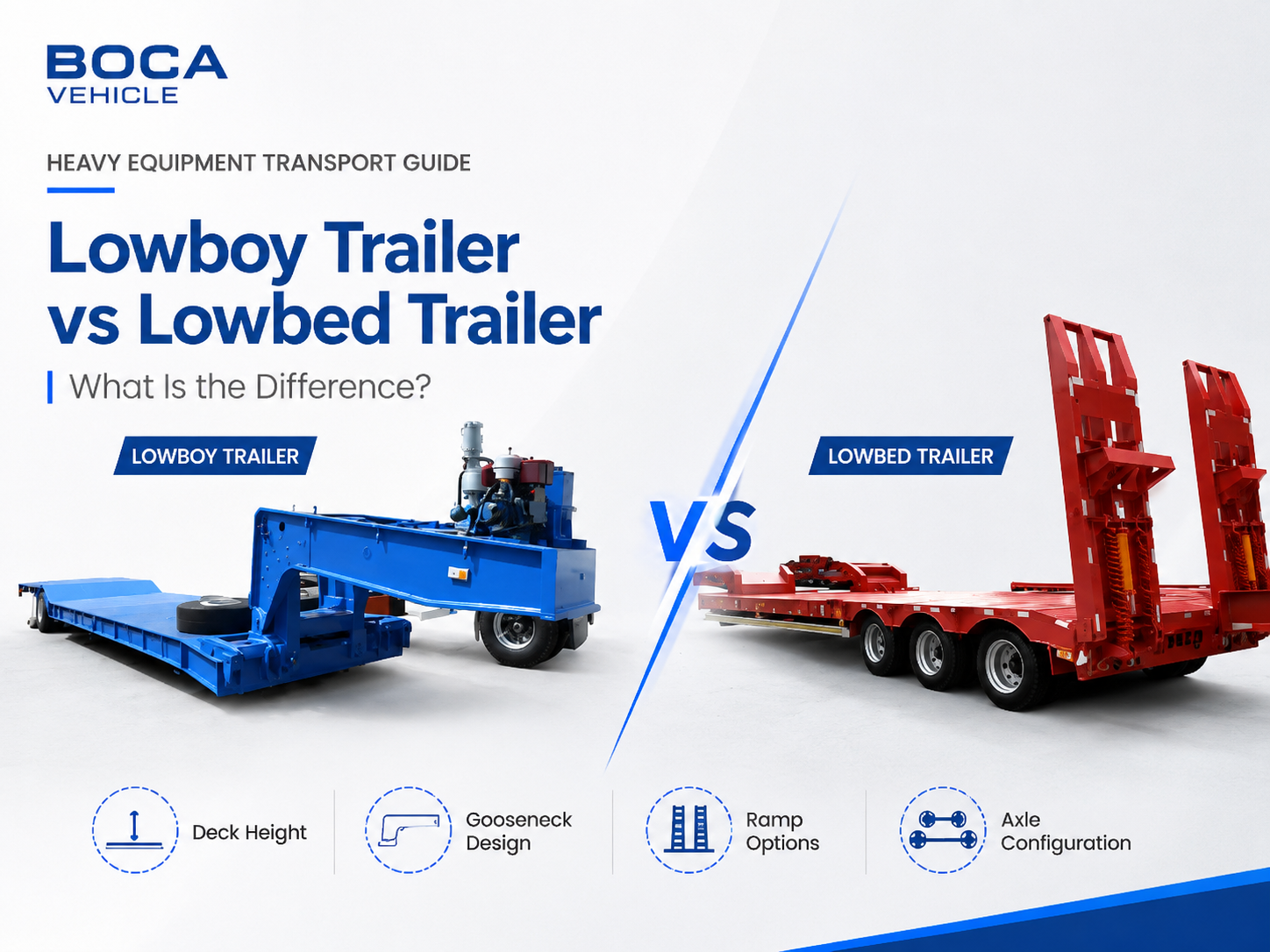
Lowboy Trailer vs Lowbed Trailer: What Is the Difference?
A practical guide to lowboy trailer vs lowbed trailer selection for heavy equipment transport, covering deck height, ramp type, axle layout, gooseneck design, loading capacity, and export quotation details.

For heavy equipment transport, lowboy trailer vs lowbed trailer is more than a naming issue. Instead, it affects loading height, route clearance, axle load distribution, ramp choice, gooseneck structure, and the final trailer drawing used for production.
In many export markets, both names describe a low-deck semi trailer for excavators, bulldozers, wheel loaders, cranes, road rollers, graders, transformers, and other heavy or oversized cargo. However, the wording changes by region. North American projects often say lowboy trailer or lowboy semi trailer, while many African, Middle Eastern, Asian, and European projects use lowbed trailer or low bed semi trailer.
Therefore, the first technical discussion should not stop at the product name. It should confirm deck height, loading capacity, axle quantity, ramp type, suspension, tire model, brake system, and destination road rules. For a product-family reference, the lowboy trailer category is the right starting point for heavy equipment transport configuration.
Quick decision point
If the cargo is tall, heavy, or difficult to load, the better question is not only “lowboy or lowbed?” Instead, the better question is: what deck height, ramp system, axle group, and gooseneck structure will keep the machine stable from loading to delivery?
What Is a Lowboy Trailer?
First, a lowboy trailer is a semi trailer with a lower carrying deck than a normal platform trailer. This lower deck helps reduce total transport height after machinery is loaded. As a result, tall equipment can move more safely under bridges, cables, factory gates, and road structures.
In practical fleet use, a lowboy semi trailer usually has a front gooseneck, a depressed main deck, and a rear axle group. Some models use a fixed gooseneck and rear ramps. Other models use a detachable gooseneck, which allows equipment to load from the front with a gentler approach angle.
Therefore, the term “lowboy” often points to a low deck structure, not one fixed design. A trailer with mechanical ramps, hydraulic ramps, air suspension, spring suspension, two axles, three axles, four axles, or a detachable neck may still belong to the lowboy trailer family when the deck sits low enough for machinery transport.
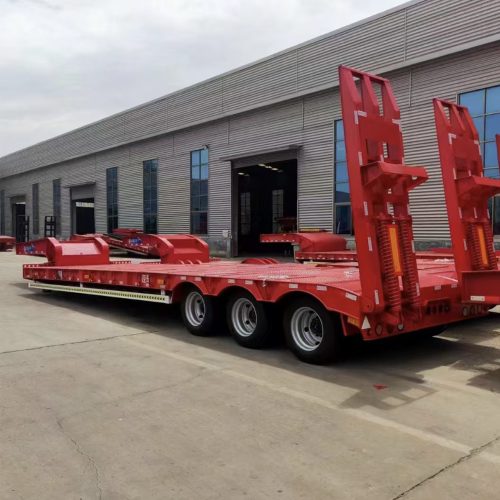
Lowboy semi trailer for heavy equipment transport
This lowboy semi trailer is a better visual match for the article because it uses a lowered deck, rear ramps, and a heavy equipment transport layout instead of a standard flatbed platform.
View Product DetailsWhat Is a Lowbed Trailer?
Similarly, a lowbed trailer is a low-platform semi trailer designed for heavy and oversized equipment. The term appears often in export projects, construction machinery transport, mining logistics, port equipment movement, and infrastructure work. However, the core purpose remains the same: lower the cargo center of gravity and reduce total loaded height.
Usually, a lowbed semi trailer includes a reinforced main beam, dense cross members, a strong gooseneck, heavy-duty axles, suspension, tires, braking parts, lashing points, and a rear loading system. In many projects, the ramp can be mechanical, spring-assisted, or hydraulic. In heavier applications, a detachable gooseneck may replace rear ramp loading.
In other words, lowbed is often a broader export term. It may describe a standard 3 axle lowbed trailer, a 4 axle heavy-duty lowbed trailer, a multi-axle equipment carrier, or a detachable gooseneck trailer. Therefore, the technical specification should always define the final product more clearly than the product name.
The Main Difference Is Often Language First, Structure Second
Across different regions, trailer names follow local habits. For example, lowboy is common in North American style communication. However, lowbed is common in many export markets across Africa, the Middle East, Southeast Asia, South America, and parts of Europe.
Meanwhile, some project documents use function-based names instead. Heavy equipment transport trailer, construction machinery trailer, excavator trailer, bulldozer trailer, and low bed semi trailer may all appear in the same procurement discussion. Therefore, the safest approach is to compare configuration, not wording.
| Common term | Typical meaning | Where it appears often |
| Lowboy trailer | Low deck semi trailer for heavy machinery | North American style inquiries and English trade terms |
| Lowbed trailer | Low platform trailer for construction equipment | Africa, Middle East, Asia, Europe, and export trade |
| Lowboy semi trailer | Tractor-pulled lowboy configuration | Equipment fleets and long-haul machinery transport |
| Heavy equipment transport trailer | Function-based description for heavy cargo | Construction, mining, port, and industrial logistics |
Key Specifications That Decide the Right Trailer
After the naming issue is clear, the comparison should move to structure. Therefore, each transport project should review deck height, loading capacity, axle quantity, gooseneck type, ramp system, suspension, tire size, brake system, and frame strength.
In addition, the trailer must match the machine footprint. An excavator creates concentrated track pressure. A bulldozer may add width through its blade. A wheel loader may create height pressure through its cabin and bucket. A crane may need careful weight distribution across a longer deck.
Deck height and total loaded height
First, deck height affects the total transport height. A lower deck helps tall machines pass under road structures with less risk. Therefore, excavators, loaders, cranes, and large graders often need deck height checked before axle quantity.
However, the lowest deck is not always the best. Rough roads, ferry ramps, mining roads, and unfinished site roads may require extra ground clearance. Therefore, deck height must balance route clearance and bottom clearance.
Gooseneck type
Next, the gooseneck affects loading method and tractor connection. A fixed gooseneck has a simpler structure and suits many standard equipment transport jobs. It often works well with rear ramps and crawler machines that can climb safely.
By contrast, a detachable gooseneck allows front loading. Once the neck separates, the main deck becomes easier to access. Therefore, low-clearance machines, long equipment, and heavy self-propelled cargo may benefit from a detachable gooseneck design.
Ramp type and loading angle
Moreover, ramp design affects daily safety. Mechanical ramps are simple and practical for many transport operations. However, hydraulic ramps reduce manual work and improve loading efficiency when equipment moves frequently.
At the same time, ramp width, ramp length, ramp surface grip, hinge strength, and rear support design all matter. A steep ramp may damage low-clearance equipment. Meanwhile, a narrow ramp may not support wide crawler tracks safely.
Axle layout and loading capacity
Furthermore, axle quantity affects load distribution, braking stability, tire pressure, and road compliance. A 2 axle trailer may suit lighter equipment. A 3 axle trailer often supports common construction machinery. A 4 axle or multi-axle model may be needed for heavier machines and stricter axle load rules.
However, more axles also increase turning radius, tire cost, and maintenance work. Therefore, axle layout should match real cargo weight, destination rules, road condition, and tractor pulling capacity.

50Ton-80Ton 3 axle lowbed semi trailer
A 3 axle lowbed semi trailer fits the article’s axle-layout discussion more naturally, especially for excavators, wheel loaders, bulldozers, and medium-heavy construction machinery.
View Product DetailsSuspension, tires, and road conditions
Additionally, suspension determines how the trailer behaves on different roads. Mechanical suspension is strong, simple, and common for rough routes. Air suspension offers smoother travel and better cargo protection on better road networks.
Meanwhile, tire choice should match axle load, road surface, maintenance access, and destination habits. Heavy-duty tires suit tough operating conditions. Tubeless tires may support long-distance highway transport. Therefore, tires should not be selected only by price.
Main beam and concentrated load
Finally, the frame must support repeated loading stress. Main beam height, flange thickness, web plate thickness, cross member spacing, reinforcement plates, welding quality, and deck plate design all affect service life.
For example, an excavator places high pressure under its tracks. A bulldozer may create extra stress during ramp loading. Therefore, frame strength should match the cargo footprint, not only the total weight.
Official Safety Reference for Cargo Securement
For securement planning, the U.S. Federal Motor Carrier Safety Administration explains cargo securement rules and performance requirements for commercial vehicle cargo. Although local laws differ by country, this official reference is useful when planning tie-down points, load restraint, and cargo movement control.
Read FMCSA Cargo Securement RulesWhich Trailer Fits Excavators, Bulldozers, Cranes, and Loaders?
Different machines create different transport risks. Therefore, the right trailer should match each machine’s weight, height, length, ground clearance, track width, tire footprint, and loading behavior. A single trailer name cannot answer every transport task.
Excavator transport
For excavators, working weight and transport height come first. The boom, arm, counterweight, bucket, and track width all affect the loading plan. Therefore, a low deck and suitable ramp width are essential.
A medium excavator may fit a standard lowbed trailer with hydraulic ramps. However, a large excavator may need a reinforced main beam, wider deck, more axles, and a detachable gooseneck. In addition, loading position should balance kingpin load and axle load.
For excavator-specific configuration, also read our guide on how to choose a lowbed semi trailer for excavators and heavy equipment.
Bulldozer transport
For bulldozers, width and concentrated track pressure require attention. The blade may increase transport width, while the tracks create heavy pressure during loading. Therefore, ramp strength and deck reinforcement become important.
In rough mining or construction routes, a heavy-duty lowbed trailer with strong ramps, reinforced deck, and suitable suspension often fits better. However, route permits may be needed if the blade remains installed during transport.
Crane transport
For cranes, transport length and weight balance are critical. Some crane parts may travel separately, including counterweights, jib sections, hooks, and accessories. Therefore, the transport plan may need more than one trailer type.
A lowbed trailer may carry the crane chassis, while a flatbed semi trailer may move accessories or support cargo. As a result, the full equipment list should be prepared before quotation.
Wheel loader transport
For wheel loaders, height often becomes the main issue. Large tires and high cabins can push the total loaded height close to route limits. Therefore, a low deck helps reduce transport risk.
However, wheel loaders usually climb ramps more easily than some crawler machines. Therefore, a fixed gooseneck lowbed trailer with hydraulic ramps may fit many loader sizes. Still, bucket position and wheelbase should appear in the loading drawing.
How to Choose the Right Configuration
A good configuration process starts with the cargo, not the catalog name. Therefore, the transport team should work through weight, dimensions, loading method, route condition, destination rules, tractor compatibility, and shipping method.
1. Confirm real working weight
First, the real working weight should include attachments and accessories. Buckets, blades, counterweights, fuel, track shoes, and auxiliary parts can change the final load. Therefore, brochure weight alone may not be enough.
In addition, the trailer should not work at its absolute limit every day. A reasonable capacity margin supports longer service life, safer braking, and better frame performance under repeated loading.
2. Measure full transport dimensions
Next, length, width, and height must be checked in transport condition. For example, an excavator may be lower after the boom is folded. A loader may be longer after the bucket position is fixed. A bulldozer may be wider if the blade stays attached.
Therefore, the transport drawing should show the actual loaded size. This helps confirm deck length, deck width, loading angle, tie-down positions, and route restrictions.
3. Select the loading method
Then, the loading method should be selected before final trailer design. Rear mechanical ramps may suit simple loading. Hydraulic ramps may suit frequent operation. Detachable gooseneck loading may suit low-clearance or very heavy machinery.
Meanwhile, crane-loaded cargo needs a different focus. Ramp type may matter less, while deck support, lifting points, and lashing positions become more important. Therefore, loading site conditions should be included in the inquiry.
4. Match road condition and route limits
Moreover, road conditions shape the entire specification. Smooth highways, mountain roads, desert roads, muddy construction roads, mining routes, and port access roads all require different choices. Therefore, suspension, tire size, ground clearance, and frame reinforcement should reflect the real route.
At the same time, height and weight limits may vary by destination country. A route with low bridges may need a lower deck. A route with strict axle load rules may need more axles. Therefore, route planning and trailer selection should happen together.
5. Check tractor truck compatibility
A lowbed or lowboy trailer must match the tractor truck. Fifth wheel height, kingpin size, air brake system, electrical socket, engine power, and turning clearance all affect daily operation. Therefore, trailer design should never ignore the prime mover.
If the project also needs a pulling unit, a used tractor truck can be reviewed as part of the transport combination. However, the tractor should match total gross weight, road grade, and brake demand.
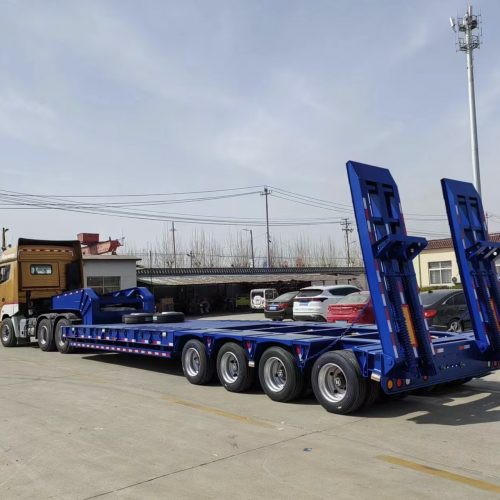
80Ton-120Ton 4 axle lowboy trailer for sale
A 4 axle lowboy trailer better supports the heavy-duty configuration section because it shows a low-deck structure and axle layout designed for heavier machinery transport.
View Product DetailsLowbed, Lowboy, and Flatbed: When Each Trailer Makes Sense
Although lowboy and lowbed trailers cover heavy equipment transport, flatbed trailers still have an important role in many projects. Therefore, the trailer family should match the cargo task instead of one single word.
A flatbed trailer offers open loading from the side, rear, or top. It works well for containers, steel, timber, pipes, pallets, building materials, and some machinery. However, it usually has a higher deck than a lowbed trailer.
By contrast, a lowbed or lowboy trailer fits taller and heavier equipment. It lowers the center of gravity and helps manage overall height. Therefore, construction machinery, mining equipment, and industrial modules often need low-deck transport.
| Trailer type | Best fit | Main advantage | Key point to check |
| Flatbed semi trailer | Containers, steel, pipes, pallets, general cargo | Flexible side and top loading | Deck height and cargo securing method |
| Lowbed trailer | Excavators, bulldozers, loaders, cranes | Lower deck and stronger equipment support | Ramp, axle layout, and deck height |
| Lowboy trailer | Heavy machinery in lowboy naming markets | Very low transport position | Gooseneck and loading method |
| Detachable gooseneck trailer | Low-clearance and very heavy self-propelled machines | Front loading with a gentler angle | Neck structure, operation, and maintenance |
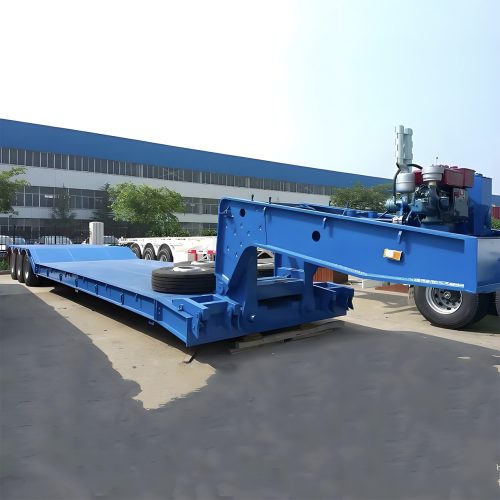
Detachable gooseneck lowboy trailer for front loading
This detachable gooseneck model visually supports the gooseneck and loading-method discussion, especially when the project needs a lower loading angle for heavy or low-clearance machines.
View Product DetailsCommon Configuration Mistakes to Avoid
Many trailer problems start before production. Therefore, the early specification stage should remove unclear assumptions. A correct trailer drawing saves time during manufacturing, inspection, shipping, and road use.
Choosing only by payload
First, payload alone cannot define the right trailer. A high-capacity trailer may still fail if the deck is too short, the ramp is too steep, or the axle layout does not match local road rules.
Therefore, payload should be checked together with dimensions, loading angle, road condition, and concentrated load. This approach creates a safer and more realistic specification.
Ignoring the loaded height
Next, total loaded height can create serious transport issues. A machine may fit the deck but still fail to pass a bridge, tunnel, factory gate, or port entrance. Therefore, loaded height should be calculated before final approval.
However, extra-low design can reduce ground clearance. Therefore, the route should decide whether the project needs the lowest possible deck or a balanced low-deck design.
Using the wrong ramp system
Moreover, ramp mismatch can slow down loading and increase equipment risk. A ramp that is too narrow, too short, or too steep may damage tracks, tires, or the trailer rear structure.
Therefore, ramp selection should consider loading frequency, machine ground clearance, track width, equipment weight, site surface, and available operators. Hydraulic ramps often help frequent loading, while mechanical ramps may suit simpler work.
Forgetting lashing and load balance
In addition, lashing points should match the machine frame. Poor tie-down angles can reduce cargo stability during braking, turning, or rough road movement. Therefore, lashing rings and chain positions should appear on the deck plan.
Load balance also matters. Heavy equipment should sit in a position that keeps kingpin load and axle load within a safe working range. Therefore, the loading position should be marked during trailer design.
Boca Vehicle Solution for Export Transport Projects
Boca Vehicle focuses on configuration clarity for export heavy transport. The same inquiry may mention lowboy, lowbed, low bed semi trailer, machinery carrier, or heavy equipment transport trailer. Therefore, the technical response should clarify structure, not only repeat the name.
A practical trailer proposal can include axle quantity, loading capacity, deck size, gooseneck type, ramp structure, suspension, tire model, brake system, main beam design, paint process, spare parts, and shipping preparation. As a result, the quotation becomes easier to compare and easier to approve internally.
In addition, photo and video confirmation can support export inspection before shipment. Production photos can show beam structure, ramp installation, welding, suspension, axles, paint, lighting, and final assembly. Meanwhile, video confirmation can show appearance and functional details before delivery.
Furthermore, export documentation should match the confirmed specification. Commercial invoice information, packing details, shipping marks, port information, and final trailer description should stay consistent. Therefore, the inquiry stage should include both technical and shipping details.
Information Needed Before Quotation
A useful quotation needs more than a trailer name. Therefore, the following information helps match the trailer structure to the actual transport task.
- Cargo type, machine model, working weight, and transport dimensions.
- Track width, wheelbase, ground clearance, and attachment position.
- Required loading capacity, axle quantity, deck length, and deck width.
- Preferred loading method, such as hydraulic ramp or detachable gooseneck.
- Road condition, route height limit, destination country, and destination port.
- Existing tractor details, including fifth wheel height and brake connection.
Send a More Accurate Inquiry
A complete inquiry shortens the quotation cycle and improves configuration accuracy. Therefore, the message should include the machine type, working weight, transport dimensions, road condition, preferred axle quantity, ramp preference, and destination country.
Contact Boca Vehicle for Configuration SupportFurther Reading and Product Pages
For related trailer selection, these real BOCA Vehicle pages can support deeper product comparison and site navigation.
- Lowbed Semi Trailer Category — for heavy equipment transport trailer options.
- 50Ton-80Ton 3 Axle Lowbed Semi Trailer — for common excavator, wheel loader, and construction machinery transport.
- Detachable Gooseneck Lowboy Trailer — for front loading and low-clearance heavy equipment projects.
FAQ
What is the difference between a lowboy trailer and a lowbed trailer?
In many export projects, both terms describe a low-deck semi trailer for heavy equipment transport. However, lowboy is more common in North American wording, while lowbed is common in many export markets. Therefore, the real difference should be checked through deck height, gooseneck type, ramp system, axle quantity, and loading capacity.
Which trailer is better for excavators?
For excavators, a lowbed or lowboy semi trailer with suitable deck height, ramp width, axle capacity, and frame reinforcement is usually practical. However, larger excavators may need a wider deck, more axles, or detachable gooseneck loading. Therefore, working weight, track width, and transport height should be confirmed first.
Can the ramp and axle layout be customized?
Yes. Ramp and axle layout can be configured around equipment weight, loading frequency, road condition, and destination rules. For example, hydraulic ramps can improve loading efficiency, while additional axles can improve load distribution. However, the final layout should match route limits and maintenance conditions.
When is a detachable gooseneck useful?
A detachable gooseneck is useful when equipment needs a lower loading angle. It can help low-clearance machines, heavy crawler equipment, and special cargo load from the front. However, it has a more complex structure than a fixed gooseneck, so the choice should match real loading needs.
What information should be prepared before quotation?
A practical quotation needs cargo type, machine model, working weight, length, width, height, road condition, loading method, destination country, axle quantity preference, and tractor details. Photos or drawings can also help confirm deck size, ramp design, and reinforcement layout.
Conclusion: Choose by Equipment, Route, and Loading Method
In conclusion, the trailer name should open the discussion, not finish it. A lowboy, lowbed, low bed semi trailer, or heavy equipment transport trailer should be selected by cargo weight, transport height, loading method, axle load rules, road condition, and tractor compatibility.
For export projects, lowboy trailer vs lowbed trailer should lead to a practical configuration review. Finally, send cargo type, loading capacity, axle quantity, road condition, destination country, and tractor details through Contact Boca Vehicle for a suitable trailer proposal.
- First, confirm real machine weight, transport dimensions, and loading clearance.
- Next, match deck height, ramp type, gooseneck structure, and axle layout to the route.
- Finally, review destination rules, tractor compatibility, shipping method, and export documents before production.