
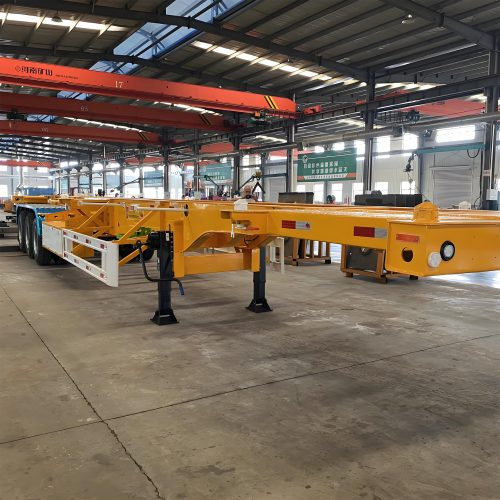
20 ft Container Chassis Trailer: Dimensions, Twist Locks, Payload

When buyers start comparing a container chassis trailer, they are usually not shopping for a number on a spec sheet. They are trying to match a trailer to a workflow. Some operations live on long mixed-container runs where flexibility matters most. Others spend their days doing terminal transfers, depot turns, yard circulation, and short warehouse shuttles where the trailer is constantly being lined up, backed into tighter unloading points, and pulled back out again for the next move. That is where the 20 ft format starts to stand apart inside the broader container chassis trailer category.
A 20 ft container chassis trailer is worth understanding because it sits right at that intersection of compact footprint and repeatable container work. The questions that really matter are not complicated: What dimensions affect the working footprint? Why do four twist locks matter so much on this type of trailer? Why should payload be read as a range rather than a single headline figure? And when does a 2 axle layout make more sense than a 3 axle layout? Those are the points that shape how a container chassis trailer actually behaves in the field, especially when the job is built around one standard 20 ft box.
There is a simple early split that helps. If the operation mainly carries one 20 ft container size, works in tighter spaces, and repeats short movements all day, a dedicated 20 ft layout is usually the cleaner fit. If the fleet regularly mixes 20 ft and 40 ft containers and needs one container chassis trailer format to cover more situations, the longer 40 ft platform usually has the edge. You can see that same split across the broader container chassis trailer lineup, the dedicated 20 ft container chassis page, and the 20ft vs 40ft chassis guide.

Why a 20 ft container chassis trailer feels different in real work
It is easy to say that a 20 ft model is “shorter.” That part is obvious. What matters more is why that shorter layout exists inside the larger container chassis trailer family. A dedicated 20 ft unit is built around one standard 20 ft ISO container, four fixed corner lock points, and a workflow that keeps repeating the same kind of movement. It is not trying to be all things to every route. It is built to handle one kind of work efficiently and repeatedly.
That is why a 20 ft container chassis trailer often feels more settled in compact-duty operations than a longer chassis that happens to carry the same box. In a terminal yard, that difference shows up when the driver has to swing into a narrow lane, straighten out beside handling equipment, reverse carefully to the loading point, pull forward, and repeat the same pattern a dozen times before noon. In a depot, it shows up when turning radius and trailer overhang start to matter more than raw versatility. In a warehouse shuttle, it shows up when the route is short but the alignment work is constant. A longer chassis can still complete those moves, but it often carries extra length that the job never really asked for.
A 20 ft model is not just the “small version” of a container chassis trailer.It is the dedicated version for a narrower but very common workflow. Once that clicks, the rest of the article gets easier to follow, because dimensions, lock layout, payload, and axle choice all begin to make sense as parts of that one idea.
The container chassis trailer specs that actually affect the job
A lot of pages about trailers pile on detail until the main story disappears. For a 20 ft container chassis trailer, the useful spec list is much shorter. The current 20 ft product page centers on a compact length range, four twist locks, 2 axle or 3 axle layouts, and a payload range around 30–45 tons. The comparison page presents a slightly different published range for the 20 ft format, which is a reminder that specs vary by configuration and market rather than behaving like one universal answer everywhere.
Those four points are the ones that shape real use:
- Length range matters because it defines the working footprint.
- Four twist locks matter because the whole trailer is built around fixed container corner points.
- Payload range matters because a 20 ft box can carry concentrated weight.
- 2 axle or 3 axle layout matters because that concentrated weight has to be shared and controlled properly.
Everything else comes later. That does not mean the rest is unimportant. It means a buyer usually understands the direction of the right container chassis trailer long before they get into secondary details. If the footprint is wrong, the lock layout is not matched to the box, the payload figure is being read the wrong way, or the axle setup does not suit the job, the rest of the discussion tends to drift.
Dimensions on a container chassis trailer are really about working footprint
People often say they want the “dimensions” of a container chassis trailer, but what they usually mean is: how much room will this trailer ask for when it is actually working? That is a more useful question than chasing a bare length number on its own. The published length range on the 20 ft page matters because it points to the compact footprint that makes this format attractive in the first place.
On a longer run with generous working space, a few extra meters can feel manageable. In tighter daily work, that same extra length can become the part the driver notices most. A 20 ft container chassis trailer is easier to bring around in yard circulation, easier to place during depot turns, and less awkward when reversing into narrower unloading points where there is not much room to correct the angle. That is why “dimensions” in this segment really means maneuverability, trailer sweep, entry angle into tighter spaces, and how much extra chassis the job is forcing the operator to carry around.
This is also where buyers sometimes compare the wrong things. They look at the box length and think the decision is already made, as if any trailer that can carry a 20 ft container should behave roughly the same. In practice, the footprint of the container chassis trailer changes how the whole day feels. A trailer that looks flexible on paper can become clumsy when it has to reverse beside forklifts, line up near cranes, or snake through tighter lanes over and over again. The compactness of a 20 ft layout is not just an abstract efficiency gain. It is something drivers and yard teams notice almost immediately in daily handling.
That is also why the 20 ft format is not automatically the right answer for every buyer. If the operation changes box sizes constantly and the route is not constrained by space, the shorter footprint may matter less than the broader flexibility of a longer container chassis trailer. But when the day is filled with repeated alignment beside handling equipment, short terminal hops, and frequent backing into places that were never generous to begin with, the compact 20 ft chassis starts to earn its place quickly.
Why four twist locks matter on a 20 ft container chassis trailer
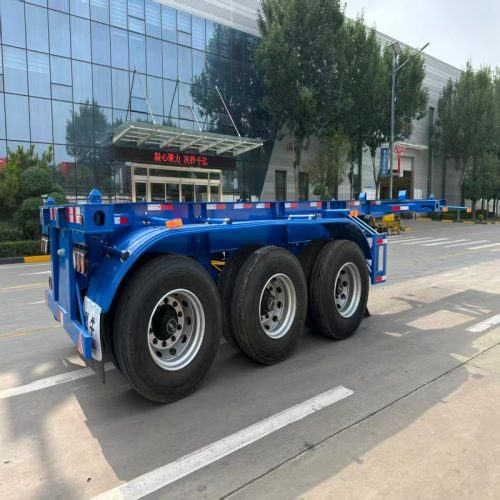
The four twist locks on a 20 ft container chassis trailer are not just there because product pages like to show a locking count. They sit at the heart of how the trailer works. A standard 20 ft ISO container is secured at four bottom corner castings, so a dedicated 20 ft chassis is built to receive the box at those fixed points. That is basic structure, not decoration.
That point is easy to understate. On a general cargo platform, securing hardware can feel like one part of a broader arrangement. On a dedicated container chassis trailer, the twist locks are part of the layout logic itself. The chassis category page explains that the lock positions are aligned with ISO corner castings and that this alignment helps create equal load distribution through the main beams. That line matters because it shows what the locks do beyond simply holding the box in place: they help define how the load enters the frame.
In daily work, that shows up in a few practical ways. First, lock positioning affects how squarely the container sits on the chassis. If the box sits where it is supposed to sit, the rest of the trailer is working the way it was designed to work. Second, lock alignment affects how cleanly weight transfers into the frame. That matters more on a 20 ft setup because the weight is carried through a shorter, more dedicated structure. Third, proper lock engagement influences the kind of stability operators notice in braking, cornering, and repeated short-haul shuttle movement.
This is why the phrase “four twist locks” deserves more respect than it sometimes gets in container chassis trailer content. On a 20 ft model, four locks are not a line item tacked onto a spec sheet. They are a direct reflection of the fact that the trailer is built around one standard box in one fixed position. That is also why the 20 ft layout feels so purpose-built compared with more flexible chassis types. The structure, the load path, and the locking geometry are all pointing at the same workflow.
Payload on a container chassis trailer should be read as a range, not a promise
Payload is where buyers often get seduced by a single number. It is understandable. Weight figures look clean, comparable, and easy to rank. But a 20 ft container chassis trailer is exactly the kind of product where that instinct can mislead people. The 20 ft product page presents a payload range around 30–45 tons. The comparison page shows a different upper-end figure for the 20 ft format, and the broader category uses range language at the lineup level. That spread is not just inconsistency. It is the sign that payload belongs to the configuration, not just to the name of the trailer.
A 20 ft box is often where dense cargo shows up. The container is shorter, but the weight can be concentrated and serious. That is why payload on this kind of container chassis trailer cannot be read the same way people sometimes read a casual sales claim. A heavier-looking headline does not tell you much by itself unless you know what axle layout, market setup, and intended duty sit behind it.
It helps to think about two different operating days. On one day, the trailer is carrying a moderate load on a stable short route, in an operation where traffic flow and working space are predictable. On another day, the same nominal 20 ft chassis type is handling denser freight, harder daily use, and more strain from repeated cycles. Both days involve a 20 ft box. They do not ask the same thing from the container chassis trailer. That is why payload should be read as a working envelope with context, not as a trophy figure to compare in isolation.
This matters when buyers compare one page against another and start wondering why the numbers do not line up perfectly. In a way, that difference is useful. It forces the right question: what version of the trailer am I actually looking at, and what kind of work is that version meant to do? Once the conversation shifts in that direction, payload becomes much more useful and much less confusing.
2 axle or 3 axle container chassis trailer: what really changes
There is a lazy version of this question and a useful version. The lazy version says 2 axle is lighter-duty and 3 axle is heavier-duty. That is directionally true, but not very satisfying. The useful version asks why axle count changes the feel and fit of a 20 ft container chassis trailer so much. The answer is that a 20 ft box does not just bring weight. It often brings concentrated weight, and concentrated weight changes the whole conversation.
A 2 axle container chassis trailer is not the “budget” choice if it matches the job. In a controlled workflow with moderate box weights, shorter movements, and fewer harsh variables, 2 axles can be the cleaner answer. The trailer stays compact, the running gear stays simpler, and the operation is not carrying more axle than it needs. That can make perfect sense for stable yard work or local shuttle patterns where the job is repetitive and the demand profile is well understood.
A 3 axle container chassis trailer starts to show its value when the load pattern becomes denser and more demanding. The main advantage is not just “more capacity” in a vague sense. It is better load sharing and more breathing room when a 20 ft box is regularly carrying denser freight or when the daily work puts more stress on the trailer. The category page’s description of 3 axle chassis as the global standard for roughly 30–40 ton loads says a lot in a short space. It suggests that once concentrated cargo weight becomes normal rather than occasional, the extra axle is part of keeping the trailer in a healthier operating window.
That point matters because many buyers bring the wrong instinct to the table. Some automatically chase three axles because it sounds safer and stronger. Others focus on payload alone and barely think about axle layout at all. Both habits oversimplify a decision that should be tied to the actual job. Axle count is one of the clearest ways a container chassis trailer gets matched to the actual weight pattern of the job. It is not just a bigger-or-smaller checkbox.
Another way to say it is that axle choice affects operating margin. A 2 axle setup can be exactly right when the load profile is predictable and moderate. A 3 axle setup earns its keep when the work gets denser, more repetitive, or less forgiving. That is the difference buyers should keep in mind, especially with 20 ft containers, where compact length does not automatically mean light-duty behavior.

Where this container chassis trailer format works best
The 20 ft format works best when daily movements leave very little room for unnecessary chassis length. Yard circulation is a good example. A driver pulls through narrow internal lanes, lines up near stackers or handling equipment, makes a tight turn into the next section, then starts over. In that kind of routine, the shorter container chassis trailer does not feel like a minor optimization. It feels like the trailer was actually chosen for the space.
Depot work is similar. The trailer is often being dropped, picked, repositioned, and turned in spaces that were designed for container throughput, not comfort. A 20 ft container chassis trailer is easier to live with when every movement includes some combination of narrow approach angles, repeated reversing, or careful alignment beside another unit. The gain is not just easier maneuvering. It is also less wasted motion over the course of the day.
Terminal transfers and short warehouse shuttles may be the most intuitive examples. The route itself is not the complicated part. The work happens at the ends of the route, where the trailer has to fit itself into busy physical spaces again and again. If the box size is consistently 20 ft, there is rarely much value in carrying the extra length of a larger chassis if the operation barely uses that extra flexibility. That is where a buyer browsing the container chassis trailer options often ends up back at the dedicated 20 ft container chassis.
The flip side should be said clearly too. If the business is constantly mixing 20 ft and 40 ft boxes, or if one chassis needs to cover more than one recurring container size, a longer layout often wins. The 20ft vs 40ft chassis guide makes that tradeoff clear: the 20 ft format is stronger in confined, compact-duty work, while the 40 ft format brings more flexibility to mixed operations. A 20 ft chassis is not “better” in the abstract. It is better when the workflow makes compactness matter more than broad format coverage.
Common mistakes buyers make with a 20 ft container chassis trailer
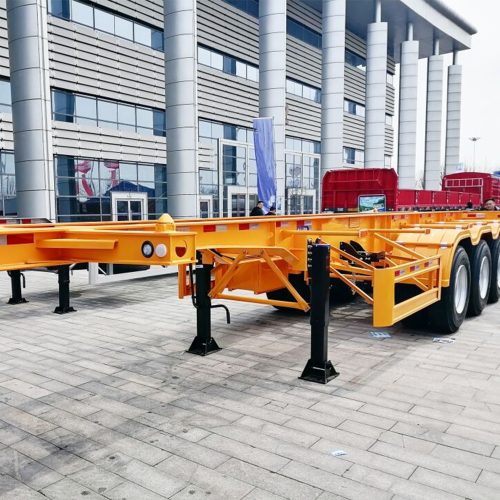
One common mistake is assuming a 20 ft container chassis trailer is just a shorter substitute for a 40 ft unit. That sounds harmless, but it tends to lead buyers toward the wrong comparison. A dedicated 20 ft model is not defined by shorter length alone. It is defined by how tightly the whole layout is matched to one box size, one locking pattern, and one compact workflow. That is a different proposition from simply “less trailer.”
Another mistake is reading payload like a single promise that should stay the same everywhere. The site’s own 20 ft references already show why that is too simplistic. Published payload numbers shift across pages because configurations shift. Once buyers understand that, the right response is not confusion. It is to ask what axle setup and working use sit behind the figure they are looking at. A container chassis trailer makes much more sense when payload is treated as configuration-dependent from the start.
A third mistake is assuming three axles are always the safer answer. Sometimes they are. Sometimes they are simply more trailer than the route really needs. If the work is lighter, more repetitive, and more controlled, 2 axles may be the better fit. If dense cargo and harder daily use are normal, 3 axles become easier to justify. The key is that axle choice should follow the weight pattern, not the buyer’s anxiety level.
There is also a quieter mistake that shows up in early-stage research: underestimating dimensions because the box size seems to tell the whole story. On a 20 ft container chassis trailer, dimensions matter precisely because the trailer is being chosen for how it behaves in real spaces. A unit that is technically compatible can still be a poor daily fit if it asks for too much room to turn, back, and line up.
What to check before choosing a container chassis trailer in this size
Most buyers do not need a giant checklist at the start. They need a few honest questions. Is the operation truly centered on 20 ft containers, or is that only part of the traffic mix? Do the loads tend to be dense enough that concentration of weight becomes a daily issue? Is the work happening in yards, depots, terminals, or short shuttle routes where compact movement saves time and hassle every single day? Those questions tell you a lot before any deeper configuration talk begins.
After that, the next step is to look at the trailer as a working package. Does the published payload range match the actual load pattern, not just the highest number someone wants to see? Does the axle layout suit the frequency and density of the work? Does the shorter footprint genuinely solve a space problem, or is flexibility going to matter more? And does the dedicated four-lock layout fit the standard 20 ft box routine the operation runs every week? Those are the checks that make a container chassis trailer selection feel grounded instead of theoretical.
At that point, comparing roles across the different pages becomes much more useful. A buyer can move through the broader container chassis trailer lineup, look closely at the dedicated 20 ft container chassis, and then use the 20ft vs 40ft chassis guide to check whether compact handling or wider fleet flexibility is really the stronger priority. Those pages are most helpful when read through the lens of workflow, not just specs.
Final thoughts
A good container chassis trailer choice is rarely about picking the unit with the biggest headline figure or the longest list of options. With a 20 ft format, the smarter approach is usually simpler than that. Look at the footprint. Look at the locking logic. Look at the payload as a range tied to configuration. Look at whether 2 axles or 3 axles actually fit the density and rhythm of the work. Once those pieces line up, the 20 ft model stops looking like a niche size and starts looking like a very logical answer for the right kind of operation.
The real strength of a 20 ft container chassis trailer is not just that it is shorter. It is that the whole trailer is more closely matched to single 20 ft box work: compact spaces, repeated turns, frequent reversing, fixed lock points, and a load pattern that can be deceptively concentrated. That is why this format keeps making sense in terminals, depots, yards, and short shuttle operations, even in fleets that already know the value of longer chassis elsewhere.
FAQ
What dimensions matter most on a 20 ft container chassis trailer?
The most important dimensions are the ones that affect the working footprint rather than just the paper length. On a 20 ft container chassis trailer, the compact published length range matters because it changes how easily the trailer can turn in yard circulation, reverse into narrower unloading points, and line up beside handling equipment in tighter spaces.
Why does a 20 ft container chassis trailer usually use four twist locks?
Because a standard 20 ft ISO container is secured at four bottom corner castings. A dedicated 20 ft container chassis trailer is built around those fixed points, so the four-lock layout is part of the trailer’s basic structural logic, not just a small hardware detail.
Is a 2 axle or 3 axle container chassis trailer better for dense cargo?
Dense cargo often pushes the answer toward a 3 axle container chassis trailer because the weight is concentrated in a shorter footprint and the extra axle helps with load sharing and operating margin. A 2 axle layout can still be the better fit for lighter or more predictable work, so the right choice depends on the actual loading pattern, not a blanket rule.
Why do payload figures vary on different container chassis trailer configurations?
Because payload belongs to the configuration, not just to the trailer name. The site’s 20 ft references show different published figures, which indicates that axle layout and market-specific setup affect the final rating. The more useful way to read payload on a container chassis trailer is as a working range shaped by the build and the intended job.
When is a 20 ft container chassis trailer a better fit than a 40 ft chassis?
It is usually the better fit when the operation mainly handles single 20 ft boxes in terminals, depots, yards, or short shuttle routes where compact handling matters every day. A 40 ft chassis is usually the better fit when the fleet needs broader flexibility for mixed container sizes and does not gain as much from the shorter working footprint.